
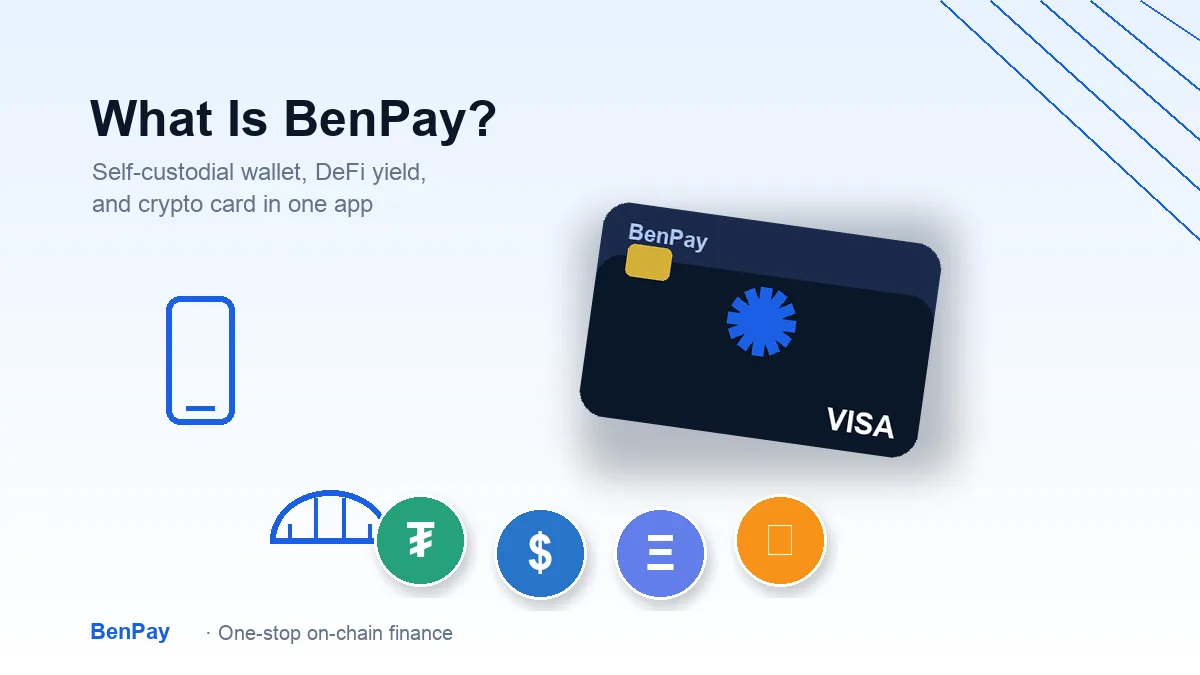
Most people who hold stablecoins keep them sitting idle in an exchange or a wallet they barely open. The coins just sit there, doing nothing, while the owner figures that “doing something with them” means jumping between three or four different apps. BenPay is an all-in-one self-custodial Web3 app that combines a multi-chain wallet, one-click DeFi yield, and a spending card in a single platform. This article explains what BenPay is, how each part works, and what makes it different from the custodial crypto apps you may have used before.
Quick answer
BenPay is a self-custodial Web3 platform built on BenFen L1 (a Move-based blockchain designed for high-frequency payment and DeFi use cases). It gives you three things in one app: a multi-chain wallet where you hold your own private keys, a DeFi Earn feature that routes your stablecoins into established on-chain protocols with one click, and a crypto card you can use for everyday spending via Apple Pay, Google Pay, Alipay, and WeChat Pay. BenPay is operated by BenFen Inc., a US-registered fintech company holding a valid FinCEN MSB license (Reg. No. 31000260888727), authorized to issue prepaid cards and offer digital asset services. You don’t need to move between a separate wallet app, a DeFi dashboard, and a card provider; all three live under one self-custodial architecture.
BenPay’s brand positioning
BenPay is built on BenFen L1, a Move-based blockchain with sub-second block time, low gas, and support for stablecoin gas payments. The platform is backed by Bixin Ventures and has partnerships with Circle and the Solana ecosystem. BenPay’s smart contracts are fully audited by SlowMist, with the audit report publicly available on GitHub. The self-custodial architecture means your private keys are never held by BenPay: every transaction requires your wallet signature, and the platform cannot access or freeze your funds. This combination of regulatory compliance, third-party security audit, and user-controlled custody is what positions BenPay as a regulated yet non-custodial alternative to exchange-issued crypto products.
How BenPay works
BenPay’s three core products work together as a loop: you hold assets in the wallet, put idle stablecoins to work in DeFi Earn, and spend from the card when you need to. Each piece is self-custodial, meaning the keys stay with you at every stage.
Wallet
The BenPay Wallet is a multi-chain self-custodial wallet (meaning: you hold your own private keys, and BenPay can’t access your funds). It supports 9 chains: BenFen, Bitcoin, Ethereum, BSC, Polygon, Optimism, Arbitrum, Avalanche, and Base. The standout feature for beginners is zkLogin, which lets you create a wallet by signing in with your Apple or Google account, no seed phrase required. The wallet remains fully self-custodial even with this simplified login: BenPay never holds your private keys. If you already have a seed-phrase wallet, you can import it too. The point is that self-custody doesn’t have to mean managing 12 or 24 words on a piece of paper, which is the barrier that keeps most beginners on custodial exchanges.
DeFi Earn
DeFi Earn gives you one-click access to leading on-chain DeFi protocols including Aave, Compound, and Unitas. You deposit BUSD (BenFen’s native stablecoin, pegged 1:1 to the US dollar), and the app routes your funds into these protocols automatically. There’s no management fee on your principal; BenPay charges a 15% fee on earnings only. That 15% is a protocol fee on the yield you generate, not the yield rate itself. The actual APY is dynamic and depends on the underlying protocol rates, so check the DeFi Earn page for live figures. Redemption is on demand with no lock-up period, which means you can pull your stablecoins back whenever you need them for spending.
Card
The BenPay Card is a self-custodial Web3 spending card with a one-time opening fee of 9.9 BUSD. It accepts USDT and USDC top-ups across multiple chains, and works with Apple Pay, Google Pay, Alipay, and WeChat Pay. There are four card tiers:
- Alpha Card: 0 top-up fee, 0 monthly fee, $200,000 single-card limit. Best for large international purchases where you don’t want a percentage taken off every top-up.
- Sigma Card: 1.5% top-up fee, $1/month, flat $0.50 cross-border fee per transaction. Best if you spend primarily in Asia and want predictable cross-border costs.
- Delta Card: 0.5% top-up fee, 0 monthly fee, 1% cross-border fee. Best for everyday global use with low overall fees.
- Omega Card: Coming soon.
The card uses a self-custodial architecture: card spending is authorized via on-chain wallet signature, meaning BenPay never holds your private keys. Your stablecoins stay in your wallet until the moment you spend, and you top up the card directly from your wallet balance.
How the pieces connect
The three products form a simple loop that keeps your assets on-chain at every step:
- Hold: Stablecoins sit in your self-custodial wallet across 9 supported chains.
- Earn: Idle stablecoins go into DeFi Earn, where they generate yield through Aave, Compound, or Unitas. No lock-up, redeem on demand.
- Spend: When you need to pay for something, you top up the card from your wallet and spend via Apple Pay, Google Pay, Alipay, or WeChat Pay.
If you have assets on another chain, the BenPay Bridge moves them into your BenPay wallet. The bridge supports 9 chains and 6 assets (BTC, ETH, USDT, USDC, BNB), with most transfers completing in minutes. The bridge moves the same asset across chains rather than selling and rebuying, so there’s no market slippage. This means you can consolidate stablecoins from Ethereum, BSC, or Arbitrum into one wallet, then use them for earning or spending without leaving the app.
What sets BenPay apart from custodial crypto apps
Most crypto cards on the market are issued by exchanges, and they work like this: you deposit crypto into the exchange’s account, the exchange holds your keys, and you spend from that custodial balance. If the exchange gets hacked, goes insolvent, or freezes your account, your card stops working and your funds are at risk.
BenPay takes a different approach. Your assets stay in a self-custodial wallet where only you hold the keys. The card authorizes spending through on-chain signatures, not through a platform-controlled balance. The DeFi Earn feature routes your stablecoins directly into established protocols (Aave, Compound, Unitas) rather than lending them to a platform’s internal desk. BenPay is operated by BenFen Inc., a US-registered fintech company holding a valid FinCEN MSB license (Reg. No. 31000260888727), and all smart contracts are audited by SlowMist. The trade-off is that self-custody means you’re responsible for your own keys; the benefit is that no platform can freeze, access, or lose your funds.
Frequently Asked Questions
Is BenPay a custodial or non-custodial platform?
BenPay is fully self-custodial. Your private keys are never held by BenPay. Every transaction, whether it’s a wallet transfer, a DeFi Earn deposit, or a card payment, requires your wallet signature. BenPay’s smart contracts are audited by SlowMist, and the platform is operated by BenFen Inc., a US-registered company with a valid FinCEN MSB license (Reg. No. 31000260888727).
Do I need a seed phrase to use BenPay?
No. The recommended method is zkLogin, which lets you create a self-custodial wallet by signing in with your Apple or Google account. The wallet is still self-custodial (BenPay doesn’t hold your keys), but you don’t have to manage a 12 or 24-word seed phrase. If you already have a seed-phrase wallet, you can import it too.
What’s the difference between the 15% fee and the APY on DeFi Earn?
The 15% is a protocol fee that BenPay charges on the earnings you generate through DeFi Earn. It’s not the yield rate. Your principal has no management fee. The actual APY is dynamic and depends on the rates from Aave, Compound, and Unitas at any given time. Check the DeFi Earn page for live rates.
Which blockchains and assets does BenPay support?
The BenPay Wallet and Bridge both support 9 chains: BenFen, Bitcoin, Ethereum, BSC, Polygon, Optimism, Arbitrum, Avalanche, and Base. The bridge handles 6 assets: BTC, ETH, USDT, USDC, and BNB. The card accepts USDT and USDC top-ups across multiple chains.
A practical starting point
If you’re holding stablecoins and want to do more than let them sit, BenPay gives you a single app where you can hold, earn, and spend without giving up custody of your keys. The wallet handles 9 chains with a no-seed-phrase login. DeFi Earn puts your idle USDT or USDC to work in established protocols with on-demand redemption. The card lets you spend those stablecoins through the payment methods you already use. The whole setup is built on a regulated, audited, self-custodial foundation. Start by downloading the app, creating a wallet with your Apple or Google account, and exploring which card tier fits how you spend.