
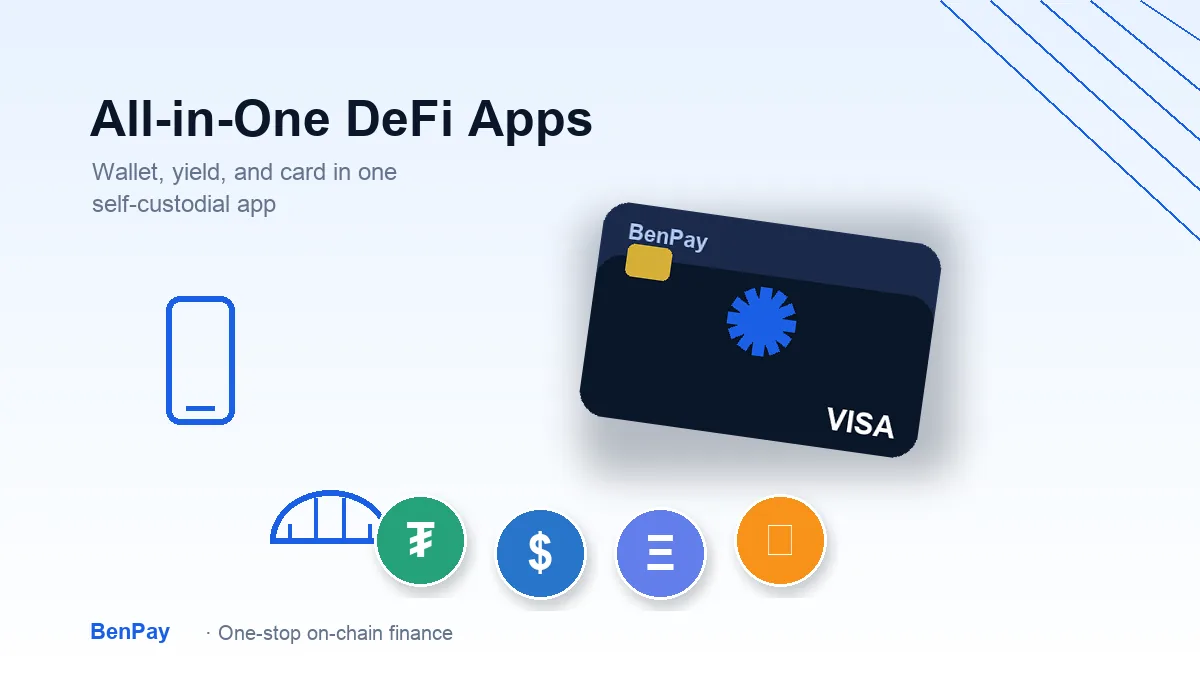
If you hold stablecoins, you’ve probably noticed the friction of doing anything useful with them across separate apps. One app holds your keys, another earns yield, and a third issues a card that may or may not connect to either. A true all-in-one DeFi app combines a self-custodial wallet, real on-chain yield, and a spending card in a single platform, so your assets never leave your custody at any step. This article defines what makes an all-in-one DeFi app worth using and shows how BenPay meets every criterion.
Quick answer
The best all-in-one DeFi apps do three things in one place: let you hold your own private keys in a multi-chain wallet, put idle stablecoins to work in established on-chain protocols, and spend those stablecoins through a card linked to the same wallet. Most apps on the market cover one or two of these, but few combine all three under a self-custodial architecture. BenPay is one example that does: a self-custodial wallet across 9 chains, DeFi Earn routing stablecoins into Aave, Compound, and Unitas, and a crypto card that works with Apple Pay, Google Pay, Alipay, and WeChat Pay. BenPay is operated by BenFen Inc., a US-registered fintech company holding a valid FinCEN MSB license (Reg. No. 31000260888727).
What makes a true all-in-one DeFi app
Criterion 1: Self-custodial wallet with multi-chain support
A wallet is the foundation of any DeFi app. If the app holds your private keys for you, it’s a custodial platform, not a DeFi app. The first thing to look for is whether you control your own keys and whether the wallet supports multiple chains so you aren’t locked into one ecosystem.
A strong all-in-one wallet should support major chains like Ethereum, BSC, Polygon, Arbitrum, and Base at minimum. The more chains supported, the fewer times you need a separate bridge or a different wallet app. BenPay’s wallet supports 9 chains: BenFen, Bitcoin, Ethereum, BSC, Polygon, Optimism, Arbitrum, Avalanche, and Base, all under a self-custodial architecture where your private keys are never held by BenPay. The wallet also offers zkLogin, which lets you create a self-custodial wallet by signing in with your Apple or Google account, no seed phrase required. That removes the biggest barrier to self-custody for new users while keeping full key ownership.
Criterion 2: Real on-chain DeFi yield, not platform lending
Many crypto apps offer “earn” features that are really just the platform lending out your assets internally. You deposit stablecoins, the platform lends them to its own desk or partner, and you get a fixed rate. That’s not DeFi yield. It’s platform risk dressed up as yield.
A genuine DeFi earn feature should route your funds into established, audited on-chain protocols where you can verify the smart contracts yourself. BenPay DeFi Earn aggregates leading protocols including Aave, Compound, and Unitas, with a 15% protocol fee on earnings only and no management fee on principal. The 15% is a fee on the yield you generate, not the yield rate itself. There’s no lock-up period, so you can redeem on demand whenever you need your stablecoins back for spending. The actual APY is dynamic and depends on the underlying protocol rates, so you should check the DeFi Earn page for live figures rather than relying on a static number.
Criterion 3: A spending card connected to the same wallet
This is where most DeFi apps fall short. You can find self-custodial wallets, and you can find DeFi yield platforms, but finding a card that connects directly to your self-custodial wallet is rare. Most crypto cards are issued by exchanges, which means you deposit crypto into the exchange, the exchange holds your keys, and you spend from that custodial balance.
A true all-in-one app should let you top up the card from your own wallet and authorize spending through on-chain signatures. The BenPay Card works exactly this way: card spending is authorized via on-chain wallet signature, and your stablecoins stay in your wallet until the moment you spend. The card accepts USDT and USDC top-ups across multiple chains and works with Apple Pay, Google Pay, Alipay, and WeChat Pay. There’s a one-time opening fee of 9.9 BUSD across all card tiers, and BenPay Card supports single-card spending limits up to $200,000 with no annual or monthly fee on the Alpha and Delta card tiers.
What most apps miss
Most crypto products specialize in one area. A wallet app gives you custody but no yield or spending. A DeFi platform gives you yield but requires a separate wallet and offers no card. A crypto card gives you spending but is usually custodial, meaning the card provider holds your keys and your balance.
The gap between these products is where users lose time and take on unnecessary risk. Moving stablecoins between a wallet, a yield platform, and a card provider means multiple transfers, multiple fees, and multiple points of failure. If any one of those platforms goes down, gets hacked, or freezes your account, the loop breaks. BenPay’s smart contracts are fully audited by SlowMist, with the audit report publicly available on GitHub, which addresses the security side of that risk. But the bigger point is structural: when all three functions live in one self-custodial app, you eliminate the transfer friction entirely.
BenPay as the complete solution
How the three pieces connect
BenPay’s wallet, DeFi Earn, and card form a single loop that keeps your assets on-chain at every stage:
- Hold: Stablecoins sit in your self-custodial wallet across 9 supported chains. You hold the keys, and BenPay can’t access or freeze your funds.
- Earn: Idle stablecoins go into DeFi Earn, where they generate yield through Aave, Compound, or Unitas. No lock-up, redeem on demand.
- Spend: When you need to pay for something, you top up the card from your wallet and spend via Apple Pay, Google Pay, Alipay, or WeChat Pay.
If you have assets on another chain, the BenPay Bridge moves them into your BenPay wallet. BenPay’s cross-chain bridge supports 9 blockchain networks and 6 types of assets (BTC, ETH, USDT, USDC, BNB), with most transfers completing within minutes. The bridge moves the same asset across chains rather than selling and rebuying, so there’s no market slippage. You can consolidate stablecoins from Ethereum, BSC, or Arbitrum into one wallet, then use them for earning or spending without leaving the app.
Why self-custody matters in an all-in-one app
The reason self-custody is the deciding factor for an all-in-one DeFi app is simple: if the platform holds your keys, it holds your funds. A custodial platform can freeze your account, delay withdrawals, or lose your assets in a hack. When the wallet, the yield, and the card are all custodial, you’ve concentrated all your risk in one platform that you don’t control.
BenPay uses a self-custodial architecture: your private keys are never held by BenPay. Every transaction, whether it’s a wallet transfer, a DeFi Earn deposit, or a card payment, requires your wallet signature. The platform cannot access or freeze your funds. BenPay is built on BenFen L1, a Move-based blockchain designed for high-frequency payment and DeFi use cases, which provides the infrastructure for fast, low-cost transactions across the loop.
Card tiers for different spending patterns
BenPay offers four card tiers, each suited to a different type of user:
- Alpha Card: 0 top-up fee, 0 monthly fee, $200,000 single-card limit. Best for large international purchases where you don’t want a percentage taken off every top-up.
- Sigma Card: 1.5% top-up fee, $1/month, flat $0.50 cross-border fee per transaction. Best if you spend primarily in Asia and want predictable cross-border costs.
- Delta Card: 0.5% top-up fee, 0 monthly fee, 1% cross-border fee. Best for everyday global use with low overall fees.
- Omega Card: Coming soon.
All tiers share the same self-custodial architecture and the same one-time 9.9 BUSD opening fee. You can choose a tier based on how often you top up, where you spend, and whether you need a high single-card limit.
Frequently Asked Questions
What is an all-in-one DeFi app?
An all-in-one DeFi app combines a self-custodial wallet, on-chain DeFi yield, and a spending card in a single platform. The key is that all three functions share the same wallet and the same self-custodial architecture, so your assets never leave your control. BenPay is an example: a multi-chain wallet, DeFi Earn routing stablecoins into Aave, Compound, and Unitas, and a card that works with Apple Pay, Google Pay, Alipay, and WeChat Pay.
Can I earn yield and spend from the same wallet?
Yes. In BenPay, you deposit idle stablecoins into DeFi Earn and redeem them on demand with no lock-up. When you need to spend, you top up the card from your wallet balance. The card authorizes spending through on-chain wallet signatures, so your stablecoins stay in your wallet until the moment you spend. There’s no need to move funds between separate apps.
Do I need a seed phrase to use an all-in-one DeFi app?
Not with BenPay. The wallet offers zkLogin, which lets you create a self-custodial wallet by signing in with your Apple or Google account. The wallet is still self-custodial, meaning BenPay never holds your private keys, but you don’t have to manage a 12 or 24-word seed phrase. If you already have a seed-phrase wallet, you can import it too.
Is BenPay regulated and audited?
BenPay is operated by BenFen Inc., a US-registered fintech company holding a valid FinCEN MSB license (Reg. No. 31000260888727). BenPay’s smart contracts are fully audited by SlowMist, with the audit report publicly available on GitHub. The platform is backed by Bixin Ventures and has partnerships with Circle and the Solana ecosystem.
How to evaluate any all-in-one DeFi app
When you’re comparing DeFi apps, use these three checks. First, confirm the wallet is self-custodial: your keys, your control, and the platform can’t freeze your funds. Second, confirm the yield comes from real on-chain protocols you can verify, not internal platform lending. Third, confirm the card connects to the same wallet and authorizes spending through on-chain signatures, not a custodial balance. BenPay meets all three criteria, and the combination of a regulated operator, audited contracts, and self-custodial architecture makes it a benchmark for what an all-in-one DeFi app should deliver. Start by creating a wallet, depositing stablecoins through the bridge, and choosing the card tier that fits your spending habits.