
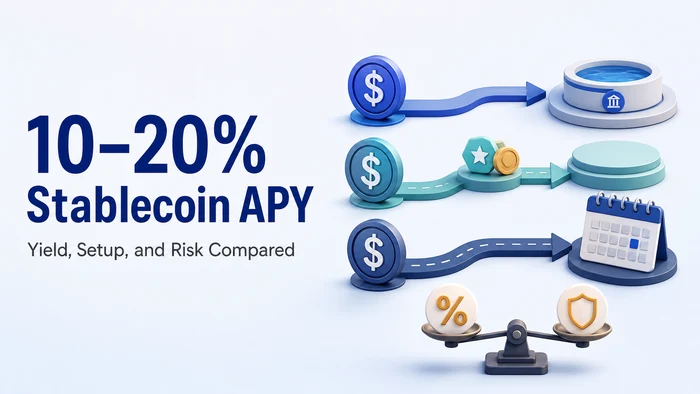
A common assumption is that a stablecoin holds its value, so the yield paid on it should hold steady too. In practice, double-digit stablecoin returns come from somewhere specific: lending demand, leveraged trading positions, token incentives, or a manager running an active strategy. When that demand cools, the rate falls, sometimes within days. So 10-20% is a condition that has to keep holding, not a safe band a platform can guarantee. A one-click deposit screen makes this harder to see, because a clean interface can sit on top of borrowing, hedging, and several layers of smart contracts. This article looks at which stablecoin yield platforms are genuinely simple to set up, where their returns actually come from, and what extra risk a saver takes on in exchange for those higher yields.
The Short Answer on 10-20% Stablecoin Yield
No platform reviewed for this article offers a reliably low-risk 10-20% stablecoin APY as a standing product. Double-digit stablecoin APY does appear, but as a live reading on a specific strategy at a specific moment rather than a rate tier a platform can hold open.
Where it appears, it comes from a short list of routes:
- Curated lending vaults such as Morpho vaults, when reward tokens or higher-risk collateral are part of the position.
- Automated multi-strategy vaults such as Yearn and Beefy, which stack lending, trading fees and incentives in one position.
- Incentivized stablecoin liquidity vaults, where an emissions budget is doing most of the work.
- Maturity trades on Pendle, where the rate is locked at purchase and realized only by holding to maturity.
- Hedged futures-market routes such as Ethena’s, where periodic payments from futures traders can provide part of the yield.
Direct lending on Aave and Compound is the simpler baseline, and those pools generally sit below the band, because any rate that rises attracts deposits that push it back down.
The clearest illustration of how fast the band can empty out comes from a strategy often quoted at 10-18%. Ethena’s own governance reporting put sUSDe APY at 3.50% at the end of April 2026, with a 30-day average of 3.49% and a 90-day average of 3.50%. It attributed the step down from 3.75% to lower payments from futures traders and a smaller set of hedged positions (Ethena governance update, March and April 2026). The same strategy that once printed a headline number was paying close to a savings rate a few months later.
Snapshot: August 13, 2026. No stable 10-20% stablecoin opportunity could be verified from an official source on this date, so this article does not restate secondary rate listings. A same-day read of Beefy’s official APY endpoint showed a small number of incentivized stablecoin-pair vaults at or above the range while most stablecoin routes sat below it, and that data does not separate base yield from reward yield. Current numbers, and the split behind them, have to be read from each live interface, which is what the routes below link to.
Where a 10-20% Stablecoin Rate Actually Comes From
Every stablecoin yield has a payer. Identifying that payer is the fastest way to judge whether a rate can persist.
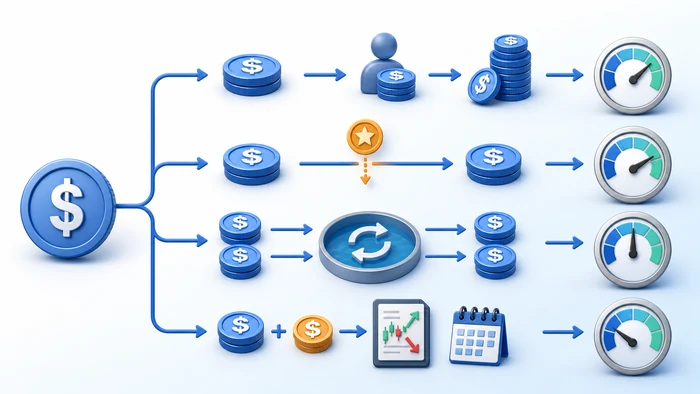
Borrowing demand
In a lending pool, borrowers pay interest and depositors receive it. Compound III sets the base supply rate as a function of pool utilization, rising more steeply once utilization passes a kink parameter (Compound interest rate docs). Aave works on the same principle, with supply rates moving with utilization and with governance-set parameters (Aave supply documentation).
This is the most legible source. It is also why pure lending rates on major stablecoins rarely sit in the double digits for long: high rates attract deposits, utilization falls, and the rate follows it down.
Hedged futures-market routes
Some dollar-pegged crypto strategies hold an asset and an equal, opposite futures position. The pairing is designed to reduce the effect of price moves. The return can then come from periodic payments between futures traders, plus other protocol revenue; Ethena states that its APY is weekly and dynamic (sUSDe rewards mechanism).
The payer here is leveraged traders. When they stop paying to be long, the rate compresses. Ethena’s own risk pages list funding, liquidation, custody, exchange and backing-asset risks as part of the package (Ethena risk documentation).
Trading fees and token incentives
Liquidity pools pay swap fees, and protocols often add token emissions on top to attract deposits. Emissions are a marketing budget, not revenue, so they end on a schedule or a governance vote.
Automated vaults compound these positions on a set cadence. Beefy states that its vaults are harvested multiple times a day, that profits are reinvested automatically, and that all vault fees are already included in the displayed APY (Beefy vault documentation). That figure is a projection built from current rates, current prices and an assumed compounding schedule, so it is not a realized return.
Fixed-rate yield tokenization
Pendle splits a yield-bearing asset into a principal token and a yield token. Buying the principal token at a discount locks a rate that is realized by holding to maturity and redeeming 1:1 for the underlying (Pendle fixed yield documentation).
The condition matters more than the headline. Exiting before maturity means selling the principal token at whatever the market pays that day, which adds price and liquidity exposure the locked rate does not cover.
Treasury and RWA backing
Some routes distribute income from short-term government bills and on-chain credit through an exchange rate that rises over time. BenPay’s pre-investment notice describes Sky’s route this way, with the deposit receipt appreciating rather than paying a separate coupon (BenPay pre-investment notice).
This source is the most stable of the group, and correspondingly the least likely to reach double digits. It tracks policy rates.
Who pays the rate and for how long
Grouping the sources gives a usable filter. Borrower interest and trading fees are revenue and can persist as long as demand does. Funding payments are revenue but swing with trader positioning. Token emissions are a subsidy with an expiry.
A route quoting 10-20% is almost always drawing on the second or third category, or stacking several of them.
Base APY Versus Reward APR
Two different numbers often appear under one label. Base or native APY is what the underlying position earns. Reward APR is what a protocol pays on top, usually in its own token, and usually temporary.
Compound documents protocol rewards separately from base supply rates (Compound rewards docs), and Morpho documents that a depositor’s total yield combines native lending APY with reward APR from separate sources (Morpho rewards docs). Morpho also documents that a performance fee is taken as a cut of the native yield and is capped at 50%, and that Morpho Vaults V2 may additionally charge a management fee on total assets deposited, capped at 5% (Morpho yield and fees docs). Those two figures are protocol maximums, not typical rates. Each vault sets its own actual fees, which have to be read on that vault’s page.
The practical rule: a headline figure that is mostly reward APR is a claim about a subsidy schedule, not about lending demand. When an interface shows only a combined number, the split is not separately disclosed, and the durable part of the rate cannot be assessed from that screen alone.
Comparing Routes by Setup Complexity and Exit Terms
The tables below group routes by type rather than ranking platforms. Each named platform is one representative of its route, not a recommendation.
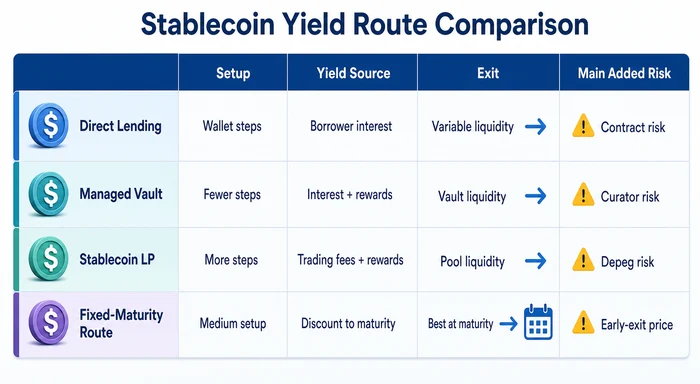
Table A: Yield source and rate disclosure
Snapshot: August 13, 2026. No stable, officially verified 10-20% stablecoin opportunity was confirmed on this date. The rate-status column describes the condition under which a route can reach that band, never a promised range, and current numbers must be read from the linked official source.
| Route type | Representative platform | Yield source | Rate status on August 13, 2026 | Base vs reward disclosure | Stablecoin | Chain and bridge step |
|---|---|---|---|---|---|---|
| Direct lending pool | Aave, Compound III | Borrower interest | Generally below the target range, because deposits compress any rate spike | Base rate is utilization-driven; token rewards documented separately | USDC, USDT, DAI | Native chain, bridge needed if funds sit elsewhere |
| Curated lending vault | Morpho vaults | Borrower interest, allocated by a curator | May temporarily enter 10-20% when rewards or higher-risk collateral are included; live rate required per vault | Displayed yield may combine native APY and rewards, net of fees; split varies by vault | USDC, USDT | Native chain, bridge needed if funds sit elsewhere |
| Automated multi-strategy vault | Yearn, Beefy | Lending, trading fees, incentives, auto-compounded | May temporarily enter 10-20% while an emissions program is running; live rate required per vault | Displayed APY is a projection after vault fees; component split not separately disclosed per vault | Varies by vault | Multi-chain, chain choice made at deposit |
| Hedged futures-market route | Ethena sUSDe | Periodic payments from futures traders plus other protocol revenue | Live rate required; officially reported at 3.50% at end of April 2026, well below the band | Single weekly, dynamic APY | USDe / sUSDe | Native chain |
| Fixed-rate yield tokenization | Pendle PT | Discount to underlying, realized at maturity | Live rate required per pool, and it applies only if the token is held to maturity | Rate is locked at purchase, not a running APY | Varies by pool | Native chain, plus a maturity to track |
| Aggregated access, one deposit screen | BenPay DeFi Earn | External protocols including Aave, Compound, Morpho, Sky, Ethena, Unitas | Generally below the target range; BenPay’s published blog terms give a 3-8% gross target, variable and not guaranteed | Per-strategy rate shown in product; described as dynamic, not fixed | BUSD, USDC, USDT | Deposit from 9 supported networks; conversion handled at deposit |
Table B: Custody, exit terms, and failure mode
| Route type | Custody | Lock or maturity | Withdrawal liquidity | Fee | Main failure mode |
|---|---|---|---|---|---|
| Direct lending pool | Self-custodial | None | Depends on liquidity available in the pool | Protocol-level, no manager cut | Pool utilization spikes and withdrawal has to wait |
| Curated lending vault | Self-custodial | None | Depends on underlying market liquidity | Performance fee on native yield, capped at 50%; V2 vaults may add a management fee on assets, capped at 5%; actual rates set per vault | Curator allocates into a market that stops functioning |
| Automated multi-strategy vault | Self-custodial | None | Depends on the strategies held | Vault fees, already reflected in displayed APY | A single strategy or reward token fails and drags the vault |
| Hedged futures-market route | Self-custodial | Cooldown may apply on unstaking | Depends on protocol mechanics and market conditions | Protocol-level | Payments from futures traders can reverse, or an exchange, custody or backing-asset failure hits |
| Fixed-rate yield tokenization | Self-custodial | Yes, to maturity | Early exit only by selling on the AMM | Trading and slippage costs | Early exit at an unfavorable market price |
| Aggregated access, one deposit screen | Self-custodial, private keys held by the user | Per strategy: instant, about 30 minutes, or 10 days | 10-day strategies stop accruing once redemption is submitted | 15% of earnings, 0% on principal, per BenPay’s published blog terms | Underlying protocol, bridge, or stablecoin failure passes straight through |
What the two tables actually say
Setup complexity and risk do not move together, and that is the main thing the tables show. A direct Aave deposit is one of the more complex routes to reach for someone holding funds on another chain, since it requires a wallet, gas on the destination chain, and a bridge transfer. Once there, the position is the simplest to reason about: borrowers pay, depositors receive, and the rate is visible on-chain.
The opposite pattern shows up in automated vaults. Two clicks, one screen, and underneath sit a lending market, a liquidity pool, a reward token, and a compounding contract. Beefy is explicit that an audit does not make a vault risk free. Simple to set up does not mean simple in structure.
Table B is where the real separation happens. On a $5,000 deposit, the difference between a route that credits immediately and one that requires a 10-day wait is not the APY, it is whether that $5,000 is reachable when it is needed. A Pendle principal token held to maturity behaves as intended. The same position sold three months early is a market trade, and the locked rate has nothing to do with the outcome.
Read together, the tables point to one filter that costs nothing to apply: identify the payer from Table A, then check the exit column in Table B. A route whose payer is a subsidy and whose exit requires selling into a thin market is carrying two risks at once, whatever the headline number says. A protocol-by-protocol version of this comparison is available in BenPay’s 2026 DeFi stablecoin yield comparison.
Native Versus Bridged Stablecoins
Two tokens can both be called USDC on the same chain and not be the same asset. Native USDC is issued by Circle. Bridged USDC.e is a wrapper created by a third-party bridge, and it must be unwrapped back to the origin chain before Circle will redeem it (Circle documentation on USDC and USDC.e).
This matters for yield hunting because bridged versions often carry the higher advertised rate on a given chain. The extra yield is partly compensation for holding a bridge’s liability instead of the issuer’s. Checking the token contract before depositing takes one minute and removes an exposure that no APY figure discloses.
Withdrawal Liquidity
A stablecoin deposit is only as liquid as the pool behind it. Aave documents that a withdrawal transfers the supplied assets and accrued interest provided there is sufficient liquidity in the pool, and that suppliers can withdraw up to the amount not currently borrowed (Aave withdrawal documentation). A position can therefore be fully solvent and still not immediately withdrawable when borrowing demand is high.
The same constraint runs through every route in Table B, in different forms. A vault inherits the withdrawal terms of everything it holds. A cooldown period is a disclosed version of the same limit. An early Pendle exit converts the question from liquidity to price.
Note: the moment to check exit terms is before depositing, because every one of these constraints becomes visible only when a withdrawal is attempted.
What Creates the Extra Risk Behind a One-Click Screen
The spread between a 4% lending rate and a 14% vault rate is paid for with specific exposures. Four of them account for most of the gap.
Contract layers
A direct lending deposit touches one protocol’s contracts. An aggregated vault position can touch four or five: the vault, the strategy, the underlying lending market, the reward distributor, and a bridge if the funds crossed chains. Each layer is an independent point of failure, and the layers do not offset each other.
Strategy risk
An active strategy makes decisions. A curator chooses which markets a Morpho vault lends into, and that choice is not visible in the APY number. A hedged strategy uses positions designed to offset price moves, but it still depends on those positions holding through volatile periods and on the venues where they sit staying operational.
Governance and parameter risk
Supply rates on Aave and Compound respond to governance-set parameters, not only to market demand. A parameter change can move a rate without any change in borrowing activity. Reward programs are governed the same way, which is why an emissions-heavy APY can reset on a vote.
What an audit does and does not prove
An audit is a review of code at a point in time by a specific firm, over a specific scope. It does not cover strategy design, market conditions, or contracts outside the reviewed scope. Beefy states plainly that an audited vault is not entirely risk free, and that framing is the correct one to apply to every audit badge on every platform, including the platform section below.
The Lower-APY Route, and When a 3-8% Gross Target Is the Better Fit
The criteria above produce a specific reader for whom a 10-20% route is a poor match: someone who wants a legible payer, a short setup, and exit terms disclosed before depositing rather than discovered at withdrawal. That combination generally rules out subsidy-driven and maturity-bound routes, and it points toward lending and treasury sources accessed with as few manual steps as possible.
The route. BenPay DeFi Earn is one option in that category. It is a one-stop on-chain platform where stablecoins can be deposited, put into a yield strategy, and later spent or transferred from the same account, with access aggregated to external protocols including Aave, Compound, Morpho, Sky, Ethena and Unitas. BenPay’s currently published blog terms give a 3-8% gross target, variable and not guaranteed, so this is not a 10-20% product.
Verified terms, from BenPay’s official documentation:
- Minimum investment is 100 USD. Deposits are accepted in BUSD, USDC and USDT, with USDT and USDC supported on Ethereum, BSC, Polygon, Optimism, Arbitrum, Avalanche, Base, Solana and TRON, and BUSD on BenFen chain (How to Invest).
- The published fee is 15% of earnings and 0% on principal, which puts a 6% gross strategy near 5.1% net. That percentage appears in BenPay’s current blog terms rather than in the Help Center, so the live product page should be checked before depositing.
- Assets are held in non-custodial mode, controlled by the user’s private key. Gas on investment and redemption transactions on BenFen chain is covered by the platform, and that coverage does not extend to bridging or source-chain transactions (Fees and Security).
- Only the BenFen public chain core smart contract is evidenced as audited by SlowMist. That scope does not extend to the external protocols the strategies route into.
Strategies and how they behave. The underlying sources are the same ones covered earlier in this article, which is the point: Aave and Compound pay borrower interest, Morpho routes through curated vaults, Sky distributes bill and credit income, and Ethena and Unitas use payments from futures traders. BenPay’s own risk page states that the rate shown over a year is dynamic, that past performance does not represent the future, and that principal may fluctuate in extreme conditions (Risk Awareness).
Redemption is set per strategy, and the current list was last updated on March 26, 2026. Morpho-USDT, Morpho-USDC, Sky-USD, Compound-USDC, Compound-USDT, AAVE-USDC and AAVE-USDT credit instantly, subject to on-chain confirmation. The V2 versions of Sky-USD, Compound-USDC, Compound-USDT, AAVE-USDC and AAVE-USDT take about 30 minutes. SOL-USD and Ethena-USDe take 10 days, and funds stop accruing on the day redemption is submitted rather than at the end of the wait (redemption mechanism).
When this route fits, and when it does not. It fits a saver whose priority is fewer manual steps, a disclosed fee applied only to earnings, and one screen showing which underlying protocol or strategy the funds are deployed into. It does not fit anyone targeting double digits, since a 3-8% gross target less 15% of earnings lands well below that. Self-custody removes one category of exposure and leaves strategy, protocol, bridge, stablecoin and smart-contract risk exactly where they were. How this compares to aggregators built purely for rate optimization is covered in BenPay’s multi-chain yield aggregator comparison.
A Small Test Before a Real Deposit
Running the full cycle with a small amount surfaces the terms that documentation does not make obvious.
- Deposit the minimum, not the intended amount.
- Record the displayed rate and the date, and check the same figure a week later.
- Confirm which token was actually received, native or bridged.
- Submit a withdrawal and time it, including any waiting period.
- Compare the amount returned against the deposit plus accrued yield, after fees.
A route that behaves as documented across all five steps has earned a larger deposit. A route that does not has cost the price of finding out early.
Questions Readers Ask Before Depositing
Are 10-20% stablecoin yields sustainable, or is the rate temporary?
They are readings on a specific strategy at a specific moment, and they compress when the demand behind them cools. Ethena’s own governance reporting put sUSDe at 3.50% at the end of April 2026, against the 10-18% figure that circulated earlier. Rates drawn from borrower interest tend to persist longer than rates drawn from token emissions. A rate should be judged by who pays it, not by how long it has already lasted.
What is the difference between base APY and reward APR?
Base APY is what the underlying position earns, such as interest paid by borrowers. Reward APR is an additional payout, usually in a protocol’s own token, funded by an emissions budget rather than revenue. Compound and Morpho document the two separately. When an interface shows only a combined figure, the split is not separately disclosed, and the durable portion cannot be assessed from that screen.
Does an audit mean a protocol is safe?
No. An audit reviews specific code at a specific time within a defined scope, and says nothing about strategy design, market conditions, or contracts outside that scope. Beefy states directly that an audited vault is not entirely risk free. Audit scope is also narrower than it appears, so the reviewed contract should be checked against the contract actually holding the funds.
Can stablecoins be withdrawn at any time?
That depends on the route. Aave documents that a withdrawal requires sufficient liquidity in the pool and is limited to the amount not currently borrowed, so a solvent position can still be delayed when borrowing demand is high. Some strategies apply a cooldown or a fixed waiting period during which funds stop accruing. A Pendle principal token can be exited early only by selling at market price, which is a different question from liquidity.
Is native USDC safer than bridged USDC.e?
They carry different exposures rather than different amounts of it. Native USDC is issued by Circle, while USDC.e is a third-party bridge wrapper that must be unwrapped before Circle will redeem it. Holding the bridged version adds exposure to that bridge on top of the issuer. Checking the token contract before depositing takes a minute and reveals which one is actually held.
Why choose a 3-8% route over a 15% one?
Because the gap is paid for with specific exposures: more contract layers, active strategy decisions, subsidy schedules that expire, and exit terms that only appear at withdrawal. A 3-8% route drawn from borrower interest has a payer that can be named and a structure that can be checked. The lower number is the correct choice when legibility and predictable exit matter more than the headline rate. It is the wrong choice for anyone whose target is double digits.
How to Choose a Stablecoin Yield Route Without Chasing the Highest APY
The comparison that matters is not between rates. It is between what each rate requires to keep holding.
Three checks cover most of it. Name the payer, and if the answer is a token emissions budget, treat the rate as temporary. Read the exit terms before depositing, since liquidity, cooldowns and maturities only become visible at withdrawal. Confirm the token contract, because a bridged wrapper and an issuer-native stablecoin are not the same asset regardless of the ticker.
After those three, route selection follows from conditions rather than from a leaderboard. Fewer manual steps and a legible payer point toward lending and treasury sources in the 3-8% range. A tolerance for subsidy schedules, curator decisions and maturity dates is what a double-digit target actually requires. A broader walkthrough of how these criteria apply across platforms is available in BenPay’s guide to DeFi platforms for stable yield.
References
- Aave: Supplying tokens
- Aave: Withdrawing tokens
- Compound: Interest rates
- Compound: Protocol rewards
- Morpho: Yield and fees
- Morpho: Rewards
- Yearn: Vaults
- Beefy: Vaults
- Beefy: APY API
- Ethena: sUSDe rewards mechanism
- Ethena: Risks
- Ethena: March and April 2026 governance update
- Pendle: Fixed yield
- Circle: USDC vs USDC.e
- BenPay: Pre-investment notice on sources of yield
- BenPay: How to invest
- BenPay: Redemption mechanism
- BenPay: Fees and security
- BenPay: Risk awareness