
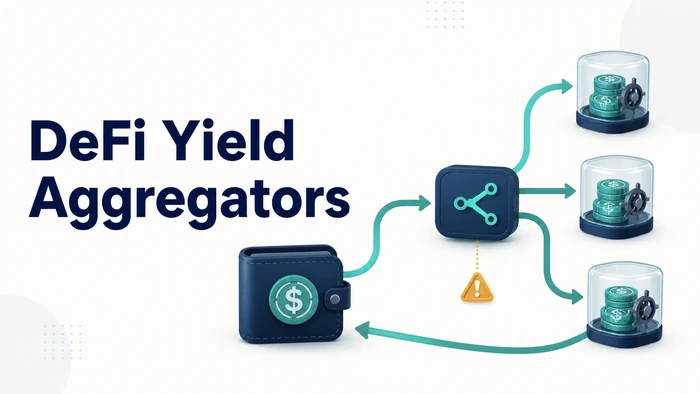
A beginner deposits $500 in USDC into a DeFi yield aggregator without knowing exactly where that money will end up. A yield aggregator is software, often a smart-contract strategy, that automates where a stablecoin deposit is allocated across lending and savings platforms to earn a return, then reinvests that return without further instructions. Whether that means actively moving funds between protocols or holding a single selected strategy varies by product, so no single path is guaranteed. Automation does not remove risk: a bug or exploit in any platform the aggregator uses can affect the deposited funds. Most aggregators also carry no deposit insurance the way a bank account would, so a loss is generally not covered. This article explains how that automated allocation works step by step and lays out the specific risks at each stage.
What Is a DeFi Yield Aggregator?
A DeFi yield aggregator is software, often built as a smart-contract strategy, that holds a stablecoin deposit and automates its allocation to lending or savings protocols to earn a return. Instead of manually connecting to each protocol, checking rates, and moving funds around, the aggregator’s smart contract does that work on a set schedule or rule set. The specific protocols it uses can vary by aggregator and by strategy, so no two aggregators route funds the same way. What stays the same across aggregators is the basic structure: a deposit goes in, a strategy decides where it works, and the resulting return gets reinvested or made available to withdraw.
How Automated Routing Works
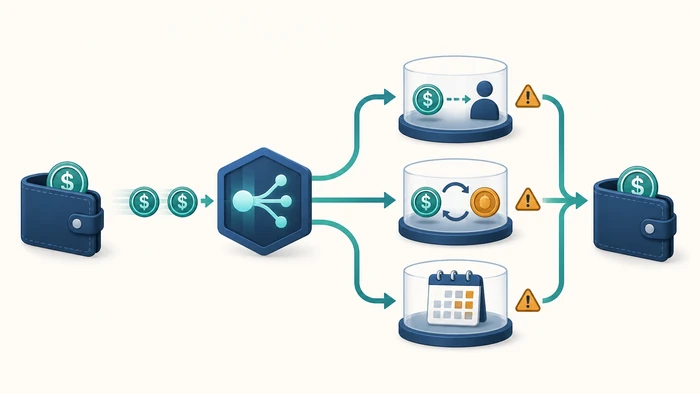
The mechanism behind automated routing breaks into four steps that happen every time funds sit inside an aggregator.
Deposit
A stablecoin deposit, for example USDC or BUSD, moves from a personal wallet into the aggregator’s smart contract. At this stage nothing has been allocated yet; the funds are simply held under the contract’s custody rules.
Strategy Allocation
The aggregator’s contract assigns the deposit to one or more pre-built strategies. Each strategy defines which lending or yield protocol the funds will interact with and under what conditions the aggregator will move them again.
Automated Execution
Once a strategy is assigned, the contract executes the transactions on-chain, such as supplying assets to a lending market or entering a vault, without further manual instructions from the depositor. This step is what removes the need to sign a new transaction every time a rate changes.
Auto-Compounding
Returns earned by the strategy are periodically collected and reinvested into the same position rather than sitting idle. Over time this is what produces the compounding effect shown in an aggregator’s advertised APY, though the APY itself is variable and not guaranteed.
What Risks to Know Before Depositing
Automated routing removes manual work, not risk. Each risk below applies at a different stage of the process above.
Smart Contract Risk
Every step described above runs through code. If that code, or the code of a protocol it connects to, contains a bug or is exploited, deposited funds can be affected regardless of how the strategy was chosen. Independent security audits reduce this risk but do not eliminate it.
Extra Risk When Protocols Combine
An aggregator that routes funds into more than one underlying protocol carries the risk of each protocol it touches, not just its own. If a strategy uses two lending markets, a problem in either one can affect the deposit, even if the aggregator’s own contract has no issue.
Reward-Token and Impermanent Loss Risk
Some strategies pay part of their return in a separate reward token, or hold assets in a pool where the mix of holdings shifts with market prices. In either case, the value received on withdrawal can be lower than the advertised APY suggested, independent of any hack or bug.
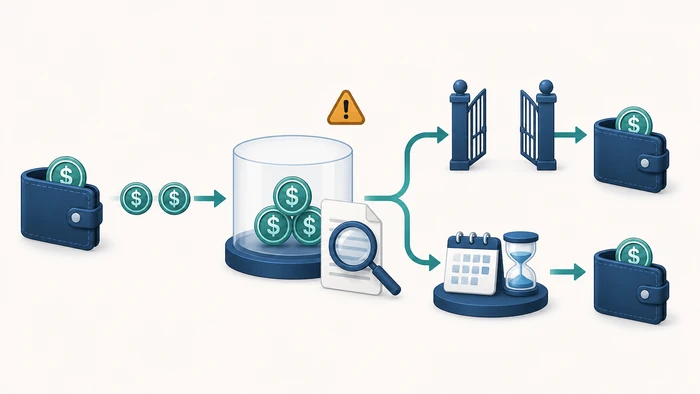
No Deposit Insurance
Unlike a bank account, most DeFi deposits carry no deposit insurance. If funds are lost to an exploit or a failed strategy, there is generally no third party covering the loss.
How to Evaluate a Yield Aggregator Before Depositing
The risks above point to a short list of things worth checking before a deposit is made:
- Independent audits: has the aggregator’s contract been reviewed by a named security firm, and is the report available.
- Total value locked and platform age: a platform running for multiple market cycles without an incident is a different risk profile than one that launched weeks ago.
- Fee structure: what percentage of profit and what percentage of principal, if any, the platform charges, and how withdrawal fees work.
- Redemption terms: whether withdrawals settle instantly or require a waiting period.
- Supported chains and assets: whether the deposit’s chain and token are actually supported before funds are sent.
- Custody model: whether private keys stay with the depositor or move to the platform.
A Simpler DeFi Route for Beginners: BenPay DeFi Earn
Once a beginner knows how to check yield source and exit terms, BenPay DeFi Earn provides a way to use selected multi-chain strategies without opening a separate interface for every protocol. The wallet stays self-custodial, so the holder keeps the private key while authorizing a strategy. BenPay also covers the BenFen gas cost for deposit and redemption.
| Beginner hurdle | How BenPay DeFi Earn handles it | What still needs a choice |
|---|---|---|
| Several protocol interfaces | Selected strategies are available in one DeFi Earn interface | The holder still chooses the strategy |
| Wallet control | Assets remain under the holder’s private-key control | Wallet security remains the holder’s responsibility |
| BenFen deposit and redemption gas | BenPay covers the gas for those operations | Other strategy terms still apply |
| Getting funds back | The redemption flow is initiated from the selected strategy | Timing can be instant or N-days, depending on that strategy |
What this means in practice: DeFi Earn removes repeated setup and BenFen gas from the basic deposit-and-redeem flow. It does not turn every strategy into the same product. Yield, redemption timing, and the underlying protocol risk remain tied to the strategy selected, so the strategy details should be the final check before authorizing a deposit.
Frequently Asked Questions
Is a DeFi yield aggregator safe for a beginner?
No DeFi yield aggregator removes all risk. Independent audits, a longer track record, and clear fee and redemption terms lower the risk profile, but smart contract exploits and protocol failures remain possible at any stage.
Do deposits need to be moved manually between protocols?
No. The core function of an aggregator is to automate allocation, and in some cases movement between protocols, based on a pre-built strategy, without a new manual transaction each time. Exactly how that automation works varies by product.
What happens if a protocol the aggregator uses is hacked?
If a protocol inside the strategy is exploited, the deposit routed to that protocol can be affected even if the aggregator’s own contract was not the point of failure. This is the extra risk that comes from combining protocols.
Is the advertised APY guaranteed?
No. APY on DeFi yield strategies is variable and changes with market conditions; it is never guaranteed, regardless of which aggregator or protocol is used.
Does self-custodial mean the platform can access the funds?
No. Self-custodial means private keys stay with the holder rather than moving to the platform, so the platform does not hold direct control over the deposit.
Choosing a Beginner-Friendly Route Into DeFi Yield
The mechanism is consistent across the aggregators covered here: a deposit goes in, a strategy decides where it works, and returns get reinvested automatically. What changes between options is custody, fee structure, audit status, and redemption timing, and those four factors, not the advertised APY alone, are what actually determine which route fits a specific deposit.