
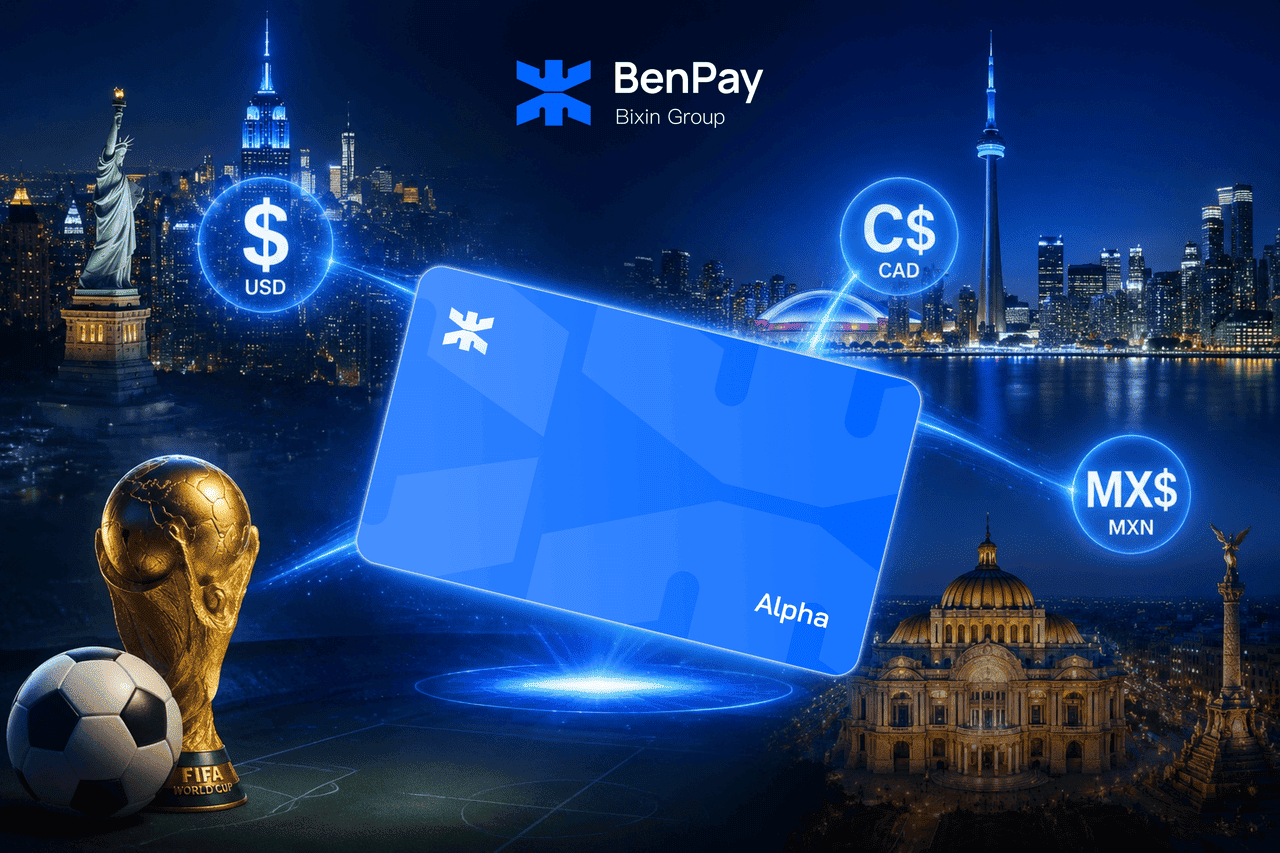
Traveling across the United States, Canada and Mexico means dealing with three currencies, different tipping and tax conventions, and payment systems that do not always behave the same way.
The 2026 FIFA World Cup brought these differences into focus as international fans moved between host cities and paid for tickets, hotels, transportation, food and everyday purchases in US dollars, Canadian dollars and Mexican pesos.
The most practical payment setup was not one universal card or currency. For most travelers, it was a combination of:
- A primary card with transparent foreign-exchange fees
- A backup card issued through a different payment account
- A small amount of local cash
- A way to check exchange rates
- An optional stablecoin-funded card for travelers who already held USDC or USDT
Stablecoin cards can simplify funding for some international travelers, but they are not automatically cheaper than conventional travel cards. The real cost depends on card funding fees, transaction fees, cross-border charges, exchange rates and any blockchain costs incurred before the funds reach the card.
This guide explains how to compare those costs and choose an appropriate payment method when traveling across the US, Canada and Mexico.
Quick Answer: What Currencies Do the US, Canada and Mexico Use?
The three countries use different national currencies:
| Country | Local currency | Currency code | Practical payment approach |
|---|---|---|---|
| United States | US dollar | USD | Cards are widely accepted; carry limited cash for tips or small businesses |
| Canada | Canadian dollar | CAD | Cards and contactless payments are widely accepted; keep a backup option |
| Mexico | Mexican peso | MXN | Cards are common in major cities, but cash remains useful for smaller merchants and local transport |
When a card terminal asks which currency to use, travelers should normally select the merchant’s local currency:
- Select USD in the United States
- Select CAD in Canada
- Select MXN in Mexico
Choosing a home currency instead may activate dynamic currency conversion, or DCC. Under DCC, the merchant or ATM provider performs the conversion and displays the charge in the cardholder’s home currency. This may include a separate markup or a less favorable exchange rate.
Visa advises merchants and ATMs offering DCC to disclose the local amount, converted amount, exchange rate and any additional markup. The cardholder must also be allowed to accept or decline the conversion.
What World Cup 2026 Revealed About Cross-Border Payments
The World Cup was an unusually visible example of a common international travel problem: a traveler’s payment needs can change from one country, city and merchant to the next.
A visitor traveling from Los Angeles to Toronto and then Mexico City could encounter:
- A hotel bill in USD
- A flight or train booking in CAD
- A restaurant bill in MXN
- A hotel deposit or temporary card authorization
- An ATM offering to convert MXN into the traveler’s home currency
- A card issuer charging a foreign transaction fee
- A merchant that accepts cards and another that only accepts cash
- A payment rejection caused by a merchant category or card security rule
These are not unique to a football tournament. They affect digital nomads, business travelers, international students and tourists taking any multi-country trip.
The main lesson is that payment convenience and payment cost are separate issues. A card may work at a merchant but still apply an unfavorable exchange rate or cross-border fee. Another card may offer lower fees but have stricter residency, merchant or funding requirements.
How FIFA Ticket Currencies Worked
FIFA’s official World Cup 2026 payment guidance stated that the currency used for ticket charges depended on residency:
- Canadian residents were charged in CAD
- Mexican residents were charged in MXN
- US residents were charged in USD
- Other international residents were generally charged in USD
FIFA also identified Visa as the tournament’s official payment technology partner.
The tournament has now concluded, so these rules should be treated as a historical World Cup 2026 example rather than guidance for future ticket purchases.
The Four Costs Travelers Should Compare
A card advertised as suitable for international use is not necessarily free to use abroad. Travelers should evaluate the complete transaction path rather than a single headline fee.
- Foreign Transaction or Cross-Border Fees
A card issuer may charge a percentage or fixed amount when a transaction takes place outside the card’s home market or is processed in another currency.
Whether this fee applies depends on the card, issuer, transaction location and billing currency. Travelers should check the official fee schedule instead of assuming that a digital, crypto-funded or travel-branded card has no cross-border fee.
- Dynamic Currency Conversion
DCC occurs when a merchant or ATM offers to charge a traveler in their home or card billing currency instead of the merchant’s local currency.
The home-currency amount may appear more understandable, but the conversion can include a markup. Accepting DCC also transfers control over the conversion from the card issuer to the merchant’s conversion provider.
Travelers should compare the displayed exchange rate and fees. In most ordinary situations, declining DCC and selecting the local currency gives the card issuer responsibility for the conversion.
A stablecoin-funded card does not automatically prevent DCC. If a payment terminal offers a home-currency conversion, the traveler still needs to review or decline it.
- ATM Fees
An international cash withdrawal can involve several separate costs:
- A fee charged by the ATM operator
- A fee charged by the card provider
- A foreign-exchange spread
- A DCC markup if the traveler accepts conversion at the ATM
- A blockchain or card-funding fee incurred before withdrawal
ATM screens should be read carefully. If the ATM offers to convert the withdrawal into the traveler’s home currency, the local-currency option may allow the card issuer to perform the conversion instead.
Travelers should also make fewer, planned withdrawals rather than repeatedly withdrawing small amounts—provided they can store the cash safely.
- Card Funding and Conversion Costs
This category is especially important for stablecoin cards.
The visible card transaction fee is only one component. A traveler may also pay to:
- Purchase USDC or USDT
- Transfer the asset to a supported wallet or network
- Bridge it to another blockchain
- Fund the card account
- Convert the stablecoin into the card’s settlement asset
- Complete a purchase in a different local currency
The correct comparison is therefore total cost, not simply “stablecoin versus bank.”
Cash or Card in the United States, Canada and Mexico?
United States
Cards and mobile wallets are widely accepted in the United States, especially in cities, airports, hotels and large retail locations.
However, carrying a small amount of cash can still be useful for:
- Tips
- Small independent merchants
- Cash-only venues
- Payment-terminal outages
- Emergencies
Travelers should also remember that displayed prices often exclude sales tax. The amount charged at checkout may therefore be higher than the shelf or menu price.
Canada
Credit cards, debit cards and contactless payments are widely used across Canada. Travelers can usually rely on a card for hotels, restaurants, shops and transportation in major cities.
A backup payment method is still recommended because a transaction may be declined due to issuer security controls, merchant restrictions or temporary network problems.
Travelers should select CAD when given a choice of currencies at the terminal.
Mexico
Card acceptance is common at hotels, major restaurants, airports, shopping centers and established tourism businesses in large cities.
Local cash remains more important in Mexico than in many parts of the US and Canada. Mexican pesos may be needed for:
- Street food
- Markets
- Smaller restaurants
- Local taxis
- Small shops
- Tips
- Local transportation
- Merchants experiencing connectivity problems
Travelers should avoid relying entirely on USD cash. Even when a merchant accepts US dollars, the exchange rate offered by the merchant may be less favorable than paying in MXN.
Which Payment Setup Is Best?
There is no single best method for every traveler. The most appropriate setup depends on residency, existing financial accounts, travel route, spending level and tolerance for crypto-related complexity.
| Payment method | Potential advantages | Limitations to check | Best suited to |
|---|---|---|---|
| Bank card with no foreign transaction fee | Familiar, simple and widely accepted | Eligibility, issuer exchange rate and ATM fees | Most ordinary international travelers |
| Multi-currency travel account | Can hold several fiat currencies and show transparent conversion | Availability, account limits and conversion timing | Frequent travelers managing several fiat currencies |
| Local cash | Works at small merchants and during network outages | Theft risk, exchange costs and leftover currency | Tips, small purchases and cash-dependent merchants |
| Stablecoin-funded card | Can connect USDC or USDT balances with card payments | Funding fees, networks, KYC, geographic eligibility and card FX fees | Existing stablecoin users who understand wallet transfers |
| Direct wallet payment | On-chain settlement without a card where accepted | Limited merchant acceptance and asset/network compatibility | Crypto-native merchants and peer-to-peer transfers |
For many travelers, a bank card with no foreign transaction fee may be simpler and less expensive than acquiring stablecoins solely for a short trip.
A stablecoin card becomes more relevant when the traveler already receives, holds or transfers USDC or USDT and wants to connect those funds with ordinary merchant payments.
When Can a Stablecoin Card Be Useful?
Stablecoins such as USDC and USDT are designed to track the value of a reference asset, typically the US dollar. They can be transferred through blockchain networks and used to fund compatible payment products.
A stablecoin-funded card may be useful when:
- The traveler already holds USDC or USDT
- Conventional international transfers are slow or unavailable
- Funds need to be transferred across borders
- The traveler wants a USD-denominated budgeting balance
- The card’s complete fee schedule is competitive
- The card is available to residents of the traveler’s country
- The traveler understands wallet addresses and supported networks
The card serves as a bridge between an on-chain balance and merchants using conventional card payment infrastructure. The merchant generally receives the currency supported by its payment provider; the merchant does not need to accept stablecoins directly.
When May a Conventional Travel Card Be Better?
A conventional bank or travel card may be the better choice when:
- It has no foreign transaction fee
- It offers an appropriate exchange rate
- It includes chargeback or purchase-protection features
- The traveler does not already own stablecoins
- Buying and transferring stablecoins would introduce additional fees
- The traveler prefers not to manage wallets or blockchain networks
- The stablecoin card is unavailable in the traveler’s country
- Hotel and rental-car preauthorizations are important
Stablecoins should not be added to a travel plan merely because they are digital. They should solve a specific funding or payment problem and remain competitive after all costs are included.
How BenPay Fits Into International Travel
BenPay offers stablecoin-funded card products intended to connect supported digital assets with everyday payment scenarios.
For travelers who already hold USDC or USDT, this model may reduce the need to move funds through several separate banking or exchange accounts before making a card purchase.
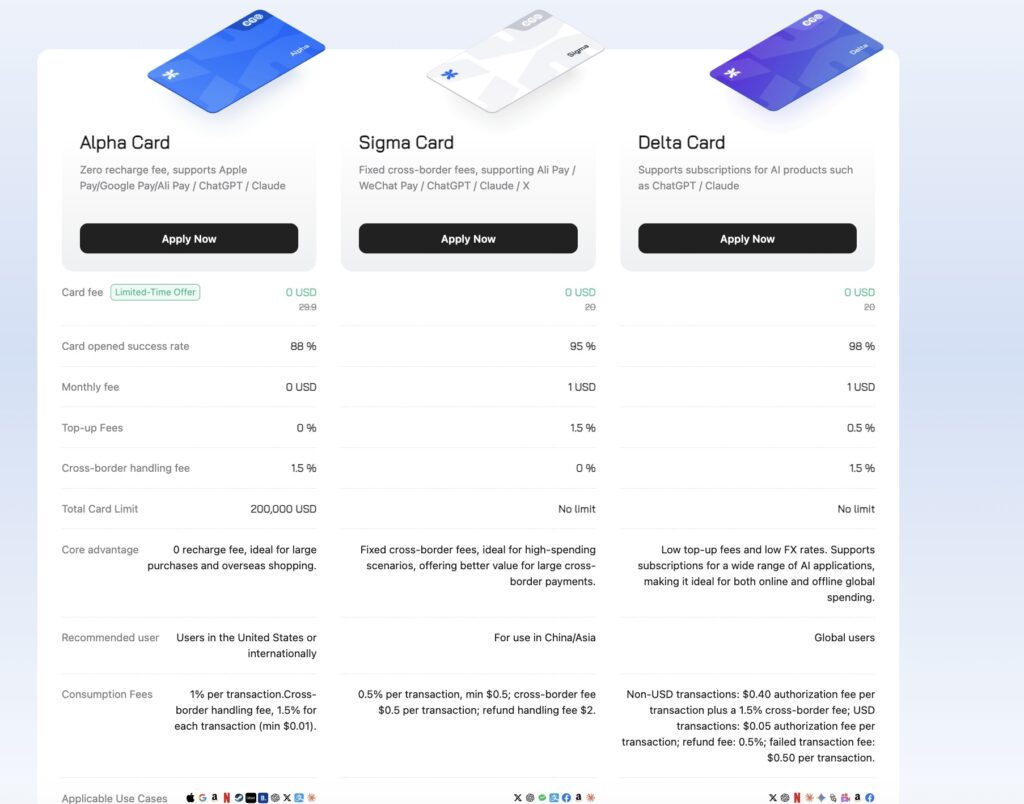
However, travelers should not assume that every BenPay card has the same cost or functionality. BenPay offers different card tiers, and each tier may have its own:
- Issuance fee
- Monthly fee
- Top-up fee
- Transaction fee
- Cross-border or FX fee
- Spending limit
- Supported payment methods
- Country restrictions
- Merchant restrictions
According to BenPay’s fee page, Alpha, Sigma and Delta cards have different top-up, transaction and cross-border fee structures. The published terms should be checked immediately before opening or funding a card because product fees can change.
Stablecoin and Crypto Card Risks to Consider
Stablecoin cards can provide another payment route, but they introduce risks that do not apply in exactly the same way to an ordinary bank card.
Stablecoin Risk
A stablecoin is not the same as cash in a bank account. Its value, redemption process and reserves depend on the issuer and market infrastructure. A stablecoin can temporarily trade below its intended reference value.
Blockchain Transfer Risk
Sending funds through the wrong network or to an incompatible address can result in delayed or lost funds. Travelers should confirm the asset, blockchain and destination address before every transfer.
A small test transfer is advisable when funding a new address for the first time.
Card and Merchant Restrictions
A card may be available to residents of one country but unavailable in another. Even after issuance, some merchants or transaction categories may be restricted.
A Visa or Mastercard connection does not guarantee that every merchant will approve every transaction.
Refund and Preauthorization Risk
Hotels, rental-car companies, fuel stations and some travel merchants may place temporary authorizations on a card. The authorization can reduce the available balance until it is released.
Travelers should check whether their card supports these merchants and how long refunds and authorization releases typically take.
Self-Custody and Account Responsibility
Self-custody gives users direct control over digital assets, but it also increases personal responsibility. Losing access credentials, approving a malicious transaction or sending funds incorrectly can have serious consequences.
A Practical Payment Checklist Before Traveling
Before traveling across the US, Canada or Mexico:
- Confirm which countries and residents are eligible for the card.
- Read the current card fee schedule.
- Check the card’s billing or settlement currency.
- Confirm which stablecoins and blockchain networks are supported.
- Enable transaction notifications.
- Inform the bank or issuer about international travel if required.
- Test the primary card before departure.
- Carry a backup card linked to a separate account.
- Keep a limited amount of local cash.
- Avoid storing all travel funds in one wallet or card account.
- Check hotel and rental-car preauthorization policies.
- Decline DCC unless the displayed conversion is demonstrably better.
- Save official support contact details before traveling.
- Keep recovery credentials offline and secure.
- Never share a seed phrase or private key with customer support.
Recommended Payment Setup by Traveler Type
First-Time International Traveler
Use:
- A conventional card with transparent foreign-exchange terms
- A backup card
- Limited local cash
- An exchange-rate calculator
Adding a stablecoin card solely for one trip may create unnecessary complexity.
Frequent Multi-Country Traveler
Compare:
- A no-foreign-transaction-fee bank card
- A multi-currency account
- A stablecoin-funded card
Use real monthly spending patterns to compare total fees.
Traveler Already Paid in USDC or USDT
A stablecoin card may reduce the number of steps between receiving funds and making purchases.
Before choosing one, verify:
- Supported stablecoins
- Supported blockchain networks
- Card funding fees
- Cross-border fees
- Local eligibility
- Merchant restrictions
- Refund handling
Traveler Visiting Smaller Cities or Local Markets in Mexico
Carry MXN in addition to a card. Do not assume every merchant will accept an international card, mobile wallet or US dollars.
Frequently Asked Questions
What currencies are used in the United States, Canada and Mexico?
The United States uses USD, Canada uses CAD and Mexico uses MXN.
Should I pay in my home currency or the local currency?
At most foreign card terminals, selecting the local currency avoids the merchant’s dynamic currency conversion. Review the displayed exchange rate and markup before accepting any conversion.
Can one card be used across all three countries?
Many international cards can be used across the US, Canada and Mexico, but acceptance is not guaranteed. Country eligibility, merchant categories, issuer security rules and cross-border fees may still apply.
Carry a backup card and some local cash.
Can I use US dollars in Mexico?
Some tourism businesses may accept US dollars, but the merchant determines the exchange rate. Paying in MXN usually makes the price and conversion easier to evaluate.
Are stablecoin cards automatically cheaper than bank cards?
No. Total cost depends on stablecoin purchase costs, network fees, card funding fees, transaction fees, cross-border fees and exchange rates.
A bank card with no foreign transaction fee may be cheaper and simpler for many travelers.
Does a stablecoin card eliminate DCC?
No. DCC is offered by a merchant or ATM. A traveler using a stablecoin-funded card may still be offered a conversion and should review the choice at the terminal.
Do I still need cash?
A small amount of local cash is useful for tips, small merchants, local transport and payment outages. Cash tends to be more important in Mexico than in major US or Canadian cities.
Can I withdraw cash with a stablecoin card?
This depends on the card product and whether physical-card and ATM functions are currently available. Do not assume ATM withdrawals are supported. Check the latest official product documentation before traveling.
What should I do if my card is declined?
Try the following:
- Confirm that the balance is sufficient.
- Check whether the payment exceeds a card limit.
- Verify that the merchant category is supported.
- Try the physical or virtual card directly instead of a mobile wallet.
- Use a backup card.
- Contact the official card issuer through a verified channel.
Do not share a seed phrase, private key or one-time security code with anyone offering support.
Final Takeaway
The central lesson from World Cup 2026 is not that every traveler needs a new payment technology. It is that crossing several countries requires a payment plan built around different currencies, merchant habits, fees and failure scenarios.
For most travelers, the practical foundation remains:
- A primary card with transparent foreign-exchange pricing
- A backup card
- A limited amount of local cash
- Local-currency payment at card terminals
A stablecoin-funded card can add flexibility for travelers who already use USDC or USDT or need an alternative cross-border funding route. Its value should be evaluated using the complete cost of acquiring, transferring, funding and spending the stablecoin—not a single advertised fee.
Before using BenPay or another stablecoin card abroad, verify current eligibility, supported assets and networks, card funding costs, transaction fees, foreign-exchange terms, merchant restrictions and refund handling.
The best travel payment method is not necessarily the newest one. It is the option that remains transparent, accessible and reliable throughout the complete journey.
Disclaimer: This article is for general informational purposes only. It does not constitute financial, investment, legal or tax advice. Stablecoin and card availability, fees, supported networks and geographic restrictions may change. Always review the latest official product terms before transferring funds or making a payment.