
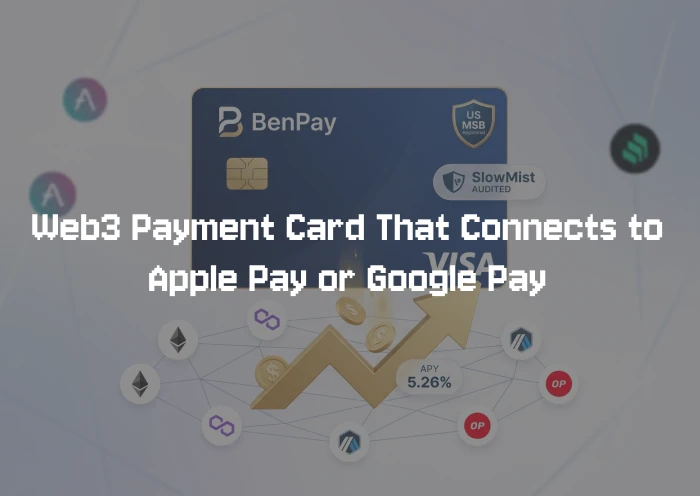
Converting cryptocurrency into everyday spending typically requires converting to traditional currency first, then waiting for bank transfers. Apple Pay and Google Pay change this equation by enabling instant, tap-based payments directly from a mobile wallet—no card swipe required. Web3 payment cards bridge crypto holdings to these payment networks, converting stablecoins at the moment of purchase.
This article explains how Web3 cards connect to mobile wallets, which networks support the integration, and how custody decisions affect payment options.
Key points:
– Apple Pay and Google Pay use NFC technology, accepted at 50+ million merchants globally
– Web3 cards create virtual card numbers that mobile wallets can tokenize
– Custody model (self vs. custodial) affects which payment methods are available
– Additional methods like Alipay and WeChat Pay extend payment reach into Asia
– Card network (Visa/Mastercard) determines compatibility with different regions
Why Apple Pay and Google Pay Matter for Crypto Spending
Crypto spending has two core challenges: finding merchants who accept crypto directly, and converting assets into fiat currency through time-consuming exchanges. Apple Pay and Google Pay eliminate the first problem entirely. Both platforms work at any terminal displaying the contactless payment symbol—approximately 50 million merchants globally.
The technology behind both is NFC (near-field communication). When a cardholder holds a phone near a terminal, NFC sends encrypted payment data without exposing the card number. The merchant receives only a one-time token, reducing fraud risk. Processing completes in under one second.
For crypto users, this means spending stablecoins like USDT or USDC at grocery stores, gas stations, and online retailers without converting to USD or EUR first. The conversion happens at the payment processor’s rate, typically with minimal markup (1-2% for Web3 cards).
Global acceptance is the decisive factor. A user in London can spend crypto at a cafe, then in Mexico at a restaurant, using the same virtual card. Neither merchant sees blockchain. Neither requires the cardholder to disclose they’re spending crypto.
How Web3 Cards Connect to Mobile Payment Wallets
Web3 cards function as intermediaries between blockchain wallets and traditional payment networks, bridging cryptocurrency holdings to real-world merchant spending. The payment flow mirrors traditional cards but settles through stablecoins instead of fiat currencies, enabling instant tap-to-pay spending from crypto balances.
Step 1: Virtual Card Issuance
- The Web3 card provider generates a virtual Visa or Mastercard number (16-digit card, expiration date, CVV).
- Unlike traditional cards, no physical plastic arrives; the card number exists as digital data only.
- Virtual cards can be issued instantly and used immediately for online and contactless transactions.
Step 2: Mobile Wallet Tokenization
- The cardholder enters the virtual card number into Apple Pay or Google Pay on their smartphone.
- The mobile wallet app encrypts the card data and stores it locally on the phone’s secure element.
- Encryption prevents the actual card number from being exposed to merchants or networks.
Step 3: NFC Transmission at Point of Sale
- At checkout, the cardholder holds the phone near the contactless terminal.
- The mobile wallet sends an encrypted payment token (not the raw card number) to the merchant’s payment terminal.
- Merchants see only a one-time token, not the underlying card details, reducing fraud risk.
Step 4: Settlement and Fund Withdrawal
- The merchant’s processor sends the transaction to the card network and card issuer for authorization.
- The card issuer pulls funds from the user’s Web3 wallet (self-custodial) or reserved balance (custodial) to complete the payment.
- Settlement happens within seconds to minutes depending on blockchain and custody model.
Why stablecoins matter: Merchants and payment networks require predictable, stable pricing for instant settlement. Bitcoin and other volatile assets cannot function in real-time payments—prices change too rapidly mid-transaction. USDT and USDC maintain 1 USD peg and are widely accepted by payment processors, making them ideal for Web3 card settlement.
Comparison: Which Web3 Cards Support Apple Pay and Google Pay
| Card Name | Provider | Network | Apple Pay | Google Pay | Alipay / WeChat Pay | Custody | Stablecoins | Top-up Fee | FX Fee | DeFi Yield |
|---|---|---|---|---|---|---|---|---|---|---|
| Alpha | BenPay | Visa | Yes | Yes | Yes | Self | USDT/USDC | 0% | 1.5% | Yes (3-8% APY) |
| Sigma | BenPay | Visa | Yes | Yes | Yes | Self | USDT/USDC | 1.5% | $0.50/txn | Yes (3-8% APY) |
| Delta | BenPay | Visa | Yes | Yes | Yes | Self | USDT/USDC | 0.5% | 1% | Yes (3-8% APY) |
| Coinbase Card | Coinbase | Visa | Yes | Yes | No | Custodial | USDC | Variable | Built-in | No |
| Crypto.com Card | Crypto.com | Visa | Yes | Yes | No | Custodial | USDT/USDC | Variable | Variable | No |
| MetaMask Card | MetaMask | Mastercard | Yes | Yes | No | Self | USDC | Variable | 0% | No |
| BitPay Card | BitPay | Mastercard | Yes | Yes | No | Custodial | USDT | Variable | Variable | No |
Table interpretation:
All major Web3 cards now support both Apple Pay and Google Pay. The differentiation is network (Visa vs. Mastercard), custody model, fee structure, and payment method coverage. BenPay stands out with four payment methods (Apple Pay, Google Pay, Alipay, WeChat Pay), offering broader geographic flexibility than competitors restricted to Visa or Mastercard only. Visa is more widely accepted in North America and Europe; Mastercard has stronger presence in Asia and Africa. BenPay’s Sigma and Delta options provide variable pricing for users who prefer transaction-based fees over percentage-based ones, with Delta’s $0.50 per-transaction FX fee offering cost predictability for high-volume traders.
Custody Model: How It Affects Mobile Wallet Spending
Custody determines who controls the stablecoins when they’re converted to fiat at checkout. This decision has direct consequences for payment method availability and security.
Self-custodial cards keep the cardholder’s private keys under their control. BenPay operates this way. Funds remain in the user’s blockchain wallet until a purchase is made. The card provider never holds the stablecoins in reserve. Advantages include full ownership and resistance to account freezes. The tradeoff is that the cardholder bears responsibility for key management and wallet security.
Custodial cards require the card provider to hold stablecoins in a reserve account. Coinbase Card and Crypto.com Card operate this way. Advantages include simpler account setup and lower technical barriers—no blockchain knowledge required. Disadvantages include counterparty risk (if the provider fails, funds may be frozen) and regulatory limitations. For example, Coinbase Card restricts USDT support due to internal policy.
For mobile wallet spending specifically, custody model affects liquidity. A self-custodial card requires the blockchain network to confirm the transaction before the payment clears. On Ethereum mainnet, this takes 12+ seconds. On faster chains like Polygon or Arbitrum, this takes 2-4 seconds. A custodial card settles instantly because funds are already held in fiat reserve.
In practice, both models work at physical terminals. The cardholder doesn’t experience the blockchain settlement—it happens in the background before the merchant’s terminal beeps to confirm payment.
Beyond NFC: Additional Payment Methods for Web3 Cards
Apple Pay and Google Pay dominate North American and Western European payment flows, but global merchant networks require regional payment methods. Alipay controls 55% of mobile wallet share in China while WeChat Pay dominates Southeast Asia spending. BenPay’s integration of all four payment methods globally is rare and enables seamless spending across all continents without regional switching.
Apple Pay and Google Pay: North American and Western European Standards
- Apple Pay and Google Pay dominate in North America and Western Europe with broad merchant acceptance.
- NFC contactless technology is standard at retail terminals throughout these regions, enabling instant tap-to-pay.
Alipay: Primary Payment Method in Greater China Region
- Alipay controls approximately 55% of mobile wallet share across mainland China, Taiwan, and Hong Kong.
- Many Chinese retailers do not accept Visa at all; Alipay is often the only digital payment option available.
- Alipay accepts foreign card additions for international users but applies withdrawal and refund limits for non-Chinese accounts.
WeChat Pay: Default Spending Method in Southeast Asia
- WeChat Pay is the default payment method throughout Southeast Asia (Singapore, Thailand, Vietnam, Malaysia).
- Merchant acceptance is ubiquitous; many retailers use WeChat Pay exclusively and reject other payment methods.
- Similar to Alipay, WeChat Pay requires verification but allows temporary access for foreign travelers.
Multi-Method Advantage: BenPay’s Global Coverage
- BenPay integrates all four payment methods (Apple Pay, Google Pay, Alipay, WeChat Pay) into a single virtual card.
- A digital nomad can travel from New York to Singapore to Shanghai spending from identical card number across all regions.
- Single card achieves simultaneous global coverage that competitors requiring regional card switching cannot match.
Interchange Fee Variations Across Regions
- Visa charges 2-3% interchange per transaction in Western markets but only 1-1.5% in Asia-Pacific regions.
- Alipay and WeChat Pay charge lower interchange at 0.5-1.5% per transaction, reducing total settlement costs.
- BenPay users pay 1.5-3.5% total (provider fee plus interchange charges), matching traditional card rates globally.
DeFi Earning: Optional Yield on Idle Stablecoins
Web3 cards enable another feature traditional cards cannot: yield generation on unused balance. BenPay offers DeFi Earn, which lends idle stablecoins to protocols like Aave, Compound, and Ethena. Rates vary by protocol (3-8% gross APY) and are not guaranteed.
The process is automatic. Cardholder maintains a balance of USDC or USDT for spending. Idle portions that aren’t immediately needed are routed to high-yield lending protocols. When the cardholder makes a purchase, funds are automatically withdrawn from the highest-yielding protocol to settle the transaction.
Risks include smart contract risk (protocol failure) and the possibility that rates drop below expectations. BenPay’s DeFi integrations are audited by SlowMist, a third-party security firm, but audit does not guarantee returns and does not eliminate protocol failure.
Profit fees apply: BenPay takes 15% of the yield earned. If a user’s stablecoins generate 6% APY, the user receives 5.1% and BenPay takes 0.9%. This structure aligns incentives—BenPay benefits only if users are actively earning yield.
For competitive context, traditional savings accounts offer 4-5% APY with FDIC insurance. DeFi Earn offers 3-8% without insurance. The choice depends on risk tolerance.
Card Features and Fee Comparison
BenPay offers three card tiers, each optimized for different spending patterns: high-volume predictable spending, frequent multi-currency transactions, or moderate usage seeking fee balance. All tiers share self-custodial architecture, multi-stablecoin support, and global payment method integration unavailable from competitors.
Alpha Tier: Zero Top-Up Fee for High-Volume Domestic Spending
- 0% top-up fee, 1.5% foreign exchange fee, $200,000 monthly spending limit, $9.90 opening fee.
- Best for freelancers with large monthly income and predictable USD/EUR spending patterns.
- Eliminates top-up costs for frequent balance loading, reducing fee drag on large transactions.
Sigma Tier: Per-Transaction FX for Frequent International Purchases
- 1.5% top-up fee, $0.50 per-transaction FX fee (no percentage markup), unlimited monthly spending, $9.90 opening fee.
- Best for digital nomads and frequent travelers making multiple small purchases in different currencies.
- Per-transaction fee structure often beats percentage fees when transaction size is modest.
Delta Tier: Balanced Mid-Tier Option for Moderate Spenders
- 0.5% top-up fee, 1% FX fee, unlimited monthly spending, $9.90 opening fee.
- Best for users seeking balance between Alpha’s no-top-up advantage and Sigma’s per-transaction flexibility.
- Mid-range fees appeal to spenders with predictable domestic usage plus occasional international travel.
Unified Features Across All Tiers
- All tiers support Apple Pay, Google Pay, Alipay, and WeChat Pay simultaneously from a single card.
- All tiers are self-custodial with full private key control; users retain cryptocurrency ownership throughout.
- All tiers accept direct USDT or USDC loading; no forced conversion to other stablecoins required.
- Cards use Visa network only; Mastercard support is not available.
Competitive Positioning Against Alternatives
- MetaMask Card uses Mastercard network (less accepted than Visa in North America) and is limited to USDC only, losing multi-stablecoin flexibility.
- Coinbase Card enforces custodial model where the provider holds all assets, removing user control over stablecoins.
- Crypto.com Card requires CRO staking and token exposure for rewards, adding complexity and locking users into a specific token’s performance.
- BenPay delivers unique combination of self-custody plus multi-region payment method coverage (Alipay, WeChat Pay) that competitors cannot match. Only BenPay simultaneously supports four payment methods globally.
BenPay: The Card for Multi-Region Spending
BenPay differentiates on two fronts: self-custody and payment method breadth.
Self-custody advantage: Users retain private keys and full control of stablecoins. This matters most for users who value autonomy or plan to hold crypto long-term. The tradeoff is that key management responsibility falls on the user; if a private key is lost, BenPay cannot recover it.
Payment method breadth: BenPay is among the few major Web3 cards supporting Apple Pay, Google Pay, Alipay, and WeChat Pay simultaneously. This is particularly valuable for:
– Digital nomads crossing multiple regions
– Businesses operating in Asia and Western markets
– Users prioritizing merchant compatibility over single-network optimization
BenPay is issued by BenFen Inc., a US-based Money Services Business registered with FinCEN (MSB No. 31000260888727). All smart contracts are audited by SlowMist, an independent security firm.
Other Web3 Cards and Their Strengths
Coinbase Card suits users who already hold crypto on Coinbase and prefer custodial simplicity. Integration is straightforward for Coinbase users; no seed phrase management required. Drawback: limited stablecoin support (USDC only) and no Alipay/WeChat Pay.
Crypto.com Card emphasizes rewards. Tier-based cashback rewards (up to 8%) incentivize spending. Drawback: custodial custody and higher baseline fees offset the rewards for frequent small purchases.
MetaMask Card appeals to Ethereum-native users already managing private keys in MetaMask, but availability is limited to EU and UK regions only. Drawback: Mastercard network is less accepted than Visa in North America; USDC-only support; no Alipay or WeChat Pay integration.
BitPay Card supports the broadest range of cryptocurrencies (Bitcoin, Ethereum, Litecoin) with automatic conversion. Drawback: custodial model and premium fees (higher than BenPay for self-custodial users).
No single card dominates all categories. The choice depends on priorities: custody autonomy, fee structure, payment method coverage, or rewards.
Common Questions About Web3 Cards and Mobile Wallets
How quickly does a mobile wallet purchase settle?
At the terminal, settlement appears instant (under 2 seconds). Behind the scenes, the card issuer confirms the transaction with the blockchain (self-custodial) or reserve account (custodial) within 12-60 seconds. The cardholder experiences no delay either way. For self-custodial cards on fast chains like Polygon or Arbitrum, blockchain confirmation is the bottleneck, not the payment network.
Can a card be added to multiple wallets simultaneously?
Yes. A single virtual card number can be added to Apple Pay on an iPhone, Google Pay on an Android phone, and Alipay on a separate device. The same card functions across all wallets. Transactions are tracked individually and deducted from a single balance.
What happens if a payment fails?
Failures occur in two scenarios: insufficient balance or network error. If the cardholder’s balance is too low, the purchase is declined. If the payment network experiences a brief outage, the terminal will ask the cardholder to try again. Cryptocurrency blockchain outages (such as Ethereum congestion) are rare but can delay settlement for self-custodial cards during network peaks.
Are cryptocurrency purchases traced by tax authorities?
Yes. Web3 card transactions create records that can be traced to the cardholder’s wallet. Tax obligations exist in most jurisdictions; the sale of stablecoins for goods is treated as a disposal event for tax purposes. Consulting a tax professional is recommended for users in the US or other high-tax countries.
Do merchants know a purchase is made with cryptocurrency?
No. From the merchant’s perspective, a BenPay purchase appears identical to a traditional Visa payment. The merchant sees no blockchain reference. The cardholder’s crypto ownership is entirely private.