
Imagine depositing USDC into a platform that advertises a high yield. During a busy week in the market, the platform pauses redemptions just as holders try to leave. The rate then matters far less than the ability to get funds back. This article follows the risks of earning yield on USDT and USDC from the deposit route through to withdrawal.
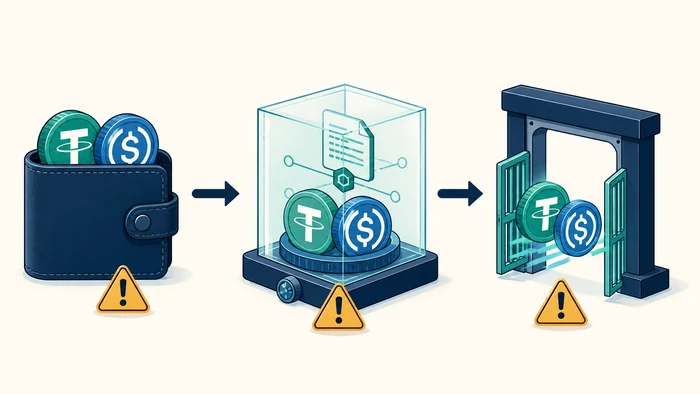
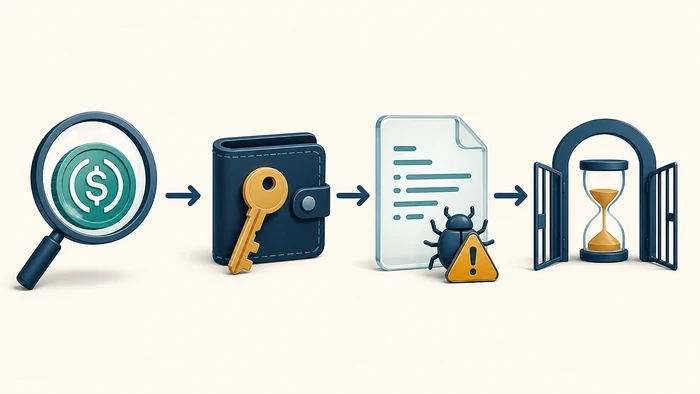
The useful question is not the headline rate alone. It is whether the route, the party or code handling the deposit, and the terms for getting funds back can all be checked before money is committed.
Why the Deposit-to-Withdrawal Chain Is the Real Risk
Most explanations of stablecoin yield stop at the interest rate. But the rate is only the outcome of a chain of decisions: which stablecoin you hold, where the yield comes from, who holds your funds while they earn, and what happens when you ask for your money back. A problem at any link in that chain can matter more than an extra percentage point of return. The rest of this article follows that chain in the order a first-time depositor actually meets it.
Step 1: What You’re Actually Holding (USDC vs USDT Issuer and Peg Risk)
Reserve backing and attestations
USDC is issued by Circle, which discloses its reserve composition weekly and provides monthly third-party assurance that reserve value exceeds USDC in circulation (Circle). Circle says USDC is backed by highly liquid cash and cash-equivalent assets and redeemable 1:1 for U.S. dollars. USDT is issued by Tether, which publishes its own circulation and reserve figures, typically updated daily, on its transparency page — this is Tether’s own disclosure, not an independent audit or formal assurance report (Tether). The disclosure format and independent assurance differ between them, and that difference is part of issuer risk.
Peg risk in practice
A peg is not a guarantee. In March 2023, USDC briefly traded near $0.87 after Circle disclosed reserve exposure to the failed Silicon Valley Bank, recovering within days once bank access was confirmed (Reuters). That event did not cause a permanent loss of the peg, but it shows that “stable” does not mean the price cannot move during a crisis, even for a stablecoin whose issuer publishes regular reserve disclosures.
Step 2: Where the Yield Actually Comes From (Yield-Source Risk)
CeFi lending desks vs DeFi lending/liquidity protocols vs algorithmic strategies
A centralized (CeFi) platform typically takes your deposit and lends it out itself, acting as the counterparty. A decentralized (DeFi) protocol, such as a lending market, instead runs on public smart contract code that borrowers and lenders interact with directly, without a company standing in the middle. Some strategies layer several protocols together to chase a higher return, which usually means more moving parts that can fail. Knowing which type you are using changes who, or what, you are actually trusting with your funds.
Smart contract and protocol exploit risk
DeFi protocols run on code, and code can contain bugs or be exploited despite audits. An exploit does not require the stablecoin itself to fail; it can drain funds directly from the protocol holding them, regardless of whether the underlying USDT or USDC is otherwise sound. Audits reduce this risk but do not remove it, since an audit only reviews the code as it existed at one point in time.
Step 3: Who Actually Holds Your Funds While They Earn (Custody Risk)
Custodial vs self-custody/non-custodial models
In a custodial setup, the platform holds the private keys and controls your funds, similar to a bank holding a deposit. In a self-custodial or non-custodial setup, the keys stay with you, and the platform can only interact with your funds through on-chain permissions you grant. This distinction decides who can freeze, delay, or lose access to your funds, independent of whether the yield strategy performs as expected.
What happens if the custodian fails
When Celsius Network filed for bankruptcy in 2022, a US bankruptcy court ruled that assets deposited into its yield-bearing “Earn” accounts belonged to the Celsius estate rather than to individual customers, which is why users were locked out for an extended period (Reuters). BlockFi and Voyager faced comparable freezes the same year. None of this means every custodial platform will fail, but it shows that custody terms, not just the yield rate, decide what happens if a platform runs into trouble.
Step 4: What Happens When You Try to Withdraw (Withdrawal Terms, Queues, and Fees)
Lock-up periods and notice requirements
Some yield products require funds to stay deposited for a minimum period, or require advance notice before a withdrawal is processed. A higher advertised rate is sometimes tied to a longer lock-up, which is a trade-off worth checking before depositing, not after.
Redemption queues and liquidity crunches
Even without a formal lock-up, a platform can pause or queue withdrawals if too many users try to exit at once and the underlying strategy cannot free up cash immediately. This is a mismatch between how quickly a strategy can be unwound and how quickly users expect to be paid, and it tends to appear during the same market stress that makes people want to withdraw in the first place.
Fees and slippage
Withdrawal, network, and performance fees reduce the amount you actually receive, and moving funds during volatile conditions can also mean paying more in network fees or accepting a worse exchange rate. Reading the fee schedule before depositing avoids an unpleasant surprise at exit.
Step 5: Mistakes That Cause Losses Before Risk Even Applies (Wrong-Chain and Approval Risk)
Sending to the wrong network
USDC and USDT both exist on more than a dozen blockchain networks, and the ticker symbol looks identical on every one of them. Sending funds to a wallet address on the wrong network is one of the most common self-inflicted losses in crypto, and it has nothing to do with a yield platform’s own risk profile. Sending a small test amount first, and confirming it arrives, is a simple way to avoid it before sending a full balance.
Unlimited token approvals and phishing
Depositing into some DeFi protocols requires granting the protocol’s smart contract permission to move your tokens, and it is possible to grant a larger or unlimited approval than the deposit itself requires. Fake support accounts and phishing sites often try to get users to sign this kind of approval. Reviewing and limiting token approvals, and only interacting with a protocol’s official site, reduces this exposure.
A Checklist for Evaluating Any USDT/USDC Yield Option
Before depositing into any platform, it helps to check: which stablecoin you would hold and how its issuer reports reserves; whether the yield comes from a CeFi lender, a DeFi protocol, or a layered strategy, and whether that protocol has been audited; whether the platform is custodial or self-custodial; the exact lock-up period, redemption type, and fee schedule; and which blockchain network the platform expects your deposit on. None of these questions has one universally correct answer; a CeFi platform, a DeFi protocol, and a self-custodial app each carry a different mix of the risks above, and the right fit depends on how much control and liquidity you are willing to trade for a given return.
How BenPay DeFi Earn Addresses the Custody and Cost Steps
BenPay DeFi Earn addresses two practical steps in this checklist. A holder authorizes a selected strategy from a self-custodial wallet instead of handing the stablecoins to a CeFi lender, and BenPay covers the gas for deposits and redemptions on BenFen. That makes it easier to move from a wallet balance into a selected DeFi strategy without paying a separate BenFen gas charge for those two actions.
The strategy remains the place to check yield and exit timing. Self-custody answers the question of who holds the private key; it does not change the issuer, smart-contract, or withdrawal risks explained earlier in this article.
FAQ
Is USDC or USDT safer to hold?
The two issuers disclose different information: Circle says USDC is backed by highly liquid cash and cash-equivalent assets, discloses reserve composition weekly, and provides monthly third-party assurance; Tether publishes its own circulation and reserve figures, typically updated daily, without describing this as an independent audit. USDC itself briefly traded near $0.87 in March 2023 during the Silicon Valley Bank crisis before recovering. Which disclosure practices matter more is a judgment call for the person holding it.
Can USDT or USDC be frozen?
Yes, at the issuer level. Tether’s Terms of Service reserve the right to blacklist a digital token address holding USDT and to freeze or confiscate funds in a user wallet, and Circle’s USDC Terms similarly allow it to block or freeze specific addresses, including in response to legal orders (Tether Terms; Circle USDC Terms). This is separate from the platform-level withdrawal freezes that occurred at CeFi lenders like Celsius during its 2022 bankruptcy.
What happens to my yield if the stablecoin depegs?
If the underlying stablecoin trades below $1, the dollar value of both your principal and any accrued yield falls with it until the peg recovers, if it does. The one confirmed instance covered above — USDC’s March 2023 dip during the Silicon Valley Bank crisis — was temporary, but a temporary dip during a large withdrawal need is still a real risk.
How long do withdrawals usually take?
It depends entirely on the platform and strategy: some allow instant withdrawal, while others impose lock-ups, notice periods, or a multi-day settlement window. Checking the redemption terms for the specific strategy before depositing is the only reliable way to know what to expect.