
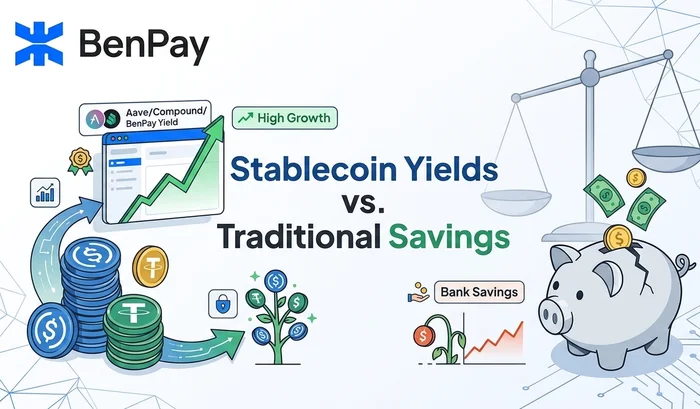
If you’re trying to decide where to park your cash, you may be wondering: is stablecoin yield actually better than a traditional savings account? On the surface, both options promise to “grow” your money, but the experience, risk, and returns are very different.
In this guide, you’ll see:
- How stablecoin yields and savings‑account APY really compare;
- When stablecoin yield makes sense (and when it doesn’t);
- How tools like BenPay DeFi Earn can simplify earning on stablecoins while keeping your funds on‑chain.
What a Savings Account Really Pays You
A savings account is what most people think of first when they want to “save safely.” You deposit money with a bank, and it earns a small interest rate—often called APY (annual percentage yield).
In 2026, a regular savings account typically pays somewhere between 0.01% and 4% APY, with some high‑yield options reaching around 4–5% APY.¹ The main advantages are:
- Your deposits are usually FDIC‑insured up to federal limits, so you’re protected if the bank fails.
- The interface is simple: you log in once, transfer money, and forget about it.
Users who want maximum safety and minimal complexity still find savings accounts very attractive.
What Stablecoin Yield is and How It Works
Stablecoin yield is the interest you earn by lending or staking stablecoins—like USDC, USDT, or DAI—through decentralized finance (DeFi) protocols. Instead of a bank, you’re earning from borrowers and protocol‑level incentives on the blockchain.
In 2026, typical stablecoin yields often range from roughly 3% to 8% APY, depending on the protocol, token, and market conditions.¹ Unlike a bank, there’s no FDIC‑style insurance, and you’re responsible for securing your own wallet and keys.
One way people simplify this is by using platforms like BenPay DeFi Earn, which connect you to multiple protocols at once and let you manage stablecoin yield in a single interface.
Stablecoin Yield vs Savings Account: Key Differences
Before you decide which is better, it helps to compare them side‑by‑side on the things that matter most: yield, safety, access, and ease of use.
Stablecoin Yield vs Savings Account: Yields and Returns
When it comes to APY, stablecoin yield often wins on paper.
- Typical savings account APY (2026): 0.01%–5% depending on the bank and product.¹
- Typical stablecoin yield (DeFi): ~3%–8% APY, depending on the protocol and risk.¹
The catch? Stablecoin yields are not guaranteed. They depend on borrowing demand, protocol health, and overall market conditions.
If you’re comfortable with that uncertainty and want to chase higher returns, stablecoin yield can be an interesting part of your strategy.
Stablecoin Yield vs Savings Account: Safety and Insurance
When people ask “is stablecoin yield safer than savings?”, the answer is usually no—in the way banks are safe.
A savings account is usually FDIC-insured up to $250,000 per depositor, which means you’re protected even if the bank fails (up to the limit). Stablecoin yield carries a different risk profile:
- Smart-contract risk: Bugs or exploits in the underlying protocol.
- Protocol risk: Liquidity issues, bad actors, or regulatory changes.
- Reserve-backing risk: Some stablecoins depend on collateral quality.
You still have control over your assets (self-custody), but that also means you carry more responsibility.
Stablecoin Yield vs Savings Account: Access, Speed, and Fees
How quickly can you move money, and how much does it cost?
- Savings accounts: 1–3 day transfers between banks. Operating hours and some fees for certain services.
- Stablecoin yield (DeFi): 24/7 operation, near‑instant settlement on many chains. Low fees, though gas or network‑fee spikes can appear.
If you value constant access and fast transfers, stablecoin yield and DeFi-earn platforms usually feel more flexible.
Stablecoin Yield vs Savings Account: Experience and Tech Barrier
For many people, the user‑experience gap is the biggest hurdle.
- Savings accounts: Very low‑tech; almost everyone can use them.
- Stablecoin yield / DeFi: Requires a crypto wallet, network‑switching, gas management, and comfort with self‑custody.
Some platforms, like BenPay DeFi Earn, aim to narrow this gap by letting you deposit and redeem with one‑click actions instead of manually interacting with multiple protocols.
When Stablecoin Yield Is Better Than a Savings Account
Stablecoin yield isn’t “better” for everyone, but it can be better for certain types of users.
Stablecoin yield is better when you…
- Are comfortable with crypto and self‑custody.
- Want higher APY than typical savings or high‑yield accounts.
- Need 24/7 access and fast transfers instead of bank‑hours.
- Don’t mind managing a wallet and accepting some protocol risk.
For these users, stablecoin yield can be a smart way to boost returns without completely leaving your base in savings accounts.
Stablecoin yield is not better when you…
- Prioritize FDIC‑style insurance and maximum safety.
- Dislike tech complexity or wallets.
- Want something you can “set and forget” with zero maintenance.
If that sounds like you, sticking mostly with savings accounts and using only a small portion for stablecoin yield is often the safer choice.
How Stablecoin Yield Actually Works
You don’t need to be a DeFi expert to understand stablecoin yield. At a high level, it looks like this:
- 1. You lend your stablecoins (for example USDC or USDT) to a protocol.
- 2. Borrowers pay interest to use that capital.
- 3. The protocol and its incentives distribute that interest back to you, often in the form of APY.
Popular lending protocols include Compound, Aave, Morpho, and others, which power many DeFi‑earn products. BenPay DeFi Earn, for example, connects to multiple protocols and lets you earn yield on stablecoins without managing each one separately.
Because everything runs on the blockchain, you can often verify your positions on‑chain, which adds transparency compared with traditional banking.
How to Start Earning on Stablecoins (Step-By-Step)
If you’re ready to try stablecoin yield, this simple process can help you get started.
Step 1: Choose Your Stablecoin
Most users start with USDC or USDT because they’re widely available, heavily audited, and used across many protocols. Make sure you understand the basics of how each stablecoin is backed (reserves, collateral, etc.) before depositing large amounts.
Step 2: Secure Your Wallet
Self‑custody means you’re responsible for your funds.
- Use a reputable wallet (hardware or software) and keep your seed phrase offline.
- Enable 2FA and avoid sharing your keys with anyone.
Step 3: Connect to a Platform like BenPay DeFi Earn
Many users choose to work through a unified DeFi-earn platform like BenPay DeFi Earn instead of managing each protocol directly.
Here’s what that looks like in practice:
- 1. Install or log in to BenPay and connect your wallet.
- 2. Go to the DeFi Earn section and select your stablecoin (for example USDC).
- 3. Choose a yield option from the listed protocols.
- 4. Click Deposit or Start Earning and confirm the transaction.
Right after that, your stablecoins begin earning yield, and you can see your balance and APY in your dashboard.
Because BenPay DeFi Earn is non-custodial, your funds stay on-chain and you retain full control.
Step 4: Monitor and Manage Your Yield
Once you’ve started:
- Check your APY regularly, since rates can change.
- Track your token balance and verify positions on‑chain if you want extra confidence.
- Withdraw or redeposit as your goals or risk tolerance changes.
Remember: some pools may have slight delays or gas costs when you move money, but this is usually much faster than traditional bank-to-bank transfers.
Risk vs Reward: A Clear Stablecoin Yield vs Savings Snapshot
Before you decide, it helps to see the trade-offs side-by-side.
Stablecoin Yield: Main Risks
- Smart-contract and protocol risk (bugs, hacks, insolvency).
- Regulatory and macro risk (policy changes, market shifts).
- Reserve-backing risk for some stablecoins.
You usually get higher APY in exchange for taking on these risks.
Savings Accounts: Main Risks
- Lower returns than stablecoin yield when APY is low.
- Rate risk: APY can drop if interest-rate policy changes.
- Bank‑failure risk only above FDIC limits (up to $250,000 per depositor).
If you want maximum safety and simplicity, savings accounts are still a strong base.
How BenPay DeFi Earn Reduces Complexity Risk
BenPay DeFi Earn doesn’t eliminate protocol risk, but it reduces complexity:
- You don’t need to manage multiple protocols, chains, or bridges by yourself.
- All operations are visible on‑chain, so you know where your funds are.
- The interface is designed to be simple and intuitive, even if you’re not a DeFi pro.
This makes it easier for more users to try stablecoin yield without diving deep into technical details.
Practical Tips Before You Choose Stablecoin Yield
Before you move money from a savings account into stablecoin yield, ask yourself a few questions.
1. How Much Risk Can You Tolerate?
- If you’re risk-averse, keep your emergency fund and core savings in a bank account.
- If you’re risk-tolerant, you can allocate a smaller portion to stablecoin yield for higher returns.
2. How Tech‑Comfortable Are You?
- If you’re comfortable with wallets, networks, and on-chain tools, stablecoin yield feels natural.
- If that sounds overwhelming, you might want a simpler platform like BenPay DeFi Earn that hides much of the complexity.
3. Do You Need FDIC-Style Insurance?
- If you need FDIC-style protection, rely mainly on savings accounts and treat stablecoin yield as a side-strategy.
- If you’re okay with transparency‑based security (on-chain, self-custody), stablecoin yield becomes more attractive.
You can also check transparency features and support pages like BenPay’s support FAQ to see how clear a platform is about its design and risk model.
Case Example: Stablecoin Yield vs Savings Over Time
To make this more concrete, imagine you have $10,000 you’re deciding between a savings account and stablecoin yield.
Simple APY Comparison
| Scenario | Approx. APY (2026) | 1‑Year Earned | 3‑Year Earned* |
|---|---|---|---|
| Traditional savings | 1–2% | $100–$200 | ~$300–$600 |
| High-yield savings | 4–5% | $400–$500 | ~$1,300–$1,600 |
| Stablecoin yield (e.g., 6% APY) | 6% | $600 | ~$1,900 |
*Compound interest; simplified for illustration.
This shows that stablecoin yield can grow your capital faster, but those numbers are not guaranteed and depend on protocol health and market conditions.
If you choose a platform like BenPay DeFi Earn, you can still earn similar yields while simplifying the user experience and keeping your funds on‑chain.
How BenPay DeFi Earn Fits Into Stablecoin Yield
BenPay DeFi Earn is designed for users who want higher yields than a savings account but dislike the complexity of managing multiple DeFi protocols.
Core Features That Matter
- One-click access to multiple protocols (for example Solana, Compound, Aave, Morpho, Sky, and Ethena).
- Non-custodial model: Your funds are not held by BenPay; they stay on-chain.
- On-chain transparency: You can verify your deposits, withdrawals, and balances publicly.
This removes a lot of the technical friction while still giving you the benefits of DeFi yield.
Who BenPay DeFi Earn Is Best For
BenPay DeFi Earn usually works best for users who:
- Want higher APY than traditional savings.
- Prefer self‑custody and transparency over FDIC-style insurance.
- Don’t want to manage cross-chain bridges and protocol-level details manually.
If that sounds like you, BenPay DeFi Earn can be a practical way to start earning on stablecoins without becoming a full-time DeFi power user.
Combining DeFi Earn With Real-World Spending
If you also use the BenPay Card, you can combine your DeFi-earned stablecoins with everyday spending.
For example:
- Earn yield on stablecoins in DeFi Earn.
- Use the BenPay Card to spend those rewards or convert them into fiat-like spending power.
This connects on-chain yield with real-world purchases, all inside one platform.
Common Questions About Stablecoin Yield vs Savings
Here are answers to questions people often search for when comparing stablecoin yield and savings accounts.
1. Is stablecoin yield safer than a bank savings account?
No, not in the way a bank is.
- Savings accounts are usually FDIC-insured up to limits.
- Stablecoin yield relies on protocol design, audits, and on-chain security instead of government insurance.
If you need absolute safety, savings accounts are still the safer base.
2. Can you lose money in stablecoin yield?
Yes, you can.
- Smart‑contract exploits, protocol failures, or slashing can lead to losses.
- Some stablecoins may depeg if their reserves are mismanaged.
That’s why it’s usually wise to only put in what you can afford to lose and keep your emergency fund in safer options.
3. How is BenPay DeFi Earn different from a savings account?
- No FDIC insurance, but non-custodial, on-chain flows and transparent dashboards.
- Designed to connect you to multiple DeFi protocols with one-click actions.
- Best for users who want higher yields and more control, not maximum safety.
If you prefer safety and simplicity, stick with savings accounts. If you want higher returns and are comfortable with self-custody, BenPay DeFi Earn can be a streamlined way to access stablecoin yield.
Is Stablecoin Yield Better Than a Savings Account?
The quick answer is: stablecoin yield can pay more, but it’s not safer or simpler than a savings account.
If you’re:
- Tech-comfortable,
- Risk-tolerant, and
- Looking for higher APY than what most banks offer,
then stablecoin yield is often a better fit—especially when you use a simple, transparent platform like BenPay DeFi Earn.
If you prefer FDIC-style safety and minimal maintenance, a savings account is still the better choice for your core savings.
Whichever you choose, the smart move is usually a mix: keep your emergency fund in savings and use only a portion of your capital for stablecoin yield so you get both safety and upside.