

DeFi Market Recovers as On-Chain Yields Gain Renewed Attention
According to the latest statistics from RootData, in June 2026, the disclosed total financing in the primary crypto market reached approximately $898 million, across 42 funding events. Among these, the DeFi sector led with 18 financing rounds, covering areas such as stablecoins, liquidity protocols, on-chain trading, and yield strategies.
These figures reflect that market capital is continuing to show sustained interest in DeFi applications that are closer to real-world use cases. As the number of DeFi protocols grows and yield opportunities become more dispersed, how to lower the barriers to participating in on-chain yields and enable more users to utilize DeFi more efficiently has become a topic worth paying attention to in the industry.
DeFi Offers More Yields, But Getting Started Is Becoming Harder
In theory, DeFi offers users an open financial market. Users can combine different protocols to build their own on-chain yield strategies, for example:
- Depositing stablecoins into lending protocols to earn interest;
- Participating in liquidity pools to earn fee rewards;
- Using yield optimization protocols to improve capital efficiency;
- Adjusting asset allocations in response to market changes.
However, in practice, everyday users often have to navigate multiple complex steps. The issue with DeFi has gradually shifted from “whether there are yields” to how to screen yields, understand risks, and continuously manage one’s own positions.
- Fragmented Yield Opportunities: Yields Are Spread Across Multiple DeFi Protocols
Currently, the DeFi ecosystem contains a large number of different types of yield protocols. Each protocol differs in its APY calculation method, reward cycle, whether it auto-compounds, redemption rules, and fee structure. For users familiar with DeFi, this means spending a significant amount of time researching and comparing.
For ordinary users without a technical background, these differences alone already pose a barrier to entry.
A typical DeFi yield-seeking process often requires users to toggle back and forth between multiple protocols. At 11 p.m., after putting his kids to bed, John — a programmer — opens his laptop, hoping to invest his bonus. He pulls up AAVE, Compound, and Morpho in three side‑by‑side tabs to compare USDC interest rates. One says “includes compounding,” another says “simple interest,” and the third only gives a 7‑day average… An hour later, his coffee has gone cold, he has over a dozen browser tabs open, and he still isn’t sure which one to choose. In the end, he sighs and closes his laptop: “I know each of these individually, but putting them together feels like reading a foreign language.”
This is the real picture of fragmented information — it’s not that yield opportunities are lacking; it’s that they are buried across a dozen tabs and countless differences in definitions. Every protocol is like an isolated island, with its own language, its own clock, and its own rulebook. What users need is not just to compare numbers, but first to translate more than a dozen different “dialects.”
- Complex Operations: Multiple Wallets, Chains, and Approvals Increase User Costs
Even if users find a yield project they want, the actual participation process remains fairly complex.
In traditional DeFi operations, users need to create a Web3 wallet, transfer the corresponding chain’s gas tokens into that wallet, and then connect their wallet, approve assets, and confirm transactions on each protocol separately.
If different yield opportunities are spread across different chains (for example, AAVE on Ethereum, Morpho on Base, and Spark on Arbitrum), users also have to deal with cross-chain bridge operations: transferring assets across chains while making sure they have enough gas fees on the destination chain.
For experienced DeFi users, this is just an added operational cost. But for newcomers trying DeFi for the first time, these steps become a major barrier to participation.
For first-time DeFi users, the whole process feels less like a simple asset allocation and more like a complicated on-chain workflow.
On a Saturday afternoon, product manager Candice decides to give DeFi a try. She spends 20 minutes withdrawing funds, connecting her wallet, approving, and paying gas fees. After finally depositing into AAVE, she realizes that Morpho — her protocol, which she also wants to invest in — is on Base, so she has to bridge her assets and buy more gas. By the time she finishes everything, it’s already dark outside. Rubbing her eyes, she says, “I just wanted to deposit some money — how did I end up spending an entire afternoon?”
That is the harsh reality of cumbersome operational processes — it’s not that users don’t want to participate; it’s that the cost of participation (time, effort, gas, cognitive load) has already far exceeded what ordinary people find acceptable for personal finance. Every confirmation is a psychological hurdle, and every network switch is a potential drop‑off point.
- Difficult Portfolio Management: More Fragmented Assets, Higher Management Costs
When users participate in multiple DeFi protocols simultaneously, how to manage everything in a unified way becomes a new problem.
Each protocol has its own dashboard, so users have to log in separately to check balances and yield changes, manually track them, or create their own Excel sheets to consolidate all their positions.
Once they want to adjust their strategy, they have to go through withdrawals, cross-chain transfers, approvals, and reinvestments separately for each protocol — a process that is both time-consuming and error-prone.
The larger the capital size and the greater the number of protocols, the more pronounced the management difficulty becomes. For many users, the biggest issue with DeFi is no longer insufficient yields — it’s that managing on-chain yields itself has turned into an extra job.
For example, on a Sunday morning, Jimmy — a freelancer — is involved in multiple DeFi protocols at the same time. Every month, he needs to log in to different wallets and organize his yield records. When he wants to adjust his strategy, he also has to withdraw, bridge, and re‑approve.
That is the essence of the position management problem — the more dispersed the funds, the heavier the cognitive burden; the more complex the yields, the harder it is to make rational decisions. When users have to rely on screenshots and manual bookkeeping to manage their own assets, DeFi ceases to be an efficient value‑adding tool for them.
Why Is One-Click DeFi Earn Becoming a Trend?
The complexity of the DeFi yield ecosystem has already exceeded the capacity of ordinary users. When DeFi first emerged in 2020–2021, users only needed to access two or three protocols on Ethereum mainnet (such as Uniswap and Compound) to earn decent yields. At that time, there were fewer choices, a single chain, and relatively simpler operations. But by 2026, the situation is completely different:
Driving Force 1: The Rapid Growth of DeFi Protocols Makes It Difficult for Users to Evaluate Them Individually
According to DeFi Llama data, there are currently over 1,800 DeFi protocols across the entire network, with hundreds of active lending, liquidity, and yield strategy protocols alone.
For professional investors, researching protocols, analyzing risks, and comparing yields is a capability.
But for ordinary users, reading through technical documentation, audit reports, interest rate models, and risk parameters one by one is simply not realistic.
When the number of choices exceeds users’ processing capacity, an aggregation layer naturally becomes a need. The value of DeFi aggregator products lies in helping users filter, display, and connect different yield opportunities.
Driving Force 2: The Multi-Chain Era Requires a Unified Entry Point
Multi-chain development has expanded DeFi’s possibilities but has also increased usage complexity. Users want to access yield opportunities across different ecosystems, but they do not want to:
- Manage multiple wallets;
- Hold different Gas Tokens;
- Bridge assets manually;
- Handle complex transactions.
Therefore, a gateway layer that hides the underlying chain complexity has become critical infrastructure for driving DeFi mass adoption.
Driving Force 3: DeFi Is Evolving from Technology-Driven Products to User-Centric Experiences
Early DeFi users were primarily crypto-native. They were willing to research protocol mechanisms, manage private keys, and manually execute on-chain transactions. But today, an increasing number of non-technical users are starting to pay attention to on-chain yields:
- Users holding stablecoins who want to improve capital efficiency;
- Enterprises or DAOs managing on-chain treasury funds;
- Everyday users seek transparent on-chain yields.
What these users expect is an experience similar to a financial app: clearly displayed yields, simple participation, unified asset viewing, and easy exits.
This means DeFi needs an additional productized gateway layer. One-click DeFi Earn is precisely an important form that has emerged under this trend.
Driving Force 4: Market Capital Is Validating the Demand for DeFi Yields
According to a Keyrock report, in 2025, the assets under management for automated on-chain yield strategies reached approximately $17.5 billion, surpassing the peak of the previous bull market. More importantly, this growth was not driven by liquidity mining token incentives, but by genuine demand — users and institutions actively seeking safe, transparent, and convenient on-chain yield channels.
Gate Ventures, in its 2026 outlook, also listed “institutional-grade DeFi yield platforms” as one of the five major structural trends. When market capital and user demand both points in the same direction, it is no longer an “option” — it becomes a “must.”
From a broader perspective, one-click DeFi Earn is essentially a key part of DeFi’s “user-friendliness” evolution: shifting from a “protocol-directly-facing-users” model to an intermediary-layer model of “aggregator + gateway.”
BenPay is a Web3 application gateway built on the BenFen public chain. Leveraging the on-chain infrastructure capabilities provided by BenFen, it offers users a simpler experience in payments, asset growth, and DeFi usage. As part of this trend, BenPay has launched DeFi Earn. And as a part of the Bixin Group ecosystem, its product philosophy also carries forward the direction of lowering Web3 adoption barriers and connecting more on-chain applications.
BenPay DeFi Earn: An Aggregation Layer Connecting Users to On-Chain Yield Opportunities
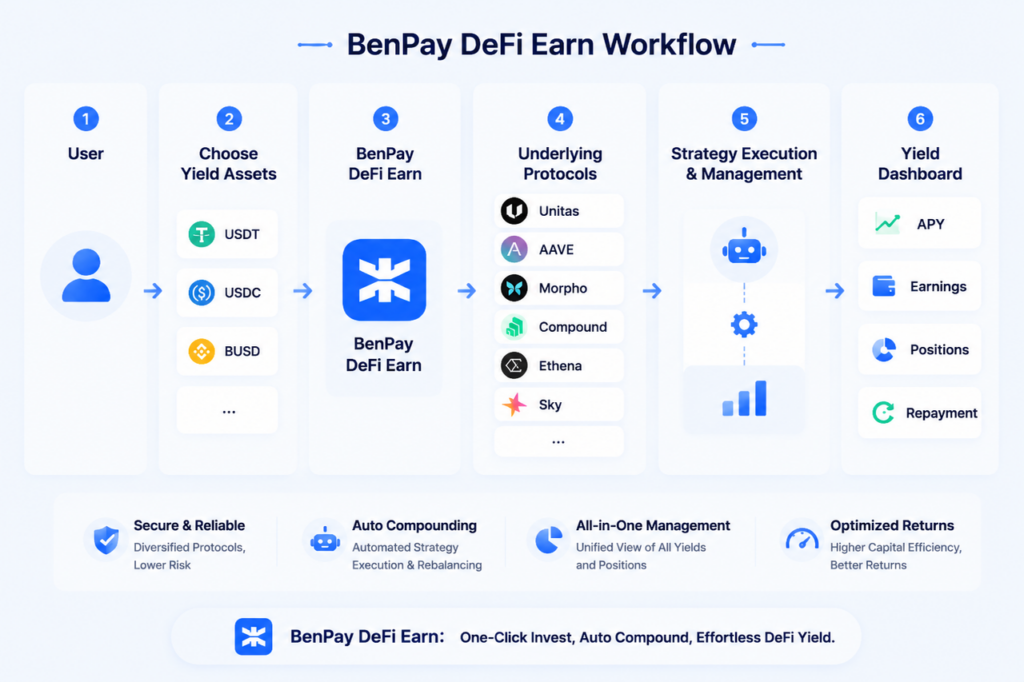
BenPay DeFi Earn is a one-click DeFi yield gateway within the BenPay ecosystem. It aggregates multiple on-chain DeFi investment opportunities, allowing users to participate in various yield strategies using USDT, USDC, or BUSD, while viewing APY, positions, earnings, redemption rules, and protocol fees all in one unified interface.
BenPay DeFi Earn: How It Works
The basic process of BenPay DeFi Earn can be broken down into three steps:
Step 1: Choose a Yield Opportunity
Users enter the DeFi Earn page and browse different yield opportunities based on their needs, including:
- Estimated APY;
- Asset type;
- Redemption cycle;
- Yield source.
Step 2: Deposit Stablecoin Assets
Users select the amount they wish to invest, using assets such as USDT, USDC, or BUSD. After confirmation, the assets are directed into the underlying DeFi protocols according to the corresponding strategy.
Step 3: View Yields in One Place
Users no longer need to log in to different protocols separately. They can view the following directly within the BenPay interface:
- Current invested amount;
- Position changes;
- Cumulative earnings;
- Yield performance.
Step 4: Redeem According to the Rules
When users need to exit, they can initiate a redemption based on the project’s rules. Different projects may have different liquidity mechanisms:
- Instant redemption;
- Short confirmation period;
- T+ cycle settlement.
Specific rules are subject to the details shown on the project page.
From Managing Individual DeFi Protocols to a Unified BenPay DeFi Gateway: A Better User Experience
DeFi yield opportunities are becoming increasingly abundant, yet users still face challenges such as fragmented protocols, multi-chain operations, and complex yield management. BenPay DeFi Earn does not alter the underlying logic of DeFi protocols. Instead, it provides a unified gateway between users and multiple on-chain yield opportunities, reducing the cost of participation and management.
| User Need | Traditional DeFi Approach | BenPay DeFi Earn |
| Finding yields | Users need to research AAVE, Compound, Morpho, and other protocols individually, comparing APYs, yield sources, and risks | Aggregates multiple DeFi yield opportunities in one place, making it easier to compare different options |
| Wallet management | Users need to manage Web3 wallets, multi-chain assets, and gas tokens | Reduces multi-chain complexity through a unified gateway |
| Transaction execution | Each protocol requires users to connect wallets, approve assets, and confirm transactions separately | Simplifies the participation process and reduces repetitive interactions |
| Cross-chain operations | Users must handle asset bridging, gas fees, and network switching on their own | Lowers the barrier to cross-chain operations and reduces friction between different networks |
| Yield tracking | Users need to access multiple dashboards and manually track earnings and positions | View assets, yields, and position changes through a unified interface |
| Strategy management | Users need to withdraw, bridge assets, and redeposit into different protocols | Makes it easier to manage multiple yield opportunities |
As can be seen from the comparison above, BenPay DeFi Earn does not solve the problem of DeFi yields themselves, but rather the efficiency issues in the user participation process.
The underlying yields still come from on-chain protocols, and smart contract risks, market volatility risks, and liquidity risks remain. However, through unified display, multi-protocol aggregation, and streamlined operations, users can reduce the costs of frequently switching between protocols, bridging across chains, and manually managing positions.
For users, the change is not that “DeFi has become risk-free,” but that “the path to participating in DeFi has become clearer.”
BenPay DeFi Earn: Supported Yield Opportunities
Currently, BenPay DeFi Earn has selected a number of mainstream DeFi protocols that have been long‑term validated by the market as yield sources, covering the following directions:
- Major Lending Protocols
Depositing stablecoins into lending markets to earn deposit interest is the most common and relatively conservative yield approach.
- AAVE: The most established lending market on Ethereum and multiple chains, supporting deposits in various stablecoins. It has a strong security track record and includes risk control mechanisms such as a Safety Module. Currently offers investment options such as USDC and USDT, with APY varying in real time based on market supply and demand.
- Compound: A long‑standing lending protocol known for its algorithmic interest rate model, providing relatively stable yield options on assets such as USDT and USDC.
- Morpho: An optimization protocol built on top of AAVE and Compound, which improves depositor yield efficiency through a peer‑to‑peer matching mechanism. It is currently an active yield‑enhancement option.
- Stablecoin Yield Protocols
These protocols focus on yield optimization for stablecoins, often employing different strategies. They offer relatively higher yield potential, but also come with certain strategy‑related risks.
- Ethena: Adopts a Delta‑neutral strategy to effectively hedge against price volatility risk, primarily capturing funding rates from perpetual contracts. In a positive funding rate environment, it can offer relatively attractive annualized yields.
- Sky / Spark: Sky Protocol (formerly MakerDAO) is a cornerstone in the DeFi stablecoin space. Its official savings system generates real yield by investing in U.S. Treasury bonds and on‑chain credit operations, distributing the system surplus to users in the form of a savings deposit rate (SSR). After users deposit funds, their receipts accumulate assets that automatically appreciate over time (with a one‑way increasing exchange rate), allowing yield growth without any manual intervention.
- Unitas: An emerging stablecoin yield protocol that adopts a unique asset collateralization and yield distribution model. BenPay will continuously evaluate its protocol security and yield performance.
Who is BenPay DeFi Earn suitable for?
The core value of BenPay DeFi Earn lies in “lowering barriers” and “improving efficiency.” The following types of users are especially well‑suited for this product:
- DeFi beginners who want an easier way to access on-chain yields
For users new to DeFi, there are steep learning curves involved in researching protocol mechanisms, setting up wallets, understanding gas fees, and completing approval transactions.
BenPay DeFi Earn brings yield projects, operational processes, and earnings displays together into a single, unified interface, helping users more easily understand and participate in on‑chain yields.
- Stablecoin holders who want to improve capital efficiency
Many users hold stablecoins such as USDT and USDC, but their funds sit idle in wallets for extended periods.
BenPay DeFi Earn provides a convenient yield gateway for these users, allowing them to allocate assets across different yield strategies and view their invested amounts, earnings changes, and position status all on one unified page.
- DeFi users managing multiple protocols who want to reduce management costs
For users already participating in DeFi, managing several protocols such as AAVE, Compound, and Morpho simultaneously means frequently switching between platforms, checking yields, and adjusting positions.
BenPay DeFi Earn aggregates multiple yield opportunities, helping users reduce repetitive operations and manage their on-chain assets more efficiently.
- Users who want to simplify cross-chain operations and reduce multi-chain complexity
With the multi-chain development of the DeFi ecosystem, yield opportunities are increasingly distributed across different networks. Users have to deal with wallet switching, Gas Token management, network selection, and cross-chain operations — all of which further raise the barrier to entry.
BenPay DeFi Earn reduces multi-chain complexity through a unified gateway, helping users lower the cost of interacting with underlying chains. Additionally, within the BenFen ecosystem, BenPay supports the Sponsor Transaction (gas subsidization) mechanism, allowing users to complete certain on-chain operations without needing to hold gas assets on the respective chain in advance — further lowering the barrier to Web3 usage.
- Users with limited time who want a simpler way to manage DeFi yields
For busy users or those who do not wish to spend long hours researching the market, logging in to multiple protocols every day to check yields and adjust strategies is simply impractical.
BenPay DeFi Earn centralizes yield information and asset status in one place, allowing users to participate in on-chain yields with lower management costs.
Conclusion: The Future of DeFi Yield Opportunities
The future of DeFi yields is not about lowering yield opportunities, but about reducing participation complexity. As stablecoins, on-chain asset allocation, and yield protocols continue to evolve, what users need is not just more protocols, but simpler, more transparent, and more manageable gateways.
BenPay DeFi Earn, as part of the Bixin Group Web3 ecosystem layout, helps users more efficiently understand and participate in on-chain yields through aggregated displays, a unified gateway, and position management.
As DeFi gradually shifts from protocol-driven to user experience-driven, one-click yield entry points will become an important infrastructure connecting users with on-chain finance. In the future, lowering the usage threshold and enhancing the efficiency of asset allocation will become important directions for promoting the wider application of DeFi.
BenPay DeFi Earn – Frequently Asked Questions (FAQ)
- Is BenPay DeFi Earn a custodial product?
No. BenPay DeFi Earn operates in a non-custodial model. Your assets remain under your control at all times, and BenPay cannot access or move your funds.
- How are yields calculated and distributed?
Yields on BenPay DeFi Earn come from the underlying DeFi protocols. The system automatically collects and displays them in a unified interface. APY is real-time and floating; historical data does not guarantee future returns
- Can I redeem my funds at any time?
It depends on the selected project. Some support instant redemption, while others have a settlement cycle (e.g., T+10). Please refer to the rules shown in the interface.
- Is BenPay DeFi Earn suitable for beginners?
Yes. BenPay DeFi Earn is designed specifically to lower the barrier to DeFi participation. Beginners can get started with one click, but they still need to understand the basic risks involved.
Risk Disclaimer: DeFi yield activities carry significant risks, including but not limited to smart contract risks, market volatility risks, liquidity risks, and underlying protocol risks. BenPay DeFi Earn does not promise any fixed returns. All APY figures are historical data and do not represent future performance. Users bear full investment risk. Please fully understand the rules before participating and ensure that you have the appropriate risk tolerance.