
BenPay Wallet: A Self-Custodial Web3 Privacy Wallet for Enterprises and Individuals
As Web3 adoption grows, users are realizing that most blockchain wallets are transparent by default. Anyone can trace wallet balances, transaction histories, and payment relationships on public blockchains.
This creates real risks for:
- Individuals who value financial privacy
- Teams paying contributors on-chain
- Companies managing salaries, suppliers, and treasury flows
Once a wallet address is linked to a real identity (through an exchange withdrawal, KYC onboarding, or public payment), every past and future transaction becomes traceable. This level of transparency may be useful for open ledgers, but it is impractical for real-world payments.
This is where privacy wallets come in — and where BenPay Wallet stands out as a self-custodial Web3 wallet built for real-world payments with privacy, efficiency, and compliance in mind.
What Is a Privacy Wallet?
A privacy wallet is a crypto wallet designed to protect users from on-chain tracking and financial exposure. Instead of exposing every detail publicly, privacy wallets reduce how much sensitive information is visible on-chain.
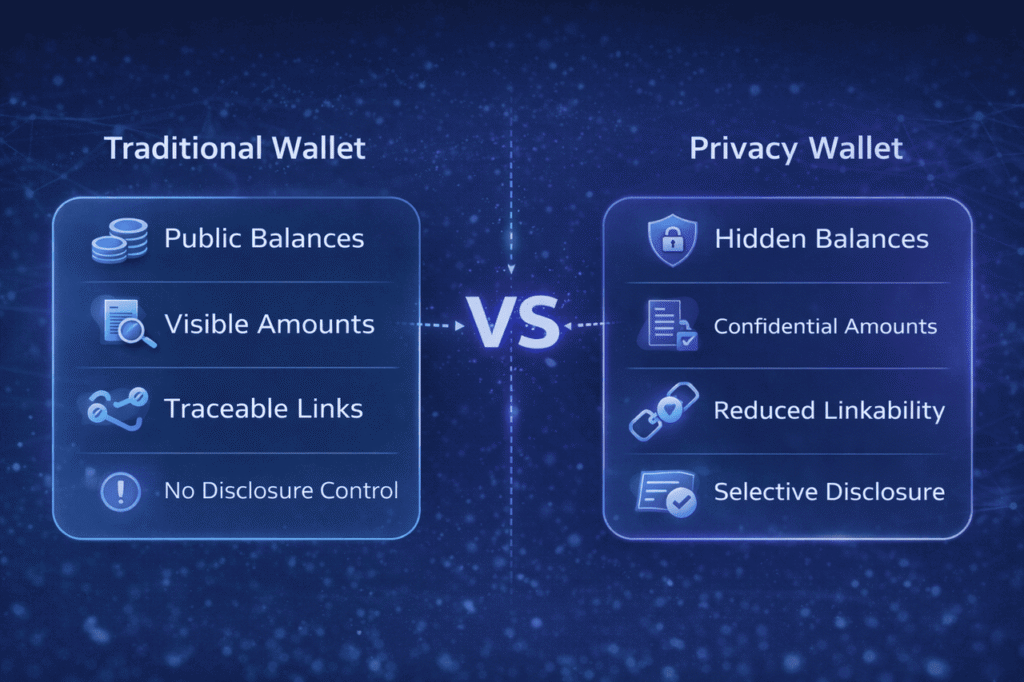
Unlike traditional wallets, privacy wallets aim to:
- Hide or obfuscate transaction amounts
- Reduce linkability between addresses
- Support selective disclosure in compliance or audit scenarios
Privacy technology in crypto was popularized by early systems such as Zcash and privacy protocols like Tornado Cash. These early solutions achieved strong privacy capabilities, such as hiding transaction amounts, fragmenting transaction paths, and anonymizing addresses, using zero-knowledge proofs or mixer mechanisms, which were a technical breakthrough. However, most early privacy solutions existed as standalone tools or separate ecosystems, which limited real-world adoption due to usability and compliance challenges:
- High usage threshold for ordinary users
- Disconnection from mainstream wallets and payment flows
- High compliance and auditing costs for enterprises
The direction of the new generation of privacy wallets has changed. Instead of treating privacy as an add-on plugin or external tool, modern privacy wallets integrate privacy capabilities directly into everyday payment flows.
A new generation of privacy wallets, including BenPay, integrates confidentiality into basic operations such as sending, receiving, and batch payments, making confidential crypto payments usable, scalable, and compliance-friendly — without forcing users to change their existing workflows.
Why Don’t Normal Crypto Wallets Have Privacy?
The vast majority of mainstream crypto wallets are designed in accordance with the default transparency principle of blockchain. In a public chain environment, anyone can view wallet-related information through a block browser or on-chain analysis tools, including:
- Wallet balances publicly
- Transaction amounts on-chain
- Counterparty relationships
- Historical activity patterns
Once an address is associated with a person or organization, third parties can:
- Estimate net worth
- Analyze spending behavior
- Infer business relationships
- Monitor payroll and supplier payments
In real-world finance, such complete transparency is uncommon. For individuals, this creates personal safety and data privacy risks. For companies, it exposes commercial intelligence and internal financial structures.
This is the core problem privacy wallets are designed to solve: not to eliminate blockchain verifiability, but to establish a reasonable boundary between transparency and privacy.
Against this backdrop, modern privacy wallets are shifting from experimental tools to practical payment infrastructure. BenPay Wallet follows this direction by making privacy a default, usable payment experience rather than an advanced feature dependent on complex workflows or third-party tools.
How BenPay Wallet Enables Confidential Crypto Payments
BenPay Wallet is a self-custodial Web3 wallet application built on BenFen Chain, a blockchain designed with default on-chain privacy and selective disclosure at the protocol level.
Privacy is therefore not added later through mixers or plugins. Instead, it is provided natively by the underlying chain architecture and exposed through BenPay’s user interface. This allows payments to remain private by default while still supporting selective disclosure for auditing or compliance when required.
In real-world Web3 scenarios, many operations can technically be implemented with privacy features. However, they often still rely on a certain degree of public verifiability, for example:
- Cross-chain deposits and withdrawals (most bridges rely on publicly verifiable balances and locked asset states)
- DeFi interactions (the majority of protocols operate based on a transparent on-chain state)
- Public asset verification (investors and regulators may require explicit numerical disclosures)
- Treasury reporting (often subject to compliance and audit requirements)
Therefore, modern privacy wallets should not adopt a single-mode approach of either “fully private” or “fully transparent.”
To balance infrastructure-level privacy with real-world operational needs, BenPay Wallet introduces a dual-mode wallet design at the product layer.
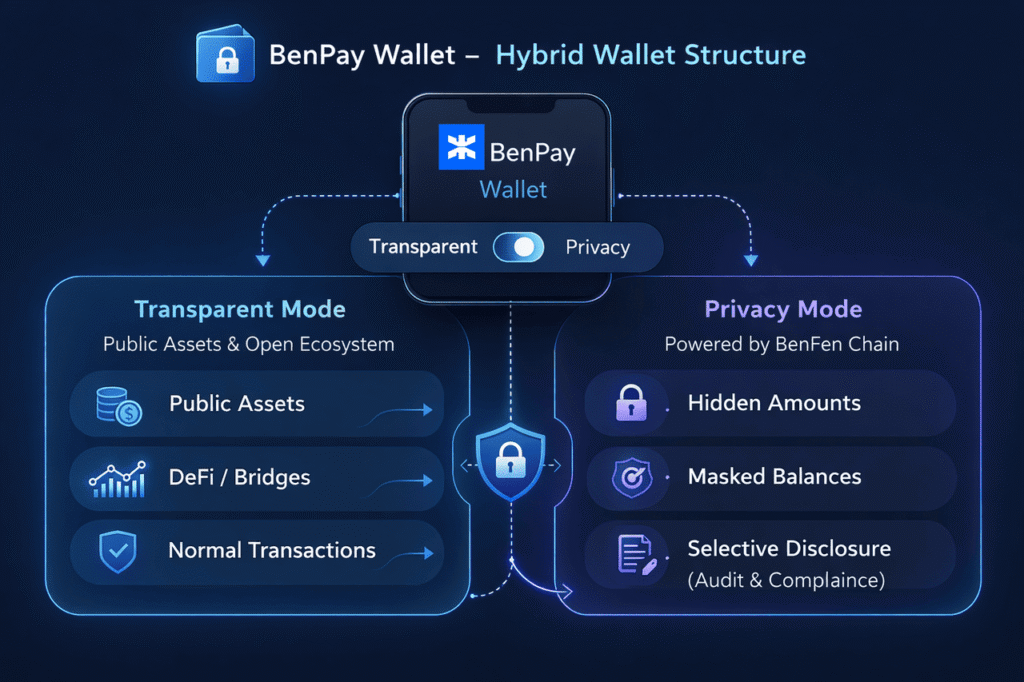
BenPay Wallet’s Hybrid Privacy Design
- Transparent Wallet Mode Users interact with public assets and standard on-chain applications when transparency is required.
- Privacy Wallet Mode (Powered by BenFen Chain) When users enter Privacy Wallet mode, assets leverage BenFen Chain’s default privacy model:
- Transaction amounts are hidden on-chain
- Counterparty relationships are obfuscated
- Balances are masked from public explorers
- Selective disclosure allows compliance and auditing
This design allows privacy to be the default capability of the chain, while privacy becomes an intentional user choice at the wallet level — aligning with how enterprises and individuals actually operate.
Technical Implementation Mechanism: FAST MPC-Driven Regulated Privacy Architecture
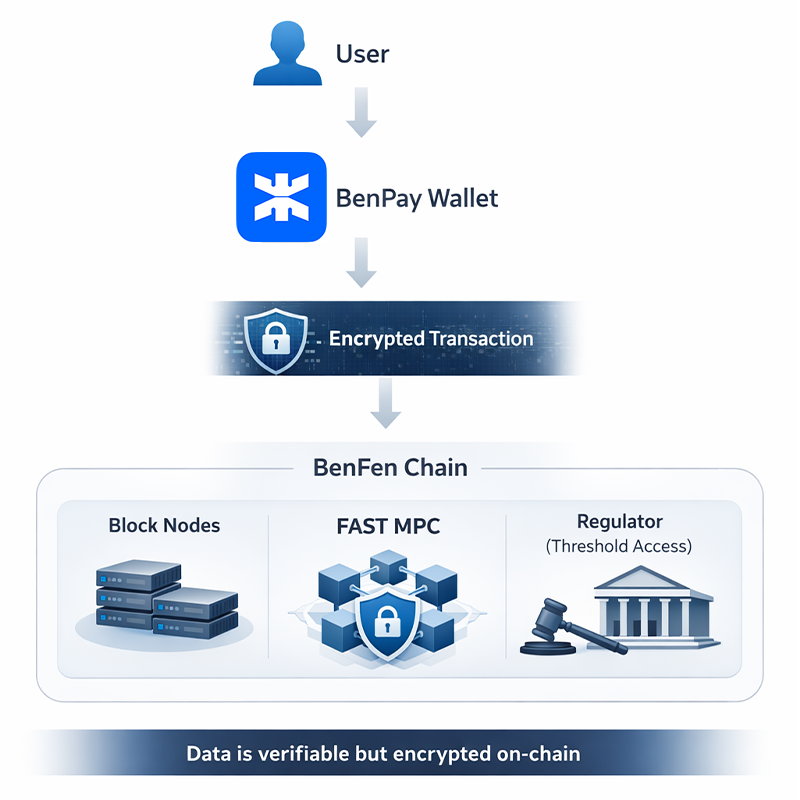
In terms of the underlying implementation, BenFen Chain, on which BenPay relies, adopts a confidential transaction architecture that integrates blockchain nodes (Block Node), FAST multi-party computation (FAST MPC), and regulatory intervention mechanisms (Regulator), achieving a privacy payment model where “data is available but not visible”.
The core design concept is: under the premise of ensuring the verifiability and compliance of transactions, keeping the sensitive data on-chain always encrypted.
Key Privacy Payment Features in BenPay Wallet
Many privacy tools work in theory but fail in practice. BenPay Wallet focuses on what actually matters in production use:
- Chain-Level Native Privacy
Privacy protection is provided by the underlying blockchain protocol, and BenPay makes it usable in a wallet interface. - Hidden On-Chain Amounts
Transaction amounts are hidden on-chain and visible only to the sender and receiver. - Batch Payments
Send multiple payments in one action — ideal for payroll, rewards distribution, and team payments. - 0 Gas User Experience
Enterprises can sponsor gas fees, reducing friction for users and lowering operational costs. - Compliance-Friendly Privacy
Selective disclosure allows auditing when required, without exposing sensitive financial data publicly.
These capabilities allow BenPay Wallet to feel like a Web2 payment app, while delivering Web3-level ownership and privacy.
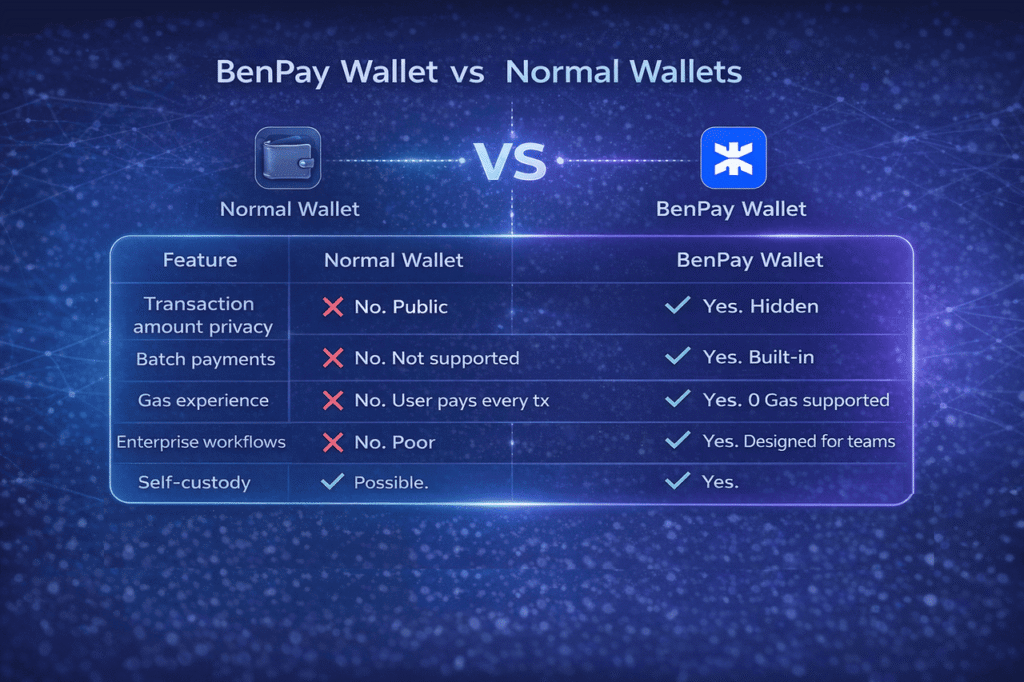
BenPay Wallet vs Normal Web3 Wallets
| Feature | Normal Web3 Wallet | BenPay Wallet |
| Transaction amount privacy | No. Public | Yes. Hidden |
| Batch payments | No. Not supported | Yes. Built-in |
| Gas experience | No. User pays every tx | Yes. 0 Gas supported |
| Enterprise workflows | No. Poor | Yes. Designed for teams |
| Self-custody | Possible | Yes |
BenPay is not just about “being private” — it’s about making privacy payments usable in real business scenarios.
Real-World Use Cases for BenPay Wallet
Payroll & Contributor Payments
Pay employees or contributors on-chain without exposing salaries publicly.
Supplier & Partner Payments
Protect commercial terms and settlement amounts from competitors.
Cross-Border Payments
Move funds globally in minutes with confidential settlement.
Treasury Management
Manage multiple accounts with verifiable on-chain records while keeping amounts private.
Privacy Is a Feature — Usability Is the Product
Many privacy solutions in crypto struggle with adoption because they are:
- Hard to use
- Fragmented across tools
- Built for experts only
- Unfriendly to compliance
BenPay Wallet focuses on product usability first:
- Self-custodial ownership
- Privacy by default
- Simple batch payments
- Enterprise-friendly workflows
- Compliance-compatible design
This is what makes BenPay a practical privacy wallet for everyday Web3 payments.
The Future of Privacy Wallets: Built for Real Payments
As chain analytics becomes more powerful, privacy-first wallets will move from optional to essential.
BenPay Wallet represents a new generation of privacy wallets: Not just hiding transactions — but making private, efficient, compliant Web3 payments actually usable.
BenPay Wallet FAQs:
- What is a privacy wallet? A privacy wallet hides sensitive transaction data and reduces address linkability to protect users from on-chain tracking.
- Is a private wallet the same as a privacy wallet? No. In crypto, “private wallet” usually means a self-custodial wallet where users control their private keys. A “privacy wallet” specifically refers to a wallet that protects transaction privacy by hiding amounts or reducing address linkability.
- Is BenPay Wallet self-custodial? Yes. Users control their own private keys and assets.
- Can businesses use BenPay Wallet for payroll? Yes. BenPay supports batch payments and confidential settlement for enterprise payment workflows.
- Is privacy provided by BenPay Wallet or by BenFen Chain? Privacy is a native capability of BenFen Chain. BenPay Wallet is the application layer that makes BenFen’s default privacy and selective disclosure usable through a user-friendly wallet interface, including optional Privacy Wallet mode.