
If you hold crypto and live in or travel frequently across Asia, finding a debit card that works smoothly with local payment ecosystems is harder than it looks. Most crypto cards marketed globally are optimized for the US and Europe, where Apple Pay and contactless Visa terminals dominate checkout. In much of Asia, the payment landscape runs on different rails: Alipay and WeChat Pay in mainland China, QR-based payments across Southeast Asia, and domestic card networks alongside Visa and Mastercard in Japan and Korea. A Web3 debit card built for Asia needs to do more than just carry a Visa logo. It needs to plug into the payment methods people actually use on the ground. Cards like theBenPay Card are designed with this in mind, supporting Apple Pay, Google Pay, Alipay, and WeChat Pay from a single self-custodial wallet.
What Makes Asia Different for Crypto Card Users
The payments infrastructure across Asia varies dramatically by country, and this directly affects which crypto cards are practical for daily use.
Mainland China is dominated by Alipay and WeChat Pay. Walk into a convenience store, restaurant, or taxi in Shanghai or Shenzhen and the default payment method is a QR code scan through one of these two apps. Physical card terminals exist but are secondary. A crypto card that only works through Visa contactless or Apple Pay misses the primary payment channel for hundreds of millions of transactions per day.
Japan has a hybrid environment. Credit and debit cards (Visa, Mastercard, JCB) are widely accepted in cities, and mobile payments through Apple Pay and Google Pay have grown steadily. But Japan also has its own contactless standards (Suica, iD, QUICPay) and a significant cash culture, especially in smaller towns and traditional businesses.
South Korea is one of the most card-friendly markets in Asia. Visa and Mastercard work nearly everywhere, and Samsung Pay and Apple Pay have strong adoption. Korean crypto users are among the most active globally, so card compatibility is less of an issue here than in some other Asian markets.
Southeast Asia (Thailand, Vietnam, Philippines, Indonesia, Malaysia) is mixed. Urban centers have good card acceptance, but outside major cities, QR-based mobile payments and cash remain dominant. GrabPay, GCash, TouchnGo, and local bank apps carry significant market share. A crypto card that works through Visa or Mastercard will function in most retail environments, but mobile wallet integration gives broader coverage.
India runs largely on UPI (Unified Payments Interface), which processes billions of transactions monthly through apps like Google Pay (India), PhonePe, and Paytm. Visa and Mastercard debit cards work but face periodic regulatory friction.
The takeaway is straightforward: a crypto card optimized for Asia cannot rely solely on Visa or Mastercard contactless. Support for Alipay, WeChat Pay, and Apple Pay or Google Pay covers the widest range of real-world payment scenarios across the region.
How Web3 Cards Differ From Exchange-Issued Crypto Cards
Before comparing specific cards, it helps to understand the two fundamentally different architectures.
Exchange-issued cards (from Binance, Crypto.com, Bybit, OKX, etc.) are tied to your exchange account. Your crypto sits in the exchange’s custody. When you spend, the exchange converts crypto to fiat and routes the payment through the card network. The advantage is simplicity: everything lives in one app. The disadvantage is counterparty risk. Your funds are only as safe as the exchange itself. If the exchange freezes accounts, gets hacked, or faces regulatory action in a specific country, your card balance and spending ability are directly affected.
Web3 self-custodial cards operate differently. Your crypto stays in a wallet where you control the private keys. You top up the card when you want to spend, and the card issuer facilitates the fiat conversion and payment network routing. But your unspent assets remain in your own wallet, not in a pooled custodial account. If the card service encounters issues, your wallet funds are still yours, accessible on-chain.
For Asia-based users, this distinction carries extra weight. Regulatory environments across Asian countries shift frequently. Exchanges that operate freely today may face restrictions tomorrow. South Korea’s strict exchange regulations, India’s oscillating crypto tax policy, and China’s exchange ban all illustrate this reality. A self-custodial model reduces your exposure to any single platform’s regulatory risk.
Comparing Web3 and Crypto Debit Cards Available in Asia
Binance Card
Binance offers a Visa card in select markets. Users can spend crypto from their Binance account, with auto-conversion to local fiat at the time of purchase.
Asia availability: Limited. Binance has faced regulatory challenges across multiple Asian jurisdictions. Card availability depends on your country and Binance’s current licensing status in that region.
Payment methods: Visa contactless, Google Pay (where supported). No Alipay or WeChat Pay integration.
Custody: Custodial. Funds held in Binance account.
Fee structure: Up to 0.9% per transaction. No card issuance fee in most markets.
Stablecoin support: USDT, USDC, BUSD, and other Binance-listed assets.
Crypto.com Card
Crypto.com’s Visa cards are available in several Asian markets including Singapore, and select other regions.
Asia availability: Moderate. Active in Singapore and some Southeast Asian countries. Not available in mainland China, and availability in other markets varies.
Payment methods: Visa contactless, Apple Pay, Google Pay. No native Alipay or WeChat Pay integration.
Custody: Custodial. Funds held within the Crypto.com ecosystem.
Fee structure: No annual fee on basic tiers. Higher tiers require CRO staking. ATM and currency conversion fees vary by card level.
Stablecoin support: USDT, USDC, and a wide range of other crypto assets.
RedotPay
RedotPay is a Hong Kong-based crypto card provider that has gained traction in the Asian market. It offers a Visa card that can be loaded with USDT and other crypto assets.
Asia availability: Broad. Available in multiple Asian markets with a focus on the Greater China and Southeast Asia corridor.
Payment methods: Visa contactless, Apple Pay, Google Pay. Limited Alipay integration in certain configurations.
Custody: Semi-custodial. Users deposit crypto into the RedotPay platform for card use.
Fee structure: Card issuance fee varies. Transaction fees and top-up fees apply. Check RedotPay’s current fee schedule for specifics.
Stablecoin support: USDT (multiple chains), USDC.
BenPay Card
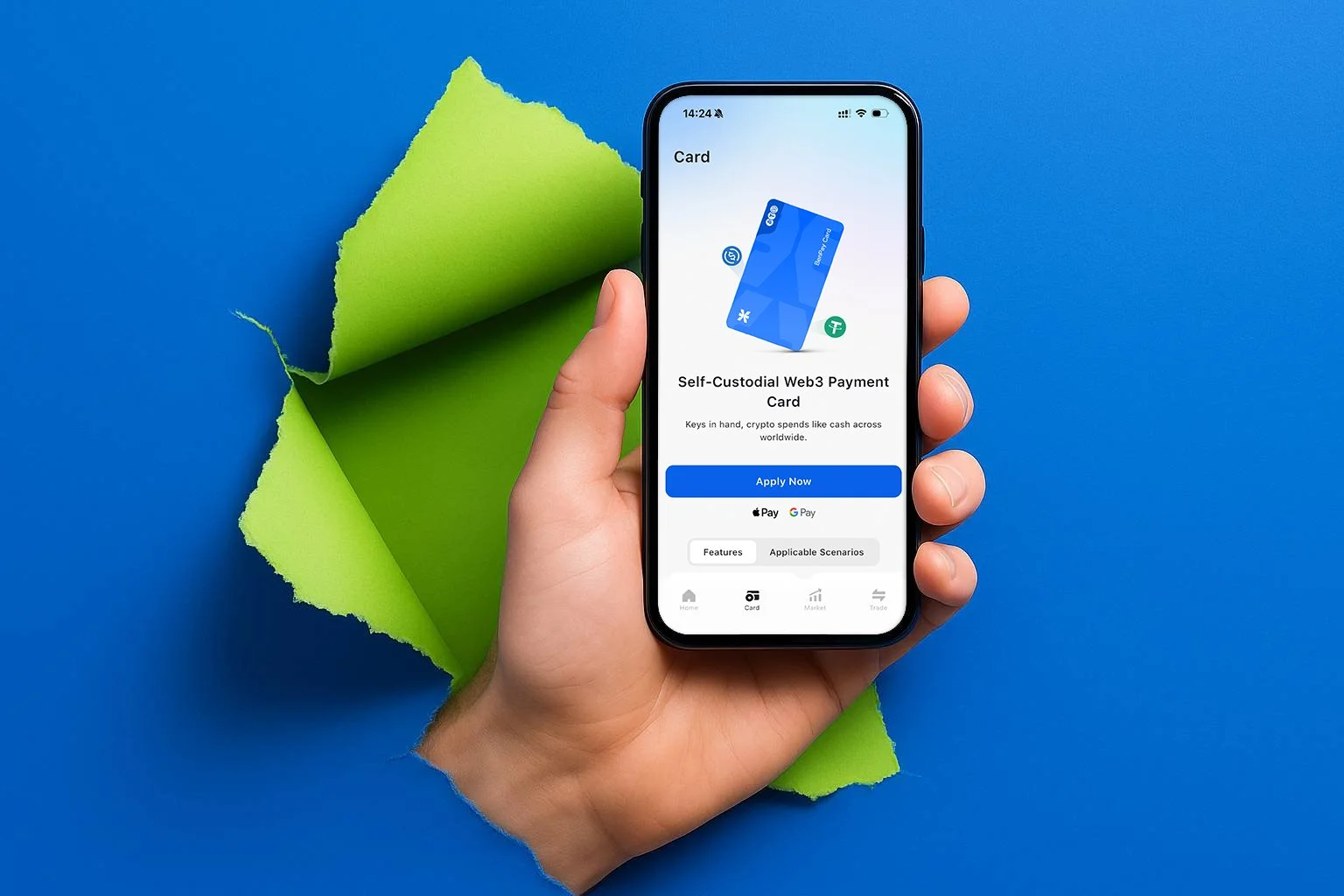
BenPay Card is built on the BenFen blockchain with a self-custodial architecture. It offers three card types (Alpha, Sigma, Delta) designed for different spending profiles and geographies.
Asia availability: Designed for global use with specific attention to Asian payment ecosystems. The Sigma Card is explicitly positioned for users in mainland China and broader Asia.
Payment methods: Apple Pay, Google Pay, Alipay, and WeChat Pay. This four-wallet coverage is the widest among Web3 card options, and it directly addresses the dominant payment methods across mainland China, Hong Kong, Southeast Asia, and Japan.
Custody: Self-custodial. Your stablecoins stay in yourBenPay Wallet until youtop up the card. You hold your private keys.
Fee structure by card type:
|
Alpha |
Sigma |
Delta | |
|
Opening fee |
9.9 BUSD |
9.9 BUSD |
9.9 BUSD |
|
Monthly fee |
$0 |
$1 |
$0 |
|
Top-up fee |
0% |
1.5% |
0.5% |
|
Per-transaction fee |
1% |
0.5% (min $0.50) |
$0.35 + 1% |
|
Cross-border fee |
1.5% (non-USD) |
$0.50 fixed per txn (China mainland) |
1% (non-USD) |
|
Card limit |
$200,000 |
Unlimited |
Unlimited |
Stablecoin support: USDT, USDC, BUSD (BenFen stablecoins). Assets from Ethereum, BNB Chain, Arbitrum, and other chains can bebridged in.
Unique for Asia users: The Sigma Card’s fixed $0.50 per-transaction fee for mainland China usage means that high-value purchases (dining, electronics, travel bookings) cost proportionally less than percentage-based fee models. On a 5,000 CNY restaurant bill, a 1.5% cross-border fee would be roughly $10. Sigma’s flat $0.50 is dramatically cheaper.
Side-by-Side Summary
|
Feature |
Binance Card |
Crypto.com Card |
RedotPay |
BenPay Card |
|
Alipay support |
No |
No |
Limited |
Yes |
|
WeChat Pay support |
No |
No |
No |
Yes |
|
Apple Pay / Google Pay |
Google Pay only |
Yes |
Yes |
Yes |
|
Custody model |
Custodial |
Custodial |
Semi-custodial |
Self-custodial |
|
Asia-specific card tier |
No |
No |
No |
Yes (Sigma) |
|
DeFi yield on idle funds |
Separate product |
Separate product |
No |
Yes (DeFi Earn) |
|
Cross-chain bridge built in |
No |
No |
No |
Yes (BenPay Bridge) |
Real Scenarios: How a Web3 Card Gets Used Across Asia
Abstract comparisons only go so far. Here is how the card choice plays out in specific situations that Asia-based crypto holders actually encounter.
Scenario 1: Digital nomad in Chiang Mai, Thailand. You earn freelance income in USDT and want to pay for coworking space, street food, and a monthly apartment rental. Most vendors in Chiang Mai accept QR-based payments or cash, with card terminals common at larger businesses. A Web3 card with Google Pay covers the terminal-equipped merchants. For smaller vendors, Alipay is increasingly accepted in Thai tourist areas, giving BenPay’s Sigma Card an edge in coverage. The self-custodial model also means your freelance income stays in your own wallet until you choose to spend it, rather than sitting in an exchange that might require additional KYC verification for Thai-based access.
Scenario 2: Business traveler bouncing between Shanghai, Tokyo, and Singapore. In Shanghai, Alipay and WeChat Pay are essential. In Tokyo, Apple Pay and physical card taps work at most retailers. In Singapore, Visa contactless and Apple Pay are standard. A single BenPay Card covers all three cities because it supports Alipay, WeChat Pay, Apple Pay, and Google Pay. The Sigma Card’s fixed cross-border fee structure is designed for this pattern of multi-country Asian spending.
Scenario 3: Crypto investor in Southeast Asia holding a large stablecoin position. You have $30,000 in USDT across multiple chains and spend $2,000-3,000 per month. Rather than keeping the full amount on an exchange card, you park $25,000 inBenPay DeFi Earn (earning yield through Aave, Compound, and Unitas), keep $5,000 in your wallet as a spending buffer, andtop up your BenPay Card monthly. The idle funds work for you instead of sitting at zero yield in an exchange account. When you need to spend, theredemption and top-up happen within the same app on BenFen, with minimal gas costs.
Risks and Limitations to Keep in Mind
Regional regulatory shifts. Crypto card availability in Asia is subject to change. A card that works in a given country today could face restrictions if local regulations change. Self-custodial cards reduce (but do not eliminate) this risk because your wallet funds are not held by a platform that might be forced to freeze accounts.
Merchant acceptance gaps. Even with Alipay and WeChat Pay support, not every small vendor or rural merchant accepts digital payments. Cash backup is still advisable in parts of Southeast Asia, rural Japan, and smaller Chinese cities.
Cross-border fee stacking. If you are spending in a non-USD currency, fees can compound: the card’s own cross-border fee, plus the Visa or Mastercard network’s exchange rate markup, plus any dynamic currency conversion the merchant terminal applies. Always choose to pay in local currency (not USD) when the terminal asks, to avoid the worst of these markups.
Bridge and on-ramp friction. If your stablecoins sit on Ethereum or BNB Chain, you need tobridge them to BenFen before topping up a BenPay Card. This adds a step compared to exchange cards where your funds are already in the right place. The bridge process takes a few minutes and the fee is modest, but it is an extra step to account for.
Smart contract and platform risk. Self-custodial does not mean risk-free. Your funds inDeFi Earn are subject to smart contract risk (mitigated by SlowMist audits but not eliminated). Your card balance, once topped up, depends on the card issuer’s infrastructure functioning normally.
FAQ
1.Which Web3 card supports both Alipay and WeChat Pay? Among the major crypto and Web3 card options,BenPay Card is currently the most prominent option that supports both Alipay and WeChat Pay alongside Apple Pay and Google Pay. Most exchange-issued cards (Binance, Crypto.com, Bybit) support Visa or Mastercard contactless and Apple Pay or Google Pay, but not Alipay or WeChat Pay natively.
2.Can I use a Web3 debit card in mainland China? Card acceptance in mainland China depends on the specific payment integration. Visa and Mastercard physical card terminals exist in China but are far less common than Alipay and WeChat Pay for everyday purchases. A Web3 card that integrates with Alipay and WeChat Pay, like BenPay’s Sigma Card, covers the dominant payment channels. The Sigma Card charges a fixed $0.50 per transaction for China mainland usage rather than a percentage-based fee.
3.Is it cheaper to use a Web3 card or to sell crypto on a local exchange and use a regular bank card? Selling on a local exchange involves exchange trading fees (0.1-0.5%), withdrawal fees to your bank, and potential delays. A Web3 card typically charges a top-up fee plus a per-transaction fee. For regular spending, the total cost is often comparable, but the Web3 card is faster (no exchange withdrawal wait) and avoids the need to maintain a local bank account, which is a significant advantage for travelers and digital nomads.
4.What happens to my card if the issuing platform shuts down? With a custodial exchange card, funds held in the exchange account are at risk if the platform becomes insolvent or inaccessible. With a self-custodial card like BenPay, any stablecoins that have not been topped up onto the card remain in yourwallet, accessible via your private keys on-chain regardless of the platform’s status. Funds already loaded onto the card are subject to the card issuer’s infrastructure, similar to any prepaid card arrangement.