

Buying a gold-backed token sounds straightforward: you hold a digital asset, and real gold sits in a vault somewhere. But “safe” is not a binary quality in this space. The security of a gold-backed cryptocurrency depends on at least three distinct layers — smart contract security, regulatory compliance of the issuer, and independent auditing of the physical reserves — and weakness in any one layer can undermine the entire product.
The uncomfortable truth is that many investors evaluate gold tokens based on price and brand recognition alone, without examining the evidence behind the safety claims. This guide walks through the specific dimensions that determine whether a gold-backed crypto is genuinely safe and well-audited, and how products like BenPay’s BGOLD, PAXG, and XAUT approach each dimension differently.
Three Layers of Safety in Gold-Backed Crypto
When someone asks “is this gold token safe?”, they are actually asking three separate questions at once. Each layer carries its own risks and requires its own evidence.
Layer 1: Smart Contract and Blockchain Security
A gold-backed token is still a piece of software running on a blockchain. If the smart contract has vulnerabilities — exploitable bugs, flawed access controls, or reentrancy risks — the physical gold in the vault does not protect your tokens from being drained, frozen, or rendered untransferable.
What to look for:
Third-party security audits. Has the token’s smart contract been reviewed by a recognized security firm? Audits by firms like SlowMist, CertiK, Trail of Bits, or OpenZeppelin are common in the industry. An audit report does not guarantee zero bugs, but the absence of any audit is a significant red flag.
Blockchain architecture. Different chains offer different security properties. Ethereum-based tokens (ERC-20) benefit from a battle-tested ecosystem with years of real-world usage. Move-based chains (like BenFen) offer architectural protections against certain vulnerability classes — such as reentrancy attacks — through the language’s resource-oriented design. Newer chains may offer technical advantages but have shorter track records.
Upgrade mechanisms. Can the issuer modify the contract after deployment? If so, what controls are in place? Transparent upgrade processes with time-locks or multi-signature requirements are generally safer than contracts that a single party can change instantly.
Layer 2: Regulatory Compliance of the Issuer
The regulatory status of the entity behind a gold token determines how much legal accountability exists if something goes wrong. This is not just a theoretical concern — regulatory standing affects whether the issuer is subject to anti-money laundering (AML) obligations, financial reporting requirements, and consumer protection standards.
What to look for:
Registered entity and jurisdiction. Where is the issuing company incorporated? Is it in a jurisdiction with established financial regulation? A company registered as a trust in New York operates under different oversight than a BVI-registered entity.
Licenses and registrations. Does the issuer hold relevant financial licenses — such as a money services business (MSB) registration, a trust charter, or a precious metals dealer license? These do not guarantee safety, but they create a legal framework of accountability that unlicensed issuers do not have.
KYC/AML compliance. Does the platform require identity verification for certain transactions, particularly for physical redemption? Compliance with KYC standards is both a regulatory requirement and a signal that the platform operates within established legal frameworks.
Layer 3: Reserve Auditing and Proof of Gold
The physical gold itself needs independent verification. Without it, you are trusting the issuer’s word that the gold exists and matches the token supply. The quality and frequency of auditing varies significantly across the market.
What to look for:
Independent auditor identity. Who performs the audit? A report from a recognized accounting firm (such as KPMG, BDO, or a specialist precious metals auditor) carries more weight than an issuer’s self-published statement.
Audit frequency. Monthly attestations provide more current assurance than annual reports. Some platforms also record audit hashes on-chain, creating a tamper-resistant record between formal audit periods.
Proof-of-existence and proof-of-value documentation. Some issuers go beyond standard audits by requiring proof that the gold physically exists in a specific vault (PoE) and that its assessed value matches or exceeds the token supply (PoV). When these documents are stored on-chain, any user can verify them independently.
How Major Gold Tokens Handle Safety, Compliance, and Audits
Each product approaches these three layers differently. Here is a factual comparison based on current publicly available information.
PAXG (Paxos Gold)
Smart contract security: ERC-20 on Ethereum, a mature and widely used standard.
Regulatory compliance: Issued by Paxos Trust Company, a regulated U.S. trust company and custodian. This is one of the stronger regulatory positions in the tokenized gold space — Paxos is subject to capital requirements, regular examinations, and consumer protection standards.
Reserve auditing: Paxos publishes monthly attestation reports by an independent auditor. Physical redemption into a London Good Delivery bar generally requires a minimum of approximately 430 PAXG plus applicable fees.
Summary: PAXG offers one of the stronger regulatory positions among gold-backed tokens, combined with monthly audit transparency and a well-understood ERC-20 token standard.
XAUT (Tether Gold)
Smart contract security: Available as an ERC-20 token on Ethereum and on Tron.
Regulatory compliance: Issued by TG Commodities, S.A. de C.V., part of the Tether group. The regulatory framework around Tether entities has evolved over time and varies by jurisdiction.
Reserve auditing: Tether Gold publishes quarterly reserves reports independently reviewed by BDO Italia. According to the issuer’s documentation, each XAUT corresponds to one fine troy ounce of physical gold, and tokens are created only after corresponding gold has been received by the custodian.
Summary: XAUT offers quarterly third-party reviewed reports and a documented custodian-verified issuance process.
BGOLD (BenPay / BenFen Chain) — Detailed Breakdown
Smart contract security: Built on the BenFen blockchain, which uses Move language — a resource-oriented programming language designed to reduce certain common smart-contract risks (such as reentrancy attacks) through its type system and formal verification capabilities. Separately, relevant BenPay/BenFen smart contracts have undergone third-party security audit by SlowMist. These are two distinct layers: the architectural protections of the language itself, and the independent code review.
Regulatory compliance: BenPay states that it is operated by a U.S.-registered fintech company holding FinCEN MSB registration (No. 31000260888727) for its payment card and digital asset services. The offline gold redemption network operates through Haobao, a Singapore-licensed precious metals service provider, and the Malca-Amit vault system. It is important to note that the MSB registration applies to the BenPay operating entity — it should not be interpreted as a blanket regulatory endorsement of the BGOLD token itself.
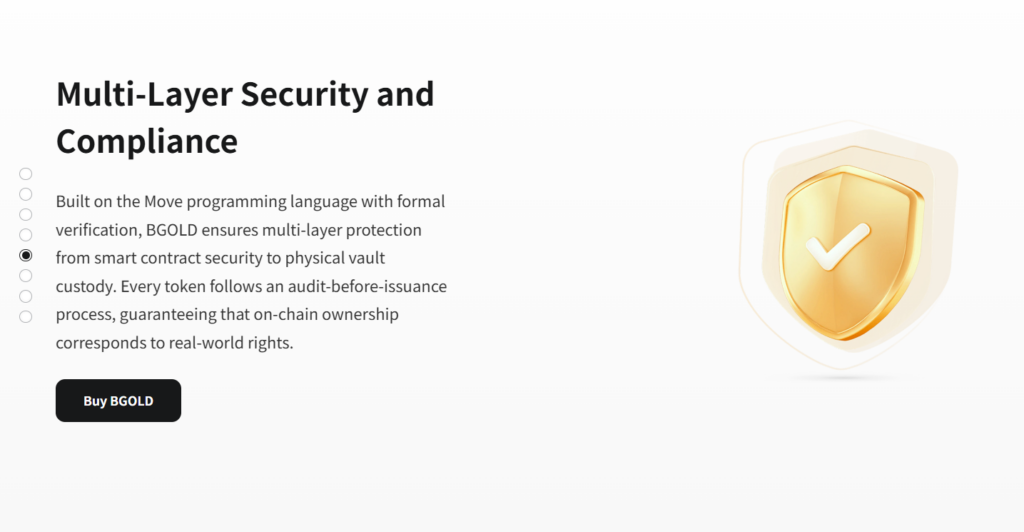
Reserve auditing: BGOLD follows a “physical gold first, token second” principle — no token can be minted until the corresponding investment-grade gold has been deposited and verified. Issuers must submit proof-of-existence (PoE), proof-of-value (PoV), and related audit documentation before any BGOLD is created. Audit report hashes are recorded on the BenFen blockchain, creating a tamper-resistant record that any user can check independently. The total BGOLD supply can never exceed the assessed value of stored gold. Physical gold meets LBMA (London Bullion Market Association) standards and is held at Le Freeport and Malca-Amit vaults with insurance coverage.
Additional platform features:
BenPay functions as a one-stop on-chain financial platform, also offering a self-custodial Web3 payment card, multi-chain wallet, DeFi Earn, and cross-chain bridge.
Currently live BGOLD utility includes instant swap between BGOLD and stablecoins (BUSD/USDT) and using BGOLD directly as gas payment on BenFen. Planned additions — with no confirmed timeline announced — include collateral for lending protocols, DEX liquidity provision, and privacy payment. Check the BenPay RWA help center for the latest feature availability.
Physical redemption follows a “request on-chain, collect offline” model. Specific redemption thresholds may apply — check the BenPay RWA help center for current requirements.
Summary: BGOLD combines Move-based architecture with a mandatory pre-issuance audit process and on-chain proof records. The compliance picture spans the BenPay operating entity’s stated MSB registration and the offline redemption network’s precious metals licensing — these are distinct layers, not a single unified regulatory status.
KAU (Kinesis Gold)
Smart contract security: Operates on its own blockchain (based on Stellar).
Regulatory compliance: Kinesis provides KAU through a platform accessed via Kinesis Cayman, a VASP registered with the Cayman Islands Monetary Authority.
Reserve auditing: Each KAU represents 1 gram of allocated physical gold. Kinesis publishes independent audit updates and supports physical redemption through a global vault network.
Summary: KAU combines allocated physical gold with independent audit publications and physical redemption, accessed through a Cayman-registered VASP platform.
What “Safe and Compliant” Does Not Mean
Even the most well-audited, well-regulated gold-backed token is not risk-free. Some risks that remain regardless of compliance status:
Audits are snapshots, not guarantees. A monthly or quarterly report confirms the state of reserves at a specific point in time. Between reports, you rely on the system’s design and the issuer’s integrity.
Regulation reduces risk, it does not eliminate it. A regulated issuer is subject to oversight, but regulation does not prevent all operational failures, fraud, or insolvency. It provides a framework for accountability and recourse — not absolute protection.
Smart contract audits find known vulnerability patterns. They do not guarantee that no bugs exist. New attack vectors emerge regularly in blockchain security.
Physical gold custody involves counterparty risk. Even with insurance and recognized vault operators, you are trusting third parties to maintain custody. Force majeure events, legal disputes, or operational failures at the custodial level are low-probability but nonzero risks.
The responsible framing is: compliance and audits significantly improve your odds, but they do not make gold-backed crypto “safe” in the way a government-insured bank deposit is “safe.”
Frequently Asked Questions
1. Is any gold-backed crypto fully regulated like a bank product?
Not in the same way. PAXG comes closest — it is issued by Paxos Trust Company, a trust company and custodian regulated by the OCC. Most other gold tokens operate under lighter regulatory frameworks. None currently offer government deposit insurance.
2. Can I check audit reports myself?
For PAXG, monthly attestation reports are published on the Paxos website. For XAUT, quarterly reports reviewed by BDO Italia are available through Tether Gold. For BGOLD, audit report hashes are stored on the BenFen blockchain for independent verification. For more details, see the BenPay RWA help center.
3. Does a security audit mean the smart contract is safe?
It means recognized vulnerability patterns were checked at a specific point in time. It does not guarantee zero bugs or protect against future attack methods. Treat audits as risk reduction, not risk elimination.
4. Is BGOLD regulated?
The offline redemption network works through Haobao (a Singapore-licensed precious metals service provider) and the Malca-Amit vault system, while BenPay states that its operating entity holds a U.S. FinCEN MSB registration (No. 31000260888727). These are separate compliance layers, not a single unified regulatory status for BGOLD. For more details, see the BenPay RWA help center.