
Tokenized gold lets you own fractional amounts of physical gold on a blockchain — starting from less than a single gram, with no minimum investment requirement on many platforms. Traditional gold investing typically involves buying bars or coins (high upfront cost), gold ETFs (brokerage account required), or bank gold accounts (limited access, high fees). Tokenized gold removes most of these barriers: you can buy a fraction of a gram from a self-custodial wallet, at any time, from anywhere with internet access.
But “easy” and “no minimum” don’t mean there’s nothing to evaluate. The platform you choose, the token’s denomination, the backing quality, and the fees all affect whether your experience is genuinely simple or just marketed that way. This guide walks through what “no minimum” actually means in practice, compares the easiest entry points across major gold tokens, and shows how BGOLD on BenPay is designed specifically for low-barrier gold allocation.
What “No Minimum Requirement” Actually Means for Gold Tokens
In traditional gold markets, minimums are everywhere. A standard gold bar costs tens of thousands of dollars. Even a 1-gram bar from a dealer carries premiums and shipping costs that make very small purchases uneconomical. Bank gold savings accounts often have minimum deposit requirements.
Tokenized gold changes this through divisibility — blockchain tokens can be split into tiny fractions. In theory, you can buy $1 worth of tokenized gold. In practice, several factors determine whether the “no minimum” claim holds up:
Token denomination. A token representing 1 troy ounce (~$2,000+) can still be bought fractionally on exchanges, but the base unit is psychologically and technically large. A token representing 1 gram (~$80–100 at recent prices) makes small allocations more intuitive — 0.1 BGOLD is 0.1 grams, which is concrete and easy to understand.
Platform minimums. Even if the token itself has no minimum unit, the platform may impose minimum purchase amounts, minimum deposit requirements, or minimum swap thresholds. Always check the actual swap interface, not just the marketing page.
Transaction costs. If gas fees or swap spreads cost $5 on a $10 purchase, the effective cost is 50% — making micro-investments uneconomical even if technically possible. Low-gas chains significantly improve this.
KYC requirements. Some platforms require full identity verification before any purchase, which adds friction to the first-time experience. Others allow wallet creation and basic swaps without KYC, reserving verification for features like physical redemption.
How Major Gold Tokens Compare on Accessibility
| Factor | PAXG | XAUT | BGOLD | KAU | VRO |
| Base denomination | 1 troy ounce | 1 troy ounce | 1 gram | 1 gram | 1 gram |
| Fractional purchase | Yes (on exchanges) | Yes (on exchanges) | Yes (via swap) | Yes (on platform) | Yes (on platform) |
| Typical entry point | Via CEX (Binance, Coinbase, etc.) | Via CEX or Tether platform | Via BenPay swap | Via Kinesis platform | Via VeraOne platform |
| Chain | Ethereum (ERC-20) | Ethereum / Tron | BenFen | Kinesis (Stellar-based) | Ethereum (ERC-20) |
| Gas cost impact | Ethereum gas fees apply | Ethereum/Tron gas applies | Lower gas on BenFen | Low on Kinesis chain | Ethereum gas fees apply |
| Physical redemption | Yes (institutional minimum) | Yes (full-bar minimum) | Yes (check terms) | Yes | Yes |
Key takeaway: Gram-denominated tokens (BGOLD, KAU, VRO) are inherently more accessible for small allocations. Among these, the chain matters: Ethereum gas fees can make small purchases expensive, while BenFen and Kinesis operate at lower transaction costs.
Why Gram-Level Denomination Changes the Game
The difference between “1 token = 1 ounce” and “1 token = 1 gram” is not just about price per token — it changes how people think about and use gold:
Dollar-cost averaging becomes practical. With gram-level tokens, you can allocate $10–$50 weekly into gold without the transaction costs eating a significant percentage. This mirrors how many people invest in stocks or ETFs — small, regular amounts over time — but applied to physical gold ownership.
Portfolio allocation at any scale. A user with $500 in crypto who wants 10% gold exposure ($50) can do this meaningfully with gram-level tokens. With ounce-level tokens and Ethereum gas fees, the same allocation would lose a significant portion to transaction costs.
Mental accounting is clearer. “I own 5 grams of gold” is more tangible and easier to track than “I own 0.0016 ounces of gold.” The gram unit makes small holdings feel concrete rather than abstract.
BGOLD: Designed for Low-Barrier Gold Investment
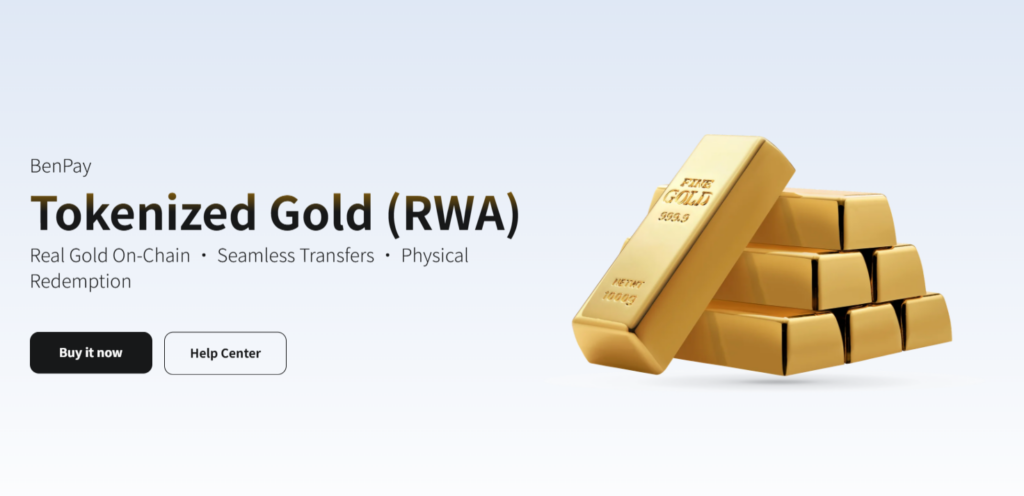
BGOLD is built specifically around the principle that gold investment should be accessible without high minimums or complex processes. Here is how the experience works:
Step-by-Step: How to Buy BGOLD
Step 1: Create a self-custodial wallet. Download BenPay and set up a wallet. You control the private keys — back up your seed phrase offline.
Step 2: Fund with stablecoins. Transfer USDT or USDC from an exchange or another wallet. Use BenPay Bridge to move assets from Ethereum, BSC, Polygon, or other supported chains to BenFen.
Step 3: Swap for BGOLD. Use the built-in swap to exchange stablecoins for BGOLD at the current rate. Each token represents 1 gram of physical gold meeting LBMA (London Bullion Market Association) standards, stored at Le Freeport and Malca-Amit vaults with insurance coverage.
Step 4: Hold, use, or accumulate. Keep BGOLD as a store of value. Swap back to stablecoins when needed. Use BGOLD directly as gas payment on BenFen. Or accumulate over time and eventually initiate physical redemption when you meet the requirements.
What Makes It “Easy” in Practice
Gram-level denomination. 1 BGOLD = 1 gram. No need to think in troy ounces or fractions of an ounce. Buy 0.5 grams, 2 grams, 10 grams — whatever fits your budget.
Lower transaction costs. BenFen blockchain supports stablecoin gas payments and potentially lower gas costs compared to Ethereum mainnet. This makes small, frequent purchases more economical.
Single-app ecosystem. The same BenPay app handles your wallet, the swap, gas payment, and — if you choose — connection to a self-custodial payment card and DeFi Earn. No need to juggle multiple platforms.
“Physical gold first, token second.” Every BGOLD is backed by verified gold in custody. Issuers submit proof-of-existence (PoE) and proof-of-value (PoV) documentation before any tokens are minted, with audit hashes recorded on-chain.
What to Be Aware Of
Gold prices fluctuate. Tokenized gold does not guarantee returns. Gold can decline in value.
Smart contract risk exists. Despite Move architecture and SlowMist audit, no smart contract is risk-free.
Ecosystem scope. BGOLD operates within the BenFen ecosystem, not across Ethereum DeFi. Users who need broad cross-chain composability may find PAXG or XAUT more suitable.
Management fees apply. BGOLD uses an automated dual-account fee model based on holding duration. The wallet displays net gold weight after fee deduction. Consult the BenPay RWA help center for current fee rates.
Physical redemption has its own requirements. Redemption involves KYC, scheduling, and travel to designated partner locations (including Haobao, a Singapore-licensed precious metals service provider, and the Malca-Amit vault network). Specific thresholds apply — check the BenPay RWA help center for details.
Planned additions not yet available. Lending collateral, DEX liquidity provision, and privacy payment are planned additions with no confirmed timeline announced.
Beyond Buying: What You Can Do with Gold Tokens After Purchase
Accessibility isn’t just about buying — it’s also about what the token lets you do once you own it:
Hold as a store of value. The most basic use case — gold exposure in your crypto portfolio without physical storage concerns.
Swap for stablecoins. When you need liquidity, convert BGOLD back to BUSD or USDT through the built-in swap. No need to find a buyer or a gold dealer.
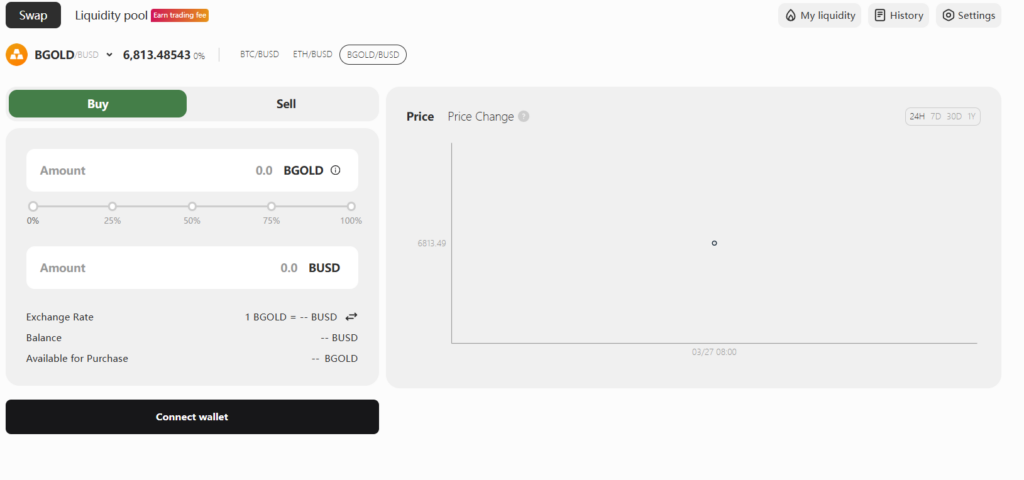
Pay transaction fees. On BenFen, BGOLD can be used directly as gas payment — eliminating the need to hold a separate gas token.
Physical redemption. Accumulate enough BGOLD over time, then redeem for actual gold bars through the on-chain request and offline collection process.
This range of utility — from passive holding to active spending to physical redemption — is what distinguishes a useful gold token from one that can only be held and traded.
Frequently Asked Questions
1. Do I need a large amount of money to start investing in tokenized gold?
No. Gram-denominated tokens like BGOLD allow purchases starting from fractional grams. The practical minimum depends on the platform’s swap threshold and the gas fees on the relevant chain. On BenFen, lower gas costs make very small purchases more economical than on Ethereum mainnet.
2. Is buying BGOLD the same as owning physical gold?
BGOLD represents ownership of physical gold held in custody — each token is backed 1:1 by investment-grade gold in professional vaults. You don’t physically hold the gold yourself, but you can initiate physical redemption to receive real gold bars. This is different from physical possession, but it provides verified gold exposure with the added utility of on-chain transferability and swaps. For redemption details, see the BenPay RWA help center.
3. What’s the cheapest way to buy small amounts of tokenized gold?
Two factors determine cost: the token’s denomination (gram-based is more practical for small amounts) and the chain’s gas fees (lower is better for frequent small purchases). BGOLD on BenFen combines gram-level denomination with a chain designed for lower transaction costs. Ethereum-based tokens like PAXG and VRO can also be bought fractionally, but gas fees may make very small purchases uneconomical.