
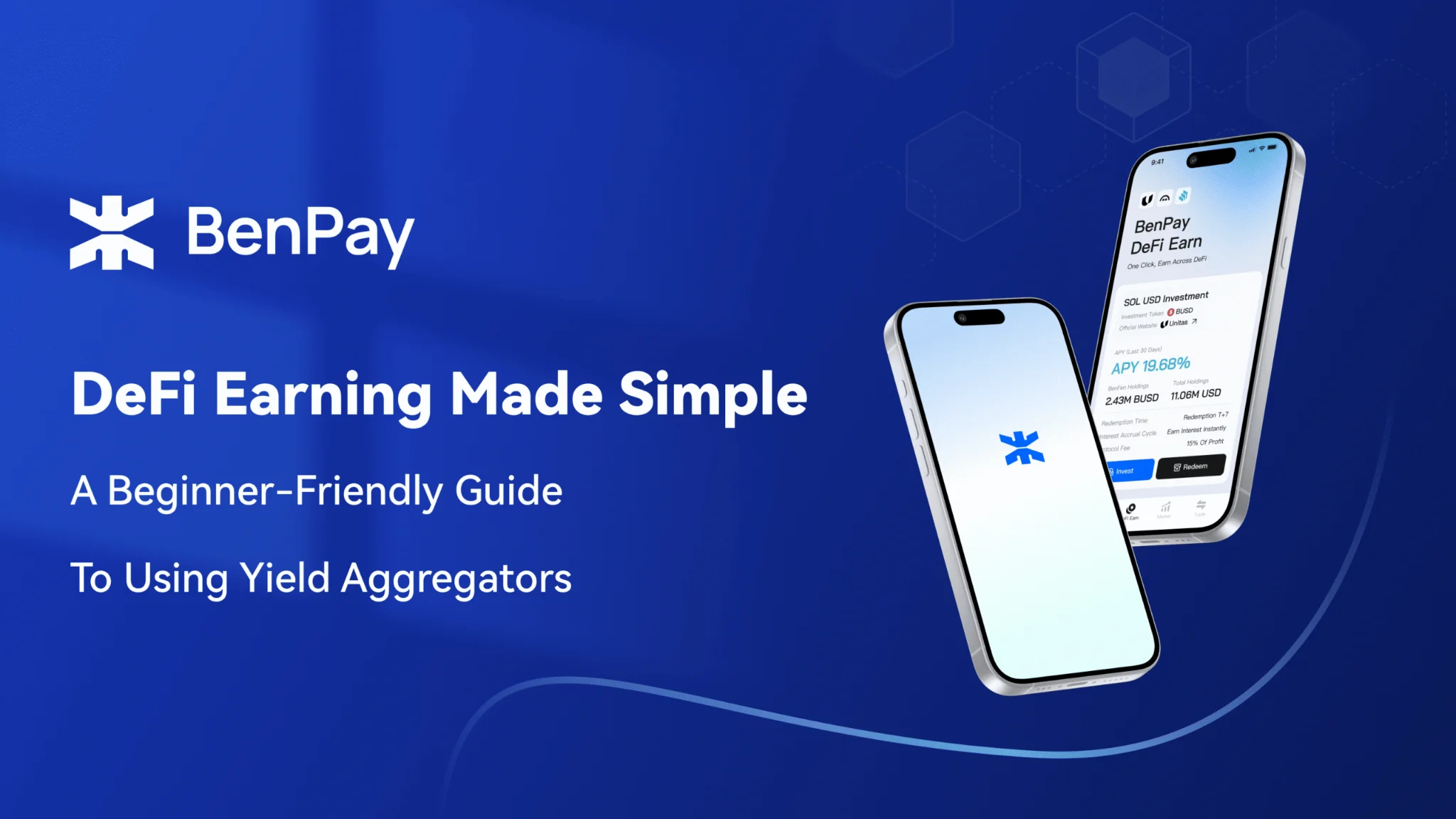
If you hold crypto in a wallet or on an exchange and want it to work for you, DeFi (decentralized finance) lets you earn yield by lending or providing liquidity through blockchain-based protocols. As a beginner, the simplest path is to start with stablecoins like USDT or USDC, pick a reputable lending protocol or a one-click aggregator such asBenPay DeFi Earn, and deposit a small amount to test the process before committing more capital. This guide breaks down exactly how DeFi yield works, what strategies are available, and how to manage the risks involved.
What Is DeFi Yield and Where Does It Come From?
DeFi yield is the return you earn by putting your crypto assets into smart contracts, which are programs that run automatically on a blockchain. Instead of a bank deciding your interest rate, the rate comes from supply and demand between borrowers and lenders on the protocol.
There are three main sources of DeFi yield:
- Lending interest. You deposit tokens into a lending pool (like Aave or Compound). Borrowers pay interest to use those tokens, and a portion of that interest goes to you as the lender.
- Liquidity provision. You supply token pairs to a decentralized exchange (DEX). Every time someone trades using that pool, the pool collects a small fee, which gets distributed to liquidity providers.
- Staking and protocol rewards. Some protocols distribute their own governance tokens as incentives to attract deposits. These rewards are on top of any base yield.
The key concept here: DeFi yield is not fixed and not guaranteed. APY (annual percentage yield) fluctuates based on how much capital is in a pool and how much demand there is for borrowing. A pool showing 8% today might drop to 3% next week if more depositors pile in.
How DeFi Yield Actually Works: A Simple Analogy
Think of a lending protocol like a community credit union. Members deposit money into a shared pool. Other members borrow from that pool and pay interest. The interest gets split among all depositors based on how much each person contributed.
The difference from a traditional bank is that no single institution controls the pool. The rules are written into a smart contract on the blockchain. Anyone can deposit, anyone can withdraw, and the interest rate adjusts automatically based on utilization, meaning how much of the pool is currently being borrowed.
For stablecoins like USDT and USDC, this process tends to produce more modest but more predictable returns compared to volatile tokens. That is why many beginners start with stablecoin lending: you avoid price swings on the underlying asset while still earning a return.
Step by Step: How to Start Earning DeFi Yield
Here is a practical walkthrough for someone who has never touched DeFi before.
Step 1: Set up a self-custodial wallet.
A self-custodial wallet (sometimes called a non-custodial wallet) means you hold your own private keys instead of trusting an exchange to hold them for you. This is the foundation of using DeFi, because smart contracts interact directly with your wallet.
Options include MetaMask, Trust Wallet, or multi-chain wallets likeBenPay Wallet that support multiple blockchains from a single interface. When you create your wallet, write down your seed phrase (recovery words) on paper and store it offline. If you lose this phrase and lose access to your device, your funds are gone permanently.
Step 2: Get stablecoins into your wallet.
If your crypto is sitting on a centralized exchange like Binance or Coinbase, you need to withdraw it to your self-custodial wallet. Choose the right network when withdrawing. For example, withdrawing USDT on Ethereum costs higher gas fees than withdrawing on Arbitrum, BNB Chain, or BenFen.
If you need to move assets across chains, across-chain bridge lets you transfer tokens from one blockchain to another. The process usually takes a few minutes, though speeds and fees vary by bridge and network congestion.
Step 3: Choose a yield strategy.
For beginners, the lowest-complexity option is stablecoin lending on an established protocol. Aave and Compound have been running for years, hold billions in deposits, and have been audited multiple times. You deposit your USDT or USDC, and the protocol starts accruing interest immediately.
If interacting with individual protocols feels intimidating, one-click DeFi aggregators simplify the process.BenPay DeFi Earn, for example, lets you deposit stablecoins and automatically allocates them across vetted protocols like Aave, Compound, and Unitas. You do not need to compare rates or manage positions across multiple apps.
Step 4: Deposit a small test amount first.
Before committing significant capital, deposit a small amount to understand the flow: how long it takes, what the gas fees look like, and how redemption works. Check that you can withdraw freely without lockup periods.
Step 5: Monitor and understand your returns.
DeFi dashboards show your accrued yield in real time. Keep in mind that the displayed APY is an annualized estimate, not a promise. If a protocol shows 6% APY, that rate can change tomorrow. Check back periodically and be ready to move your assets if conditions shift significantly.
Manual DeFi vs. One-Click Aggregators: What Is the Difference?
|
Factor |
Manual DeFi (e.g., using Aave directly) |
One-Click Aggregator (e.g., BenPay DeFi Earn) |
|
Setup complexity |
You connect wallet, choose pool, approve tokens, deposit manually on each protocol |
Single deposit; the platform allocates across protocols |
|
Chain management |
You handle bridging, gas tokens, and network switching yourself |
Aggregator often handles cross-chain routing |
|
Yield optimization |
You monitor rates and manually rebalance between protocols |
Platform rebalances to seek better rates |
|
Learning curve |
High; requires understanding each protocol’s interface |
Low; designed for users who want simplicity |
|
Control |
Full control over which protocol and pool you use |
Less granular control; you trust the aggregator’s selection |
|
Risk profile |
You choose the risk; you audit each protocol yourself |
Aggregator pre-vets protocols, but you rely on their judgment |
If you are the type of person who wants to understand every protocol deeply and manage each position manually, direct DeFi interaction gives you maximum flexibility. If you prefer to deposit and let a system handle allocation, an aggregator is a more practical starting point.
BenPay DeFi Earn takes a 15% fee on the yield earned (not on your principal), and the underlying protocols have been audited bySlowMist. Your principal stays in your self-custodial wallet throughout the process, meaning BenPay does not take custody of your funds.
Risks You Should Know Before Starting
Every DeFi yield opportunity comes with real risks. Understanding them upfront helps you make better decisions about how much to allocate and which platforms to trust.
Smart contract risk. The code running the protocol could have bugs or vulnerabilities. Even audited contracts are not 100% safe. Audits reduce risk, they do not eliminate it. Stick with protocols that have been audited by reputable firms and have a long track record.
Impermanent loss (for liquidity providers). If you provide liquidity to a trading pair and the price ratio of the two tokens shifts significantly, you can end up with less value than if you had simply held the tokens. This mainly applies to volatile token pairs, not stablecoin-only pools.
Rate volatility. APY in DeFi is not locked in. Rates move constantly. A pool advertising 10% APY might settle at 4% once more capital flows in. Do not plan your finances around a specific rate holding steady.
Regulatory uncertainty. DeFi regulations are still evolving in most countries. Certain protocols or services may become restricted in your jurisdiction. Using a platform that operates under a recognized regulatory framework, such as a US FinCEN MSB license, provides some additional assurance but does not make the investment risk-free.
Bridge and cross-chain risks. Moving assets between blockchains introduces another layer of smart contract risk. Use well-known bridges with audit histories, and avoid bridging large amounts in a single transaction until you are comfortable with the process.
How to Pick a DeFi Platform as a Beginner
When evaluating where to earn yield, ask these questions:
Has the protocol been audited, and by whom? Look for audits from recognized security firms like SlowMist, CertiK, or Trail of Bits. Read the audit report if it is publicly available.
How long has it been running? Protocols that have operated for over a year with significant deposits and no major exploits carry a stronger track record than brand-new projects.
Can you withdraw at any time? Some yield products have lockup periods. For beginners, choose options that let you redeem your funds freely.
Is the platform self-custodial? This means your private keys stay with you. If the platform goes offline, you can still access your assets through the blockchain. Centralized yield products (like exchange “earn” features) require you to trust the exchange with custody.
What fees are involved? Compare deposit fees, withdrawal fees, and performance fees. A platform that takes 15% of your yield is very different from one that charges 2% of your total deposit annually.
Getting Started: A Practical First Move
If you have USDT or USDC sitting idle and want to test DeFi yield with minimal friction, here is a concrete path:
- Download a multi-chain wallet (BenPay Wallet supports BenFen, ETH, BNB Chain, Arbitrum, and more).
- Transfer a small amount of stablecoins from your exchange.
- Try a one-click deposit throughBenPay DeFi Earn to see how the process works.
- Monitor your accrued yield for a week before deciding whether to add more capital.
Starting small and learning the mechanics is always smarter than going all in on a rate that looks attractive.
FAQ
1.What is the minimum amount needed to start earning DeFi yield? There is no universal minimum across all protocols. On some lending platforms, you can deposit as little as $10 worth of stablecoins. On BenPay DeFi Earn, theminimum deposit is low enough for most users to test with a small amount first. The main cost to factor in is gas fees for the transaction, which vary by blockchain.
2.Is DeFi yield the same as staking? Not exactly. Staking typically means locking tokens to help secure a proof-of-stake blockchain and earning rewards for doing so. DeFi yield is broader and includes lending, liquidity provision, and other strategies. Some platforms bundle both under “earn” features, so check what is actually happening with your deposited tokens.
3.Can I lose my principal in DeFi? Yes. If a smart contract is exploited, or if you provide liquidity to a volatile pair and experience impermanent loss, your principal can decrease. Stablecoin lending on audited protocols is on the lower end of the risk spectrum, but it is never zero-risk. Read more abouthow BenPay approaches security for their DeFi Earn product.
4.Do I need to pay taxes on DeFi yield? In most jurisdictions, yield earned from DeFi is considered taxable income. The specifics vary by country. Keep records of your deposits, withdrawals, and earned interest for tax reporting purposes.
5.What is a self-custodial wallet and why does it matter for DeFi? A self-custodial wallet means you control the private keys to your crypto. No company or exchange holds your funds. This matters for DeFi because you interact directly with smart contracts from your wallet. Learn more about how self-custodial wallets work in ourBenPay Wallet guide.