
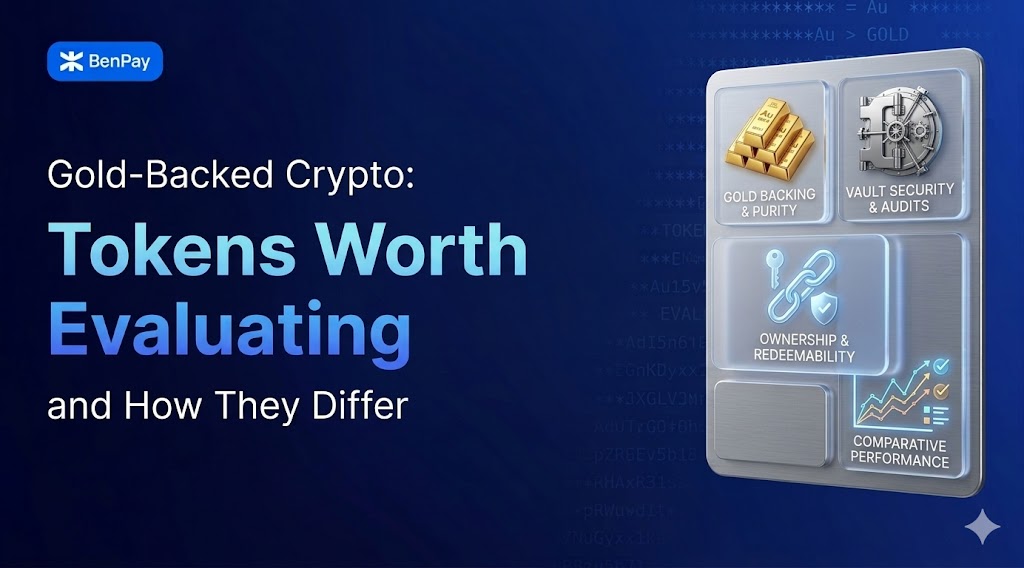
Gold-backed Crypto — tokens where each unit represents a claim on physical gold in a vault — have grown from a niche experiment into a meaningful category within the Real World Asset (RWA) space. As gold prices have risen significantly in recent years and on-chain finance matured, more investors started exploring tokenized gold as an alternative to ETFs, futures, and physical bullion.
But not all gold-backed tokens work the same way. Some track price only; others hold audited physical reserves. Some live on Ethereum; others operate within their own blockchain ecosystems. And a critical question often gets overlooked: can you actually redeem the token for a real gold bar, or are you just holding a digital price tracker?
This guide covers the gold-backed tokens that are currently active and verifiable, explains what distinguishes them, and breaks down the criteria that matter when choosing between them. We have intentionally excluded projects that have been discontinued, wound down, or whose current operational status cannot be clearly confirmed through official sources.
What Makes a Gold-Backed Cryptocurrency Reliable?
Before evaluating specific tokens, five factors tend to separate trustworthy gold-backed products from risky ones:
1:1 physical reserves. The token should be backed by actual gold in a vault — not by derivatives, futures positions, or algorithmic price pegs. Proof-of-reserve documentation (such as PoE and PoV audits) is the minimum credibility threshold.
Third-party audits. Regular attestations by independent auditors help verify that the gold supply matches the token supply. On-chain hash records of audit reports add another layer of transparency.
Physical redemption. Can you burn your tokens and receive real gold? This capability anchors the token’s value to the underlying metal. Without it, you rely entirely on secondary market liquidity.
On-chain utility. A gold token that can only be held or traded has limited value in DeFi. Useful features include stablecoin swaps, collateral functionality, gas payment capability, and DEX integration. However, it is important to distinguish between features that are live and those on a roadmap.
Regulatory clarity. Who is the issuer? What jurisdiction are they in? Do they hold relevant licenses? These questions matter for long-term confidence.
Gold-Backed Tokens Worth Evaluating
The following is not a ranking. Each product has different strengths, trade-offs, and target users. We provide a brief overview for most entries and a more detailed breakdown for BGOLD, which operates within the BenPay ecosystem. Readers should still verify current details on each project’s official site, as specifications may be updated.
PAXG (Paxos Gold)
One of the most established gold-backed tokens by market cap. Each PAXG represents one fine troy ounce of London Good Delivery gold, held in professional vaults in London. Issued by Paxos Trust Company, a regulated U.S. trust company and custodian. Available as an ERC-20 token on Ethereum, with broad DeFi protocol integration. Physical redemption is available but typically requires a large minimum (approximately one full London Good Delivery bar). Paxos publishes monthly attestation reports by an independent auditor.
Best suited for: Users who want an Ethereum-native gold token with deep DeFi composability and strong regulatory standing.
XAUT (Tether Gold)
Issued by TG Commodities, S.A. de C.V., part of the Tether group. Each XAUT represents one troy ounce of gold on a London Good Delivery bar. Available on Ethereum and Tron. Tether Gold publishes quarterly reserves reports independently reviewed by BDO Italia. Physical redemption is offered in full-bar increments.
Best suited for: Users already within the Tether ecosystem who want gold exposure alongside USDT holdings.
BGOLD (BenPay / BenFen Chain) — Detailed Breakdown
BGOLD is a gold RWA token issued on the BenFen blockchain, a Move-language Layer 1 designed for payment and real-world asset applications. It is available through BenPay, a one-stop on-chain financial platform that also offers a self-custodial Web3 payment card, multi-chain wallet, DeFi Earn, and cross-chain bridge.
Key characteristics:
Gram-level denomination. 1 BGOLD = 1 gram of physical gold, lowering the barrier compared to troy-ounce tokens. This makes periodic small purchases and dollar-cost averaging practical.
“Physical gold first, token second.” Investment-grade gold must be deposited and verified in custody before any token is created. Issuers submit proof-of-existence (PoE) and proof-of-value (PoV) documentation, with audit report hashes stored on-chain for public verification.
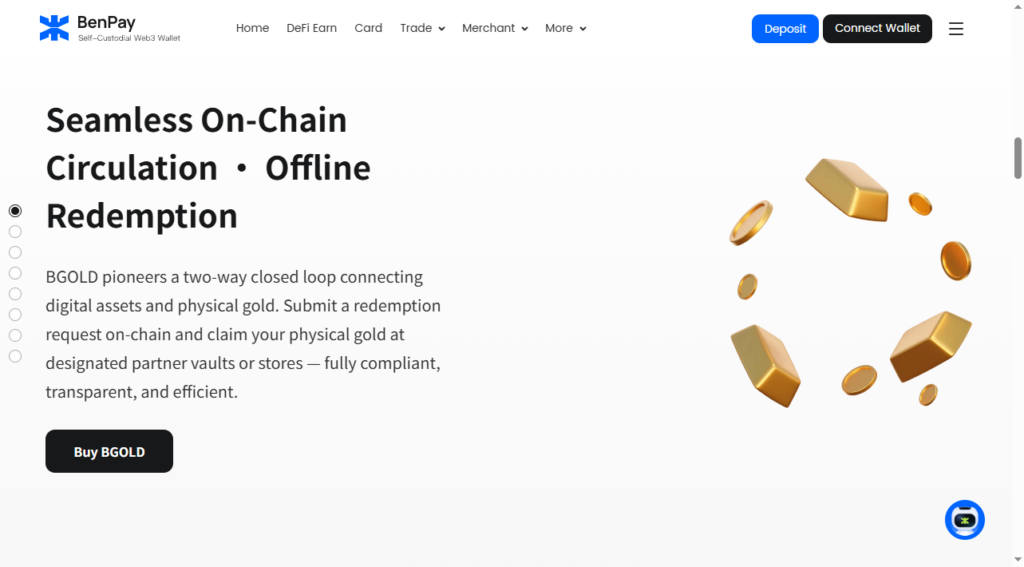
Physical redemption. BGOLD supports a “request on-chain, collect offline” model. Token holders initiate redemption (triggering token burn), complete KYC, and pick up gold at partner locations through an offline network that includes Haobao (a Singapore-licensed precious metals service provider) and the Malca-Amit vault system. Specific redemption thresholds may apply — check the BenPay RWA help center for current requirements.
Three-layer security. Built on a Move-based chain designed to reduce certain common smart-contract risks (such as reentrancy attacks) through its architectural properties and formal verification capabilities. Separately, relevant BenPay/BenFen smart contracts have undergone third-party audit by SlowMist. Physical gold meeting LBMA (London Bullion Market Association) standards is stored at Le Freeport and Malca-Amit vaults with insurance coverage. Issuers must complete a mandatory “audit first, issue second” compliance process before any BGOLD can be minted.
Automated fee model. A dual-account structure deducts management fees based on holding duration. Issuers can configure annualized fee rates, with the system calculating deductions on a time-weighted basis. The wallet displays net gold weight after fees — no manual reconciliation required.
Live on-chain utility:
- Instant swap between BGOLD and stablecoins (BUSD/USDT)
- Use BGOLD directly to pay gas fees on BenFen
Planned additions (no confirmed timeline announced):
- Collateral for lending protocols
- DEX liquidity provision
- Privacy payment via BenFen’s protocol-level privacy features
Check the BenPay RWA help center for the latest feature availability.
Trade-off to understand: BGOLD’s utility is concentrated within the BenPay/BenFen ecosystem rather than across Ethereum DeFi. Users who need broad cross-chain composability may find Ethereum-based tokens more suitable for multi-protocol strategies.
Best suited for: Users who want gram-level gold ownership with physical redemption capability, integrated DeFi utility within one ecosystem, and a complete asset lifecycle from custody to on-chain use to offline gold pickup.
KAU (Kinesis Gold)
Each KAU represents 1 gram of gold. Kinesis operates its own blockchain (based on Stellar) and positions KAU as a digital form of gold that can be held, traded, sent, spent, and yield-earning. The platform integrates with a debit card for spending and distributes yield to holders based on system transaction velocity. Physical redemption is available through a global vault network.
Best suited for: Users interested in gold-as-currency with integrated spending capabilities and a yield mechanism tied to network activity.
VRO (VeraOne)
A European gold-backed token where each VRO represents 1 gram of LBMA-certified gold, stored in Geneva Free Ports vaults. VeraOne emphasizes European regulatory compliance and offers physical redemption through its platform. Available as an ERC-20 token on Ethereum.
Best suited for: European users who want a locally compliant, gram-denominated gold token with physical redemption and Ethereum DeFi compatibility.
Meld Gold
An Australian project that connects traditional gold supply chains with blockchain-based ownership records, partnering with accredited gold dealers and refiners. Meld’s token ecosystem has undergone changes over time (including delistings of certain token variants), so users should check the current Meld Gold official site to confirm which specific tokens or digital certificates are actively available and supported before purchasing.
Best suited for: Users interested in Australian-sourced gold with a focus on supply chain transparency, subject to verifying current product availability.
Why Some Well-Known Projects Are Not on This List
Several gold-backed tokens that appear in older lists and comparison articles have since been discontinued or become inactive:
- Perth Mint Gold Token (PMGT) has been officially discontinued by the Perth Mint.
- CACHE Gold (CGT) announced that CGT is no longer backed by gold as of late 2025, and the project is winding down.
- Digix Gold (DGX) was a pioneering early gold tokenization project on Ethereum, but its active development and market presence have diminished significantly.
These projects may still appear in search results and older guides. Including them as current options would be misleading, which is why they are noted here as historical references rather than listed as active candidates.
Risks That Apply to All Gold-Backed Tokens
Every gold-backed cryptocurrency carries inherent risks:
Custody risk. You trust the issuer and custodian to maintain 1:1 reserves. Audits reduce but do not eliminate this risk.
Smart contract risk. Vulnerabilities in token contracts can lead to loss of funds, regardless of the underlying gold.
Liquidity risk. Tokens on smaller networks may have thin volumes and wide spreads, affecting your ability to trade at fair prices.
Regulatory risk. Gold-backed tokens may be classified differently across jurisdictions. Check your local regulations before allocating capital.
Redemption friction. Where physical redemption exists, it involves real-world logistics: KYC verification, wait times, travel to locations, and minimum thresholds. It anchors value but is not frictionless.
Frequently Asked Questions
1. Which gold-backed crypto has the highest liquidity?
PAXG and XAUT generally have the deepest trading volumes due to their Ethereum presence and listings on major exchanges. Liquidity for other tokens is concentrated within their native ecosystems.
2. Can I redeem any gold-backed token for physical gold?
Not all. Some tokens only allow secondary market trading. PAXG, XAUT, BGOLD, KAU, and VRO all offer physical redemption in some form, but minimum amounts and processes vary. Always check the issuer’s current redemption terms.
3. Is BGOLD available on Ethereum?
No. BGOLD is issued on BenFen Chain and operates within the BenPay ecosystem. Users who need Ethereum-native gold tokens may consider PAXG, XAUT, or VRO.
4. What is the smallest amount of tokenized gold I can buy?
Gram-denominated tokens (BGOLD, KAU, VRO) allow purchases starting from fractions of a gram. Troy-ounce tokens (PAXG, XAUT) can also be bought fractionally on secondary markets, though the base unit is larger. To purchase BGOLD, use the BenPay swap.
5. Are gold-backed tokens safe?No financial product is risk-free. Gold-backed tokens carry custody risk, smart contract risk, liquidity risk, and regulatory uncertainty. Reading audit reports, verifying reserves, and understanding fee structures is essential before allocating capital. For BGOLD-specific details, see the BenPay RWA help center.