
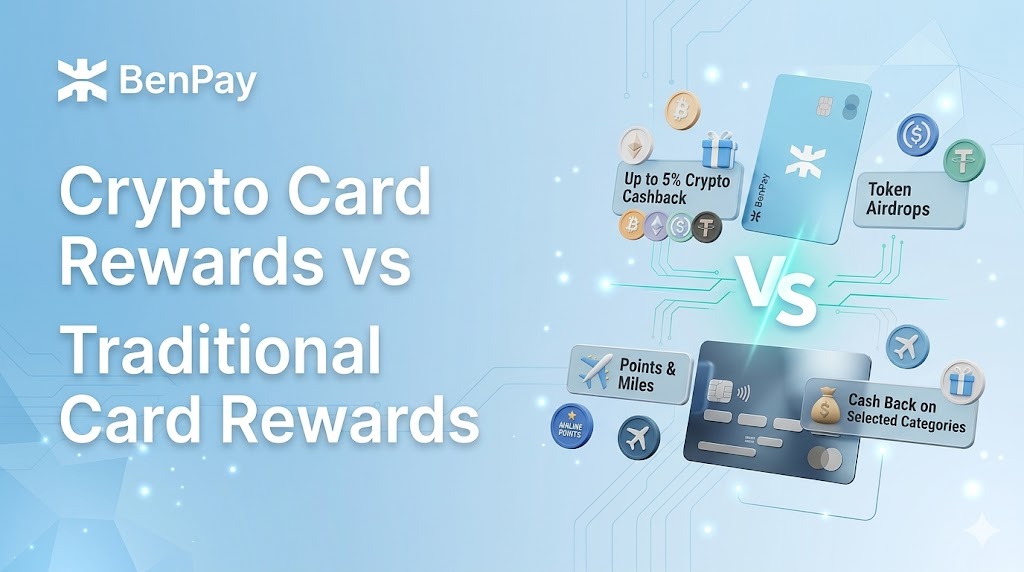
When evaluating Crypto Card Rewards vs Traditional Card Rewards, most users only look at the headline cashback percentages. However, what you’re really getting depends on more than just a number.
Some crypto cards offer cashback rates that appear to rival traditional credit cards — up to 5% on Crypto.com’s highest tier with substantial CRO lockup, compared to the typical 1–2% baseline on most bank cards (with category bonuses reaching 3–5% on some traditional cards). But the headline number is only half the story. Crypto card rewards often come with conditions — token lockups, subscriptions, volatile reward currencies — that traditional cards don’t have. This guide breaks down how crypto card rewards actually work, compares them directly to traditional credit card cashback, and explains why for some users, rewards may not be the most important factor in choosing a card. BenPay Card is included in the discussion — even though it doesn’t offer cashback — because it illustrates when other dimensions matter more.
How Crypto Card Rewards Actually Work
Crypto card rewards look similar to traditional card cashback on the surface, but the underlying mechanics differ in ways that affect your real return.
Cashback in Crypto vs Cashback in Fiat
Traditional credit cards pay rewards as statement credits, cash deposits, or points with stable fiat value. You earn 2%, you get 2%.
Crypto cards typically pay rewards in cryptocurrency — often the platform’s native token (like CRO for Crypto.com). If that token is volatile, your “5% cashback” can lose real value between when you earn it and when you spend or convert it. A token that drops 40% turns your 5% reward into an effective 3% — or less. Rewards paid in stablecoins (like USDC) don’t have this problem, but stablecoin cashback is less common.
Staking and Lockup Requirements
Traditional credit cards: you apply, get approved, and earn rewards immediately. No upfront investment required (though some premium cards charge annual fees).
Crypto cards: the highest reward tiers typically require you to lock up the platform’s token or subscribe to a premium plan. Crypto.com, for example, requires CRO staking or a Level Up subscription to access higher cashback rates. This means your rewards aren’t free — you’re tying up capital that could be earning yield elsewhere, and you’re exposed to the token’s price movement for the duration of the lockup.
Tiered and Conditional Rewards
Traditional cards usually have straightforward reward structures — a flat rate, or category-based rates (3% on dining, 1% on everything else).
Crypto card rewards tend to be more tiered and conditional: different card levels unlock different percentages, and the conditions to reach each level (staking amount, subscription cost) can change. Several major crypto card programs have updated their reward structures over the years, sometimes reducing benefits for existing users.
Crypto Card Rewards Compared
Here’s how the major crypto cards stack up on rewards specifically:
| Card | Cashback Rate | Reward Currency | Staking Required | Key Condition |
| Crypto.com | Up to 5% (highest tier only, requires substantial CRO lockup / Level Up) | CRO (volatile) | Yes (CRO lockup / Level Up) | Rate depends on tier; terms have been updated over time |
| Gnosis Pay | May provide ecosystem incentives | GNO-based | No (optional for bonus) | Incentives tied to GNO ecosystem participation; not a fixed cashback program |
| Bleap | May offer cashback depending on current promotions | Check official site | No | Conditions and rates may vary |
| BenPay Card | None | — | No | Value proposition is self-custody + ecosystem integration |
What the table shows: The highest raw cashback comes from Crypto.com — but with the highest conditions attached. Gnosis Pay and Bleap offer rewards without mandatory staking. BenPay doesn’t compete on rewards at all, which is a deliberate trade-off we’ll address later in this article.
Crypto Card Rewards vs Traditional Credit Card Rewards
This is the comparison most articles skip — putting crypto cards directly against the traditional cards users already carry:
| Dimension | Traditional Credit Card | Crypto Card |
| Typical cashback | 1–2% baseline; category bonuses up to 3–5% | 0–5% depending on product and tier |
| Reward currency | Fiat (statement credit or cash) | Often crypto (CRO, BTC, USDC, etc.) |
| Reward value stability | Stable | Varies — volatile tokens lose value; stablecoins don’t |
| Upfront cost to unlock | Usually none (some premium cards have annual fees) | Often requires token staking or subscription |
| Credit line | Yes (spend first, pay later) | No (prepaid — load first, spend balance) |
| Interest charges | Yes (if you carry a balance) | No (can’t overspend) |
| Sign-up bonus | Common in the US ($200–$500+); less common in other regions | Rare |
The key insight: A traditional card’s 1–2% baseline cashback is typically unconditional — you don’t need to lock up any capital to earn it. A crypto card’s 5% looks higher, but once you factor in the staking requirement (capital locked up that could earn yield elsewhere), the volatility of the reward token, and the possibility that terms may change — the net return can end up closer to, or even below, what a traditional card delivers.
This doesn’t make crypto card rewards worthless. It means you need to calculate net return after all costs, not just compare headline percentages.
The Hidden Cost of Chasing Crypto Card Rewards
Four costs that don’t appear in the cashback percentage:
1. Token price risk. If your rewards are paid in a volatile token and you hold rather than immediately convert, a significant price decline can erase most of your cashback gains. This has happened in practice with several major crypto tokens.
2. Staking opportunity cost. Capital locked in a staking requirement can’t be used elsewhere. If you lock a significant amount in a platform token to earn 3% cashback, but that same capital could earn 5–8% in a DeFi yield product, you’re effectively paying for your cashback with forgone yield.
3. Changing terms. Crypto card reward programs are not bound by the same regulatory stability as traditional bank card programs. Adjustments to cashback rates, staking thresholds, and benefit tiers have occurred across multiple products. What you sign up for today may look different in a year.
4. Behavioral cost. Optimizing for rewards can lead to over-spending on a tier you don’t need, staking more than your risk tolerance allows, or staying locked into a platform you’d otherwise leave — simply because you’ve already committed capital.
When Rewards Aren’t the Metric That Matters Most
For some users, other dimensions outweigh cashback entirely. Consider whether any of these apply to you:
Self-custody matters more than rewards. If controlling your own private keys is a priority, you’re choosing between a smaller set of cards — and the one with the best cashback may not be the one with the strongest self-custody model. BenPay Card offers self-custodial architecture with on-chain top-up authorization, zero annual fee, and no staking requirement — at the cost of zero cashback.
You need specific payment methods. Cashback is irrelevant if the card doesn’t support how you actually pay. Users who need Alipay or WeChat Pay have very few options — BenPay covers these on select card tiers, while most rewards-focused cards don’t offer them at all.
DeFi yield may exceed card cashback. If you’re already earning yield on stablecoins through DeFi, a card that connects directly to your yield source — like BenPay’s integration with DeFi Earn — lets you spend earnings without switching apps. The yield itself (variable, not guaranteed, with smart contract risk) may deliver more value than a 2% cashback rate on a separate card.
Simplicity has value. Not wanting to track staking positions, monitor token prices, or worry about changing reward terms is a legitimate preference. A card with transparent fees and no rewards complexity can be less stressful to use daily — and stress has a cost too.
Bottom line: Rewards are one dimension of card selection. Evaluate them alongside custody model, fee structure, payment method coverage, regional availability, and ecosystem integration to find what genuinely fits your situation.
FAQ
Q1: Is 5% crypto cashback better than 2% traditional credit card cashback?
On the surface, yes. In practice, it depends on the conditions. A 5% rate available only on the highest tier — requiring substantial token staking (with price volatility risk), paying rewards in a token that may decline, and operating under terms that can change — may net you less than a simple 2% fiat cashback with no conditions. If the crypto cashback is paid in stablecoins with no staking requirement, the comparison is more favorable. Always calculate net return after all costs. For more on card fee structures, visit the BenPay blog.
Q2: Do any crypto cards offer rewards without staking?
Yes. Bleap may offer cashback rewards depending on current promotions — check their official site for current rates. Gnosis Pay may provide ecosystem incentives for GNO participants but doesn’t require staking to use the card itself. BenPay Card takes a different approach entirely — it offers no cashback, with its value proposition centered on self-custody, Asian payment method support (on select tiers), and DeFi ecosystem integration rather than rewards.
Q3: Should I choose a crypto card based on rewards alone?
Generally not recommended. Custody model (who controls your assets), fee structure (FX fees, top-up fees, conversion spread), payment method compatibility, and regional availability all affect your daily experience as much or more than cashback percentage. Determine your core need first — self-custody, specific payment methods, DeFi integration, low fees — then treat rewards as a bonus rather than the deciding factor. For a framework covering all dimensions, see our crypto debit card comparison.