
Tokenized gold — digital tokens backed by physical gold in professional vaults — has become one of the fastest-growing segments in the Real World Asset (RWA) space. As gold prices have risen significantly in recent years, more crypto users are looking for ways to hold, trade, and use gold directly within DeFi, rather than relying on traditional brokers or ETFs.
But buying tokenized gold is only half the question. The practical question is: once you own it, what can you actually do with it? Can you swap it for stablecoins? Pay gas fees with it? Redeem it for a real gold bar?
This guide explains how tokenized gold works in DeFi, lays out the criteria that matter when choosing a platform, and walks through how BenPay approaches gold RWA through its BGOLD token — including what is available today and what is planned for the future.
What Is Tokenized Gold, and Why Does It Matter?
Tokenized gold (also called gold RWA) is a blockchain-based token where each unit represents ownership of physical gold held by a custodian. Instead of buying a bar and storing it yourself, you hold a token backed 1:1 by real gold in a vault.
For DeFi users, this turns a traditionally illiquid asset into something programmable: swappable for stablecoins, transferable globally in minutes, and manageable alongside other crypto assets in one wallet. In traditional finance, moving gold across borders involves logistics, insurance, customs, and days of settlement. On-chain, a gold-backed token can be transferred in seconds.
That said, not all tokenized gold products are equal. The differences lie in how the gold is stored, whether you can redeem it for physical metal, how transparent the audits are, and what on-chain utility the token offers. A token that merely tracks the gold spot price without verifiable physical reserves is an index product, not a genuinely asset-backed instrument.
What to Look for in a DeFi Gold Platform
Physical backing and proof of reserves. Is there real gold behind each token? Look for platforms that publish proof-of-existence (PoE) documentation, third-party audits, and on-chain attestations — not just price-tracking tokens.
Redemption capability. Can you convert tokens back into physical gold bars, or only sell on secondary markets? Physical redemption — where the token is burned and you receive real gold — is what anchors a token’s value to the underlying asset.
On-chain utility. A useful gold token supports swap functionality, lending integration, gas payment, or DEX liquidity. However, distinguish carefully between features that are available now and those planned for the future.
Security architecture. Evaluate both the smart contract layer (audited? by whom?) and the physical custody layer (which vault? insured? what standards?).
Fee transparency. Check for management fees, redemption fees, spread costs, and minimum purchase requirements. Clear fee schedules matter.
How Major Tokenized Gold Products Differ
PAXG (Paxos Gold) and XAUT (Tether Gold) are the most established tokenized gold tokens by market cap. Both are ERC-20 tokens on Ethereum, offering deep integration with Ethereum DeFi protocols. Each token typically represents one troy ounce of gold. Physical redemption is available on both, though minimum amounts tend to be substantial — generally suited for institutional holders rather than retail users. Specific thresholds and fees should be verified on each platform’s official documentation.
BGOLD (issued on BenFen Chain, available through BenPay) takes a different approach. It denominates in grams rather than troy ounces (1 BGOLD = 1 gram of gold), lowering the barrier to entry for everyday investors who want to allocate small amounts periodically. It is built on a Move-language blockchain focused on complete asset lifecycle management: from physical gold custody and on-chain token issuance, through DeFi utility during the holding period, to physical redemption when the holder is ready to take delivery.
The key trade-off: PAXG and XAUT offer broader cross-chain DeFi composability on Ethereum and its Layer 2 networks, while BGOLD offers deeper integration within the BenPay ecosystem — including features like using gold to pay gas fees and instant stablecoin swaps. The right choice depends on whether you prioritize breadth of protocol access across multiple chains or depth of utility within one cohesive platform.
BenPay’s Gold RWA: How BGOLD Works
BenPay is a one-stop on-chain financial platform on the BenFen blockchain, offering a self-custodial payment card, multi-chain wallet, DeFi Earn, and cross-chain bridge. BGOLD is its gold RWA module.
Core Design
“Physical gold first, token second.” Before any BGOLD is minted, the corresponding investment-grade gold must be deposited and verified in custody. Issuers submit proof-of-existence (PoE) and proof-of-value (PoV) audit documentation, with report hashes stored on-chain for public verification. Total token supply can never exceed the assessed value of stored gold.
Gram-level denomination. 1 BGOLD = 1 gram of physical gold — making gold allocation accessible for periodic small purchases or dollar-cost averaging.
Automated fee model. A dual-account structure (separating Symbol Token and Coin) automatically calculates and deducts management fees based on holding duration. Issuers can configure annualized fee rates, with the system calculating deductions on a time-weighted basis. The wallet always displays net gold weight after fees — “what you see is what you own.”
Security: Three Layers
Code layer: Move language with formal verification protections against common vulnerabilities. Contracts audited by SlowMist.
Audit layer: Mandatory “audit first, issue second” compliance process with on-chain hash records. Issuers must submit PoE, PoV, and custody documentation before any tokens are minted.
Physical custody layer: Gold meeting LBMA (London Bullion Market Association) standards, stored at Le Freeport and Malca-Amit vaults with insurance coverage.
Physical Redemption
One of BGOLD’s most significant differentiators is its physical redemption workflow. BGOLD uses a “request on-chain, collect offline” model: token holders initiate redemption (triggering token burn), complete KYC verification, and pick up physical gold at designated partner locations through the offline fulfillment network, which includes Haobao (a Singapore-licensed precious metals service provider) and the Malca-Amit vault system. This creates a complete lifecycle — issuance, circulation, and physical settlement — rather than just a trading instrument.
Important caveat: Specific redemption thresholds and logistics details may vary — check the BenPay RWA help center for current requirements. The process involves real-world logistics (identity verification, scheduling, travel to a location) and is not instantaneous.
Current Features and Planned Additions
Available now:
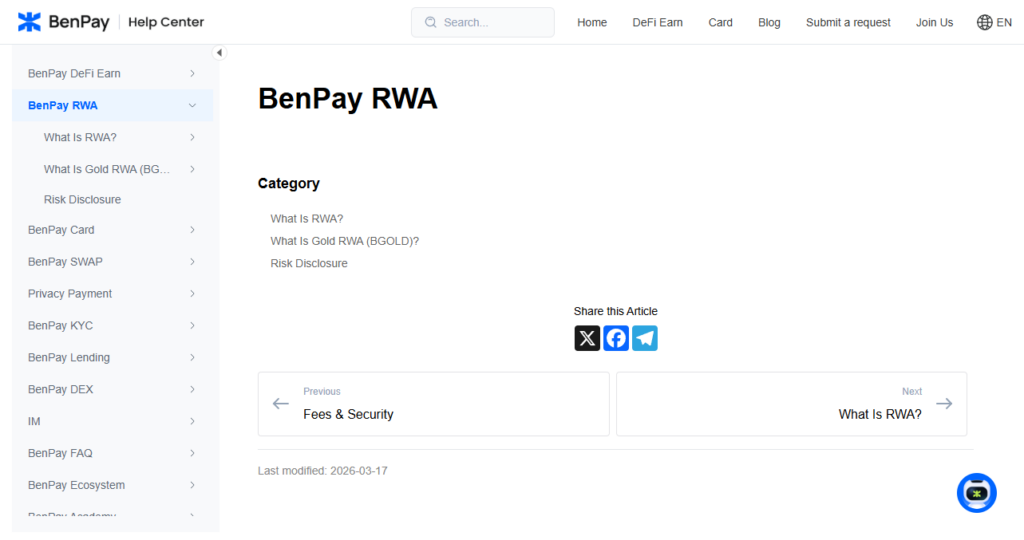
- Instant swap: Convert BGOLD to stablecoins (BUSD/USDT) and back for real-time gold-cash hedging. Try the swap here.
- Gold as gas: Use BGOLD directly to pay transaction fees on BenFen, no separate gas token needed.
Planned additions (no confirmed timeline announced):
- Lending collateral: BGOLD as collateral to borrow stablecoins while retaining gold exposure.
- DEX liquidity provision: Earn trading fee shares by providing BGOLD liquidity.
- Privacy payment: Shielded transactions via BenFen’s protocol-level privacy features.
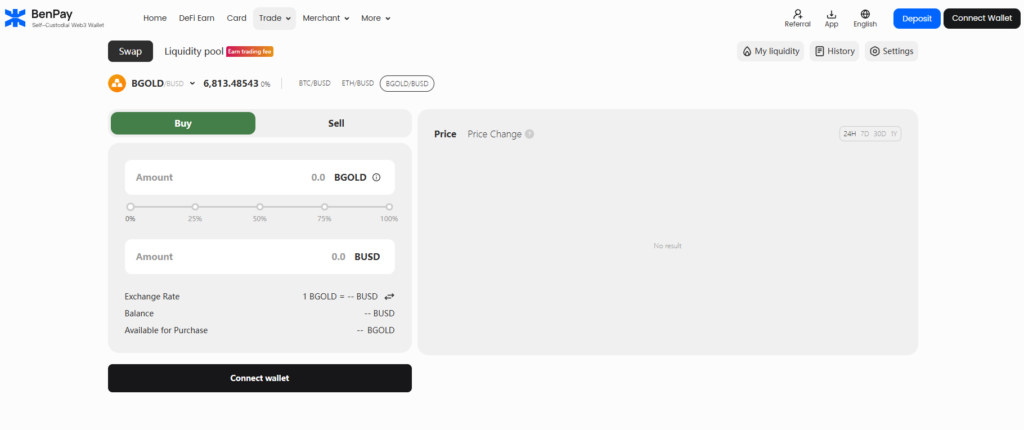
These features are part of BenPay’s product roadmap. Check the BenPay RWA help center for the latest availability updates.
RWA Framework Beyond Gold
The RWA issuance framework used for BGOLD is designed to be reusable across other asset types. The core modules — 1:1 asset anchoring, audit hash on-chain, automated fee calculation, dual-account net value display, and on-chain burn with offline delivery — can be applied to bonds, yield-bearing instruments, and other assets with verifiable ownership. Gold is the first verified use case, not the only planned one.
How to Buy BGOLD: Step by Step
Step 1: Create a self-custodial wallet. Download BenPay and set up a wallet. You control the private keys — back up your seed phrase offline.
Step 2: Fund with stablecoins. Transfer USDT or USDC from a CEX or another wallet. Use BenPay Bridge to move assets from Ethereum, BSC, Polygon, or other supported chains to BenFen.
Step 3: Swap for BGOLD. Use the built-in swap to exchange stablecoins for BGOLD at the current rate. Each token represents 1 gram of gold in custody.
Step 4: Hold, use, or redeem. Keep BGOLD as a store of value, swap back to stablecoins when needed, use it for gas fees, or initiate physical redemption once you meet the requirements.
Before you start: KYC is required for physical redemption. Gold prices fluctuate — tokenized gold does not guarantee returns. Smart contract risk exists despite audits and Move architecture. The BenPay ecosystem continues to expand, with additional features planned.
Risks and Limitations
These apply broadly to tokenized gold products:
Custody risk. You trust that the custodian and issuer maintain the 1:1 reserve. Audits reduce but do not eliminate this risk.
Smart contract risk. Code vulnerabilities could lead to loss of funds. Move-based contracts have architectural advantages, but newer ecosystems may have less battle-tested codebases than Ethereum.
Liquidity risk. Tokens on smaller ecosystems may have thinner volumes and wider spreads than Ethereum-based alternatives.
Regulatory risk. Classification of gold-backed tokens varies by jurisdiction. Verify legal status in your region.
Redemption logistics. Physical redemption involves identity verification, potential wait times, and travel to designated locations — not as frictionless as on-chain swaps.
How to Choose: A Decision Framework
Rather than declaring a single “best” option, consider what matters most for your situation:
Broad DeFi composability across Ethereum: Products like PAXG and XAUT currently offer wider integration with Ethereum-based protocols. They tend to suit users who want tokenized gold within existing multi-protocol DeFi strategies — for example, using gold as collateral on Aave or providing liquidity on Uniswap.
Integrated ecosystem with physical redemption focus: BGOLD on BenPay is designed for users who want gram-level gold exposure, value physical redemption, and want gold within an integrated platform handling payments, swaps, and (in the future) lending. The trade-off is that BGOLD’s utility currently lives within the BenFen ecosystem.
A hybrid approach is also practical: holding one product for Ethereum DeFi strategies and another for physical gold access within a different ecosystem. There is no rule that says you must pick only one.
Regardless of platform, start with a small allocation to understand the fees and mechanics. Read the audit reports. Verify proof of reserves. Treat tokenized gold as a convenient way to gain gold exposure through DeFi — carrying both the benefits of programmable assets and the inherent risks of blockchain-based finance.
Frequently Asked Questions
1. Can I redeem BGOLD for physical gold?
Yes. Initiate a request on-chain (tokens are burned), complete KYC, and collect gold at a designated partner location — including through Haobao (Singapore-licensed) and the Malca-Amit vault network. Specific redemption thresholds may apply — check the BenPay RWA help center for current requirements.
2. Is BGOLD available on Ethereum?
No. BGOLD is issued on BenFen Chain and operates within the BenPay ecosystem. Users who need Ethereum-native tokenized gold may consider PAXG or XAUT.
3. Is BenPay self-custodial?
Yes. Users hold their own private keys. BenPay states that its operating entity is a U.S.-registered fintech company holding a FinCEN MSB registration (No. 31000260888727) for its payment card and digital asset services.
4. Can I use BGOLD for DeFi lending?
Lending, DEX liquidity, and privacy features are planned additions — no confirmed timeline has been announced. Currently, BGOLD supports instant swap (BGOLD ↔ BUSD/USDT) and gas payment on BenFen. Check the BenPay RWA help center for the latest feature availability.
5. How is the physical gold stored?
Gold backing BGOLD meets LBMA (London Bullion Market Association) standards and is stored at internationally recognized facilities including Le Freeport and Malca-Amit vaults, with insurance coverage. Audit documentation (PoE and PoV) is recorded on-chain for user verification.
6. What fees does BGOLD charge?BGOLD uses an automated management fee model based on a dual-account structure. Issuers can configure annualized fee rates, and the system calculates deductions on a time-weighted basis. The wallet displays net gold weight after deduction — consult the BenPay RWA help center for current rates.