
Introduction: Why Crypto Privacy Matters More Than Ever in 2026
Financial privacy is not a luxury — it is a fundamental right. Yet in 2026, on-chain surveillance has reached unprecedented sophistication. Blockchain analytics firms, government agencies, and data brokers routinely trace wallet addresses to real-world identities, monitor transaction histories, and build detailed financial profiles — often without users ever knowing.
In such an environment, choosing a wallet with privacy as its core design principle and a solid underlying public blockchain is essential for safeguarding digital assets.
This guide will systematically introduce the core evaluation criteria for encrypted crypto wallets in 2026, conduct a horizontal comparison of 12 mainstream products on the market, and focus on analyzing BenPay – a Web3 wallet solution built on the BenFen privacy blockchain.
Before diving deeper, it’s worth understanding what defines a privacy wallet and how confidential crypto payments actually function in real-world scenarios.
What to Look For in a Privacy Crypto Wallet in 2026
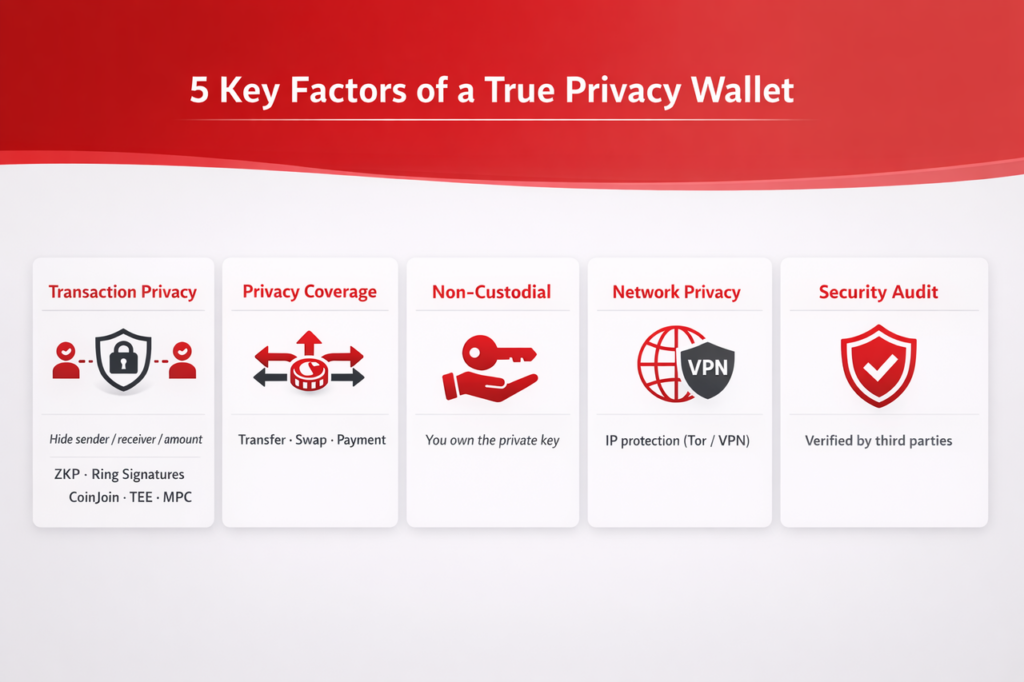
Not all wallets that claim to offer privacy actually provide true protection. The key to choosing a privacy wallet lies in understanding the privacy implementation technologies it uses, the scenarios it covers, and whether the security measures can withstand verification. Here are the main technical means and the key dimensions for evaluation:
- Transaction Privacy — Not Just Address Obfuscation
True transaction privacy means an outside observer cannot link sender to recipient, cannot determine transaction amounts, and cannot reconstruct a user’s transaction history. The current mainstream technical implementation methods include:
- Zero-Knowledge Proofs (ZKPs): Cryptographic proofs that verify a transaction is valid without revealing any underlying data.
- Ring Signatures & Stealth Addresses: By obfuscating the sender, receiver, and transaction amount, these mechanisms achieve on-chain anonymity and are suitable for privacy-oriented single-chain scenarios.
- CoinJoin: A Bitcoin mixing technique that combines multiple transactions to break the on-chain trail.
- Trusted Execution Environments (TEE): Hardware-level secure enclaves that process sensitive data without exposing it.
- Multi-party computation (MPC): By distributing key generation and signing among multiple parties, it eliminates the risk of a single point of failure and is a mainstream key management solution.
- Privacy Coverage Scope
The scope of privacy technology determines the actual boundary that the wallet can protect for users. When evaluating, the focus should be on whether it only provides privacy protection for basic transfers or also has privacy capabilities in scenarios such as internal exchanges and payments within the chain.
- Non-Custodial Architecture
If a third party holds your private key, they can control the assets, including freezing funds or responding to external requests. Choosing a non-custodial wallet and keeping the private key under the user’s control is the foundation for asset security.
- Network Layer Privacy
Even if the transaction itself is obfuscated, network-layer information (such as IP addresses) may still reveal the user’s identity. It is recommended to prioritize wallets that support Tor or VPN, or are designed to avoid revealing metadata.
- Independent Security Audit
Whether it has undergone a third-party security audit is an important criterion for evaluating the wallet’s security. Projects verified by authoritative institutions are usually more reliable in terms of security architecture and implementation details.
2026 Privacy Wallet Horizontal Comparison
The table below conducts a horizontal comparison of the current mainstream Web3 wallets from the perspectives of privacy technology, chain support, and usage scenarios:
| Wallet | Privacy Technology | Supported Chains | Non-Custodial | Best Use Case |
| Monero (GUI) | Ring Signatures + Stealth Addresses | Monero (XMR) | ✓ | Maximum Privacy: Default full-ledger anonymity with the highest resistance to tracking. |
| Wasabi Wallet | CoinJoin (WabiSabi) | Bitcoin (BTC) | ✓ | BTC Privacy Mixing: Enhances Bitcoin privacy through statistical transaction obfuscation. |
| Samourai Wallet | Whirlpool (Discontinued) | Bitcoin (BTC) | ✓ | Risk Notice: The service has been discontinued. |
| Zcash (Zashi) | zk-SNARKs (Shielded Transactions) | Zcash (ZEC) | ✓ | High-Performance Privacy: Fast private transactions powered by zero-knowledge proofs. |
| Exodus | Basic Encryption | Multi-chain | ✓ | Beginner-Friendly: Intuitive UI, but all on-chain transactions are fully transparent. |
| MetaMask | None (Fully Transparent On-Chain) | EVM-Compatible Chains | ✓ | DeFi & NFT Access: Standard Web3 wallet with no built-in privacy features. |
| Trust Wallet | None (Fully Transparent On-Chain) | Multi-chain | ✓ | Mobile Users: Widely used mobile wallet with full on-chain transparency. |
| OKX Wallet | None (Fully Transparent On-Chain) | Multi-chain | ✓ | Advanced Traders: Strong multi-chain integration, ideal for DEX aggregation. |
| Phantom | None (Fully Transparent On-Chain) | Solana / EVM | ✓ | Solana Users: Leading wallet in the Solana ecosystem with fully public transactions. |
| Ledger (Nano) | Secure Element (Hardware Isolation) | Multi-chain | ✓ | Security-Focused Storage: Industry-leading security, but no transaction-level privacy. |
| Trezor (Safe 3 / Model T) | Native CoinJoin Integration | Multi-chain | ✓ | Cold Storage + Privacy: Hardware wallet with integrated CoinJoin support. |
| BenPay Wallet | MPC + Zero-Knowledge Proofs | BenFen Chain & others | ✓ | Privacy Wallet Switch: One-stop Web3 application entry, easy to use. |
Privacy Wallet Deep-Dives
Monero GUI Wallet (Official Wallet of XMR)
Monero remains the gold standard for privacy protocols. Its network mandates the use of Ring Signatures, RingCT (confidential transactions), and stealth addresses, enabling native obfuscation of the amount, sender, and receiver at the protocol level.
- Advantages: Mandatory privacy, no need for manual activation, extremely high cryptographic security, and cannot be traced externally.
- Limitations: Limited to the XMR single currency. Due to global regulatory pressure, it has been removed from many mainstream exchanges, increasing the difficulty of obtaining liquidity.
Wasabi Wallet
Wasabi is a Bitcoin-only wallet that implements WabiSabi CoinJoin — a sophisticated coin mixing protocol that breaks the transaction graph on the Bitcoin blockchain. It is highly regarded among Bitcoin privacy advocates.
- Strengths: Strong Bitcoin privacy, non-custodial.
- Limitations: Bitcoin-only. CoinJoin is not natively private — mixing is detectable, and heuristics can sometimes partially de-anonymize users.
Samourai Wallet
Samourai is another Bitcoin-focused wallet, well-known for its Whirlpool CoinJoin mixing and Stonewall/Ricochet transaction features. It targets advanced Bitcoin privacy users.
- Limitations: The service has been discontinued. In April 2024, the server was seized by the US Department of Justice, and services such as Whirlpool became completely unusable.
Zcash (Zashi Wallet)
Zcash was one of the first cryptocurrencies to implement zk-SNARKs (Zero-Knowledge Succinct Non-Interactive Arguments of Knowledge) for shielded transactions. The Zashi Wallet is Zcash’s official mobile wallet, focused on shielded transactions.
- Strengths: Cryptographically strong ZK-based privacy, proven technology.
- Limitations: Shielded transactions are optional; transparent transactions are still common. Limited smart contract capability and DeFi ecosystem. Exchange delistings remain a concern.
Exodus Wallet
Exodus is a multi-chain wallet with a strong emphasis on user experience and aesthetics. It supports hundreds of assets across many blockchains.
- Strengths: Excellent UI/UX, broad asset support, beginner-friendly.
- Limitations: Not a privacy wallet. No native privacy features. Closed-source core components. Not suitable for users with genuine privacy requirements.
MetaMask
MetaMask is the dominant EVM wallet, essential for Ethereum and compatible chain interactions. It is not a privacy wallet by any measure.
- Strengths: Universal EVM support, wide ecosystem compatibility.
- Limitations: No privacy features. Transaction data is fully visible on-chain. IP address exposure via default RPC providers is a known concern.
Trust Wallet
Trust Wallet is the official multi-chain mobile wallet of Binance, supporting over 100 blockchain networks and millions of tokens. It is currently one of the most popular mobile Web3 wallets with the largest user base.
- Advantages: Wide support for multiple chains, built-in DApp browser, user-friendly interface, suitable for mobile DeFi users.
- Limitations: No native privacy features, all transaction data is fully visible on the chain. As an affiliated product of the parent company Binance, some users have concerns about data independence.
OKX Wallet
OKX Wallet is a multi-chain Web3 wallet launched by OKX Exchange, supporting mainstream ecosystems such as EVM, Solana, and Bitcoin, and featuring built-in DEX aggregator and cross-chain bridge functions, with a relatively comprehensive set of features.
- Advantages: Strong cross-chain functionality, smooth DEX aggregation trading experience, and support for a large number of chains.
- Limitations: No native privacy protection, transaction data is transparent on the chain. As an affiliated product of a centralized exchange, there is a potential correlation between the user privacy boundary and the exchange’s data.
Phantom
Phantom is the most popular wallet in the Solana ecosystem. In recent years, it has expanded its support to Ethereum, Polygon, and Bitcoin, and is renowned for its simple UI and smooth NFT management experience.
- Advantages: Preferred in the Solana ecosystem, excellent NFT support, excellent interface design, suitable for Solana DeFi users.
- Limitations: No privacy features, all chain activities are fully public. Privacy protection capability is at the lowest level among the wallets listed in this article.
Ledger (Hardware Wallet)
Ledger is the leading brand of hardware cold wallets globally. By storing private keys in offline secure chips, it physically isolates network attacks and is an industry benchmark for asset security storage.
- Advantages: Private keys are stored offline, has extremely strong resistance to remote attacks, supports thousands of assets, suitable for long-term holding of large amounts of assets.
- Limitations: The hardware wallet solves the problem of key security, but not transaction privacy. Chain transactions records are still fully public. Ledger itself does not provide any transaction layer privacy protection. A user database leak incident occurred in 2020, so attention should be paid to personal information security.
Trezor (Hardware Wallet)
Trezor is one of the earliest hardware cold wallet brands, renowned for its complete openness. Both the firmware and hardware design are transparent and accessible, earning the trust of users who value security and independent verification. The Trezor Suite includes Bitcoin CoinJoin mixing, making it the only cold wallet to natively integrate hardware-level privacy mixing.
- Advantages: Completely open source, high security transparency, offline protection of private keys, supports hardware CoinJoin, outperforming Ledger in the field of privacy hardware.
- Limitations: Limited functionality expansion, DeFi interaction experience is not as smooth as software wallets.
Introducing BenPay: Privacy-Native Web3 Wallet on the BenFen Chain
BenPay is not just a privacy wallet — it is the gateway to BenFen, a public blockchain designed from the ground up as a privacy-first Layer 1. Where other wallets bolt privacy features onto existing chains, BenPay and BenFen are co-designed so that privacy is the default, not the exception.
What is BenFen Chain?
BenFen is a privacy-based public blockchain that treats privacy as a core protocol feature rather than an application-layer add-on. Built for the demands of Web3 in 2026, BenFen combines multiple state-of-the-art privacy technologies into a unified, developer-friendly Layer 1 ecosystem.
Key privacy architecture of BenFen includes:
- Multi-party Computation (MPC): The private key is split into multiple parts and distributed and stored in different nodes. The transaction is signed through the Threshold Signature Scheme (TSS). The private key never appears in plaintext form, significantly reducing the risk of asset theft.
- Zero-Knowledge Proof (ZKP) Hybrid Architecture: Based on the generation of private transactions in Multi-party Computation, combined with Zero-Knowledge Proofs to verify chain state changes, nodes only verify the correctness of the results and cannot reverse-engineer the original transaction information.
- Native Privacy Support for Move Virtual Machine (Move VM): BenFen is based on native support for privacy accounts and privacy payments in Move VM. Developers can build privacy applications on this foundation, and the transaction amount and account balance are hidden on the chain.
BenPay Wallet: Key Features
BenPay is the official self-custodial Web3 wallet of BenFen. It supports cross-chain aggregation of mainstream assets across multiple chains and is compatible with 11 networks. It includes functions such as Swap, cross-chain bridge, payment card, staking, DeFi Earn, and purchasing and using in-ecosystem tokenized gold (BGOLD). Users can complete the entire cross-chain transaction and asset allocation process without switching between multiple applications.
- Dual-Mode Wallet: Freely Switch Between Normal Mode and Privacy Mode
You can switch to the privacy wallet directly by clicking the “Enter Privacy Wallet” button on the wallet interface. The privacy mode activates BenFen’s MPC+ZK hybrid privacy protocol: all amounts, addresses, and transaction metadata are encrypted and protected; the asset balance is hidden in **** form; and all on-chain activities are completely invisible to external observers. Currently, the privacy mode supports privacy payments, privacy receipts, and privacy exchanges.
- Privacy Payments and Asset Protection Capabilities
Based on BenFen’s underlying privacy protocol, it will gradually expand into more scenarios for on-chain asset use in the future. Under the premise of compliance, it will protect transaction amounts and account information, reducing the risk of tracking and association of on-chain data. At the same time, this capability will also support the use needs of ecosystem assets, including BGOLD, in the privacy mode, providing a higher level of privacy protection for high-value assets.
- Selective Disclosure
Support selective auditing through view keys. Regulatory authorities or authorized third parties can view relevant transaction records with the user’s authorization, while protecting privacy and meeting compliance requirements.
- SlowMist Security Audit Certification
The smart contract has undergone an independent security audit by SlowMist Technology, ensuring transparent asset security.
BenPay vs. The Competition: The Key Differentiator
The fundamental limitation of wallets like Wasabi and Monero GUI is that they are purpose-built for a single chain — and that chain was not designed with modern Web3 use cases in mind. Monero cannot run smart contracts. Wasabi cannot interact with DeFi. Zcash’s shielded ecosystem is still limited. More importantly, all the above-mentioned wallets are either full-time private or completely private; users have no choice.
BenPay offers a more flexible privacy solution: it supports a one-click switch between the regular mode and the privacy mode, allowing users to strike a balance between usability and privacy protection based on different scenarios.
Who Should Use BenPay?
- Individual investors: They hope to enhance privacy in scenarios such as asset transfer and payment, reducing the risk of transaction behaviors and account information being linked and analyzed on the blockchain.
- Enterprise users: In scenarios such as payment, fund distribution, or salary payment on the blockchain, they need to protect transaction amounts and transaction counterpart information to prevent commercial data from being tracked externally.
- Users of blockchain assets: They hope to reduce the risk of data exposure in chain internal operations such as asset transfer, exchange, or payment, and strike a balance between availability and privacy protection.
- Developers: When building data-sensitive dApps (such as in the fields of healthcare, law, human resources, supply chain, etc.) on BenFen, they need to have certain data protection capabilities at the level of smart contracts.
Frequently Asked Questions
- Is BenPay Wallet legal?
BenPay is a non-custodial Web3 wallet, and its legality depends on the specific usage scenario and the jurisdiction where it is used. In most regions, using a non-custodial wallet is permitted. From a compliance perspective, BenPay is operated by a fintech company registered in the United States and has obtained an MSB license issued by the US Department of the Treasury’s Financial Crimes Enforcement Network (FinCEN).
- How secure is the BenFen privacy blockchain?
BenFen is a Layer 1 blockchain prioritizing security and has undergone a SlowMist security audit. It uses multiple technologies such as MPC and ZKP to enhance system security, and has high security standards in key management and transaction verification.
- What is the privacy coin of the BenPay Wallet?
The privacy token of BenPay is a dedicated asset used in the privacy wallet mode. Currently, the supported privacy tokens include ABFC and AUSD. In the privacy mode, the balance of these assets will be displayed in an “****” format, and external observers cannot obtain specific balance information through on-chain data, thereby enhancing the privacy of the assets.
- How to switch from the BenPay regular wallet to the privacy wallet?
The operation is very simple: Find the “Enter Privacy Wallet” entry on the BenPay wallet interface and click to enter the privacy wallet mode and start using privacy payment, privacy receiving, and privacy exchange functions. To return to the regular wallet, click the “Exit Privacy Wallet” button at the top left of the page. You can switch between the two modes at any time.
Conclusion: The Correct Privacy Wallet Choice for 2026
In 2026, blockchain-based financial privacy will no longer be just a personal preference. For anyone who seriously values the sovereignty of digital assets, it is a necessary guarantee. This article evaluates 12 wallets with different focuses: Monero and Zcash have mature technologies in protocol-level privacy, Wasabi is an exclusive tool for Bitcoin privacy users, Ledger and Trezor address key security rather than transaction privacy, while MetaMask, Trust Wallet, OKX Wallet, Phantom, and Exodus have advantages in functional richness, but none provide native privacy protection.
The differentiation of the BenPay Wallet lies in its simultaneous possession of multi-chain Web3 functions and on-chain privacy capabilities, and its support for flexible switching between the two modes. For users who want to strike a balance between functional completeness and privacy protection, such solutions are becoming a new development direction.