
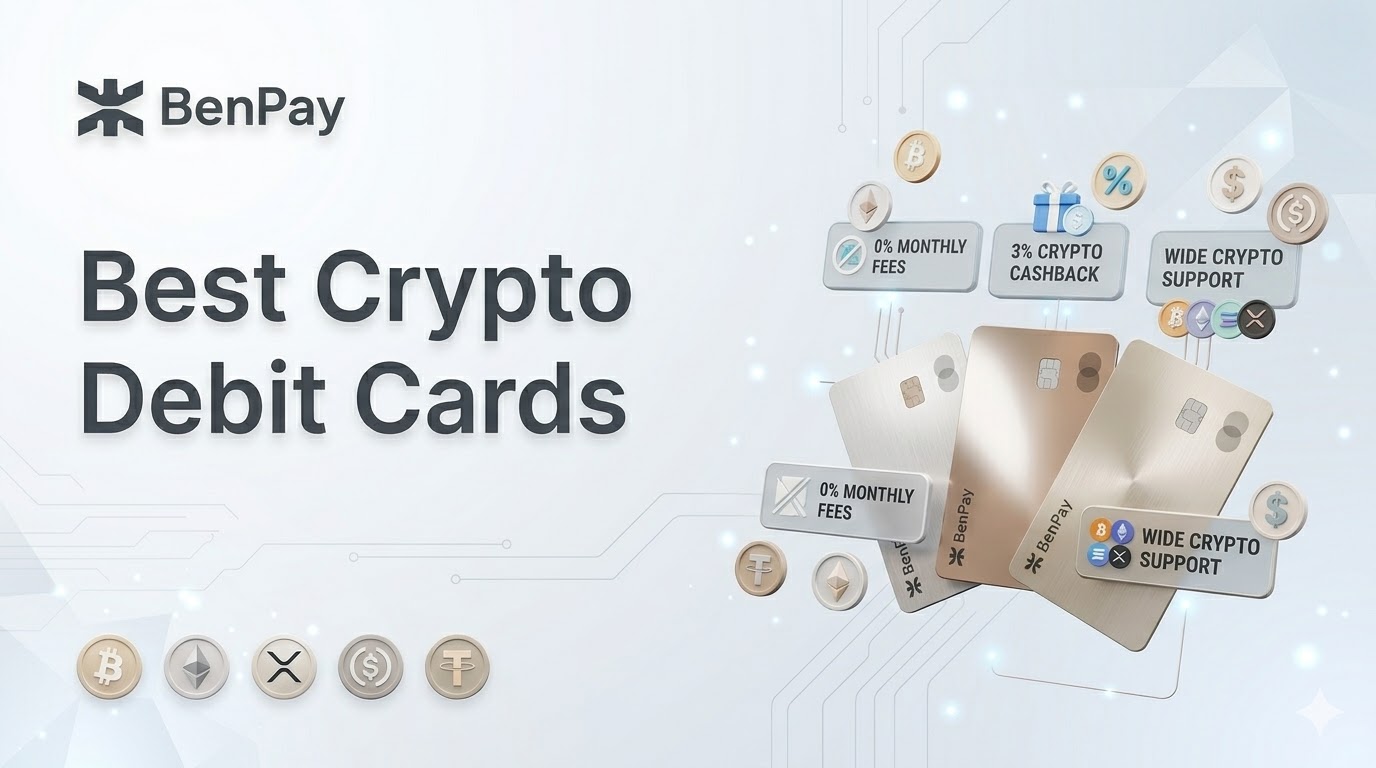
The best crypto debit card depends on what you actually need it for — there’s no single “best” option for everyone. A card built for cashback maximizers won’t be the same one that suits users who want self-custody or Alipay/WeChat Pay support. Rather than ranking cards on a single scale, this guide recommends top picks across five common use cases and explains what each does well and where it falls short. BenPay Card is included as one of the options evaluated.
Our Top Picks
| Use Case | Card | Why |
| Self-custody | BenPay Card | Self-custodial wallet + Asian payment support (varies by tier) |
| Cashback | Crypto.com Card | Up to 5% rewards with CRO staking |
| Europe users | Gnosis Pay | Self-custodial Visa card with no added FX fees |
| Zero-fee simplicity | Bleap | No FX fee, no monthly fee |
| Stablecoin + DeFi | BenPay Card | Bridge → Earn → Spend workflow |
Now let’s look at what each pick does well — and where it falls short.
What Makes a Crypto Debit Card “Best”? It Depends on What You Need
Before diving into specific products, it helps to recognize that different users define “best” in completely different ways:
- Security-first users → Self-custody is the top priority. They want to hold their own private keys and authorize card top-ups via on-chain signatures rather than trusting a platform with their funds.
- Rewards-focused users → Cashback percentage and subscription perks matter most. They’re willing to stake tokens or use a custodial platform to unlock higher rewards.
- Users in Asian markets → Alipay and WeChat Pay compatibility is a dealbreaker. Most crypto cards don’t offer this.
- Cross-border spenders → Low or zero FX fees and broad regional coverage determine which card actually saves them money.
- DeFi-active users → They want their card connected to the same ecosystem where they earn yield — no app-switching, no manual transfers.
There’s no card that wins across all five dimensions. The right choice comes from matching the card’s strengths to your actual usage pattern.
Best Crypto Debit Cards by Use Case
Best for Self-Custody — BenPay Card
BenPay Card is a self-custodial Web3 payment card built on the BenFen blockchain — a Layer 1 chain designed for payment and financial applications. You hold your own private keys in BenPay Wallet, and every card top-up requires your on-chain signature. Assets remain in your wallet until you actively load them onto the card.
What it does well:
- Three card tiers (Alpha / Sigma / Delta) with zero annual fee
- Supports Apple Pay, Google Pay, Alipay, and WeChat Pay — though supported payment methods vary by card tier (e.g., Alpha supports Apple Pay / Google Pay; Sigma supports Alipay / WeChat Pay). Check the card comparison page for tier-specific details
- Multi-chain stablecoin top-up (USDT/USDC on 10+ chains)
- Alpha tier supports up to 200,000 USD per card
- Integrated with DeFi Earn and cross-chain bridge in the same app
Where it falls short: No cashback or token rewards program. The BenFen ecosystem is still growing compared to Ethereum or established exchange ecosystems. Some features are region-dependent — verify availability for your country before applying.
Best for: Users who prioritize asset control over rewards; users who need Alipay or WeChat Pay (available on select tiers); anyone who wants wallet-card-DeFi in one app.
Best for Cashback Rewards — Crypto.com Card
Crypto.com offers one of the most established crypto card programs in the market, with a tiered rewards structure that can reach up to 5% cashback on spending — plus subscription perks like Spotify and Netflix reimbursements at higher tiers.
What it does well:
- Visa network with broad global coverage
- Tiered cashback up to 5% (requires CRO staking or Level Up subscription)
- Subscription perks at higher card tiers
- Apple Pay and Google Pay support
- Large existing user base and brand recognition
Where it falls short: Custodial — your assets sit in the Crypto.com exchange, and the platform controls access. Higher reward tiers require locking up CRO tokens, which exposes you to token price volatility. Fee structures and reward conditions vary by tier and jurisdiction, and have changed multiple times historically — always verify the current terms. Some tiers involve a Level Up subscription cost that offsets part of the cashback benefit.
Best for: Users already active in the Crypto.com ecosystem who are willing to stake CRO for higher rewards and accept custodial trade-offs.
Best for European / EEA Users — Gnosis Pay
Gnosis Pay is a self-custodial Visa debit card that connects directly to an on-chain wallet. It has positioned itself strongly in the European market with a clean fee structure and growing geographic coverage.
What it does well:
- Self-custodial — card is linked to your on-chain wallet
- No added FX fee from Gnosis Pay (Visa exchange rate applies)
- Apple Pay and Google Pay support
- No annual or monthly fees
- GNO token holders receive additional reward benefits
- Currently available in EEA, Switzerland, UK, and Brazil, with expansion planned
Where it falls short: Chain support is primarily centered around the Gnosis Chain ecosystem. Limited presence in Asian markets. Reward benefits are most compelling for GNO token holders — users outside the Gnosis community may find less incentive.
Best for: Web3-native users living in Europe or EEA countries, especially those already involved in the Gnosis/DAO ecosystem.
Best for Zero-Fee Simplicity — Bleap
Bleap offers a non-custodial (MPC-based) Mastercard with a straightforward proposition: no FX fee, no monthly fee, and cashback rewards — wrapped in a clean, simple interface.
What it does well:
- Non-custodial via MPC (Multi-Party Computation) key management
- No foreign exchange fee
- No monthly or annual fee
- Cashback rewards (check Bleap’s official site for current rates and promotions)
- Apple Pay and Google Pay support
- Also offers self-custodial yield products alongside the card
Where it falls short: Geographic coverage is currently limited to EEA + Switzerland — users outside this region cannot apply. MPC-based custody is different from traditional seed-phrase self-custody; some users may prefer full control over their own seed phrase. The product is relatively new, with a smaller track record compared to Crypto.com or MetaMask-adjacent ecosystems.
Best for: Users in the EEA/Switzerland who want a low-friction, low-fee crypto card without managing seed phrases directly.
Best for Stablecoin Spending + DeFi Integration — BenPay Card
BenPay Card appears again here — not as a repeat recommendation, but because it fits a genuinely different use case. While the first mention focused on self-custody and Asian payment methods, this one is about the full-cycle stablecoin workflow.
The flow: Hold stablecoins in BenPay Wallet → bridge assets from ETH, BSC, Polygon, Arbitrum, or other chains via the built-in bridge → earn yield through DeFi Earn → load earnings or principal onto the card → spend via Apple Pay, Google Pay, Alipay, or WeChat Pay (depending on card tier). All within one app.
This “bridge → earn → spend” loop is uncommon. Most crypto cards exist in isolation from DeFi — you earn yield in one app and spend in another. BenPay connects the two.
Where it falls short: DeFi yields are not guaranteed and carry smart contract risk. DeFi Earn involves protocol fees — check the current fee schedule on the official site. The BenFen chain ecosystem is smaller than Ethereum. Some card features are region-dependent.
Best for: Users holding significant stablecoin positions who want passive yield and everyday spending connected in a single workflow.
How to Choose — A Quick Decision Framework
If the five detailed profiles above feel like a lot, here’s a simplified path:
Start with your top priority:
- Control over my assets → BenPay Card or Gnosis Pay
- Maximum cashback → Crypto.com Card
- Lowest fees → Bleap or Gnosis Pay
- Alipay / WeChat Pay → BenPay Card
- DeFi yield + spending in one app → BenPay Card
Then filter by region: Not all cards serve all countries. Gnosis Pay and Bleap are strongest in Europe; BenPay covers Asian payment methods; Crypto.com has the broadest global footprint but is custodial.
Then check the fee schedule: Every card has a different cost structure. Look at the full picture — issuance fee + monthly fee + top-up fee + FX fee — not just one line item. For a deeper breakdown of fee dimensions and what to watch for, see our cryptocurrency debit card comparison.
FAQ
Q1: What is the best crypto debit card for beginners?
For complete beginners, the lowest-friction option is typically a custodial card tied to an exchange account you already use (such as Crypto.com), since it doesn’t require learning wallet management separately. However, if you’re already comfortable with self-custodial wallets, cards like BenPay Card or Gnosis Pay give you more control from the start. In either case, start with small spending amounts to test the top-up and payment flow before committing larger funds.
Q2: Are there crypto debit cards with no fees?
No crypto debit card is completely fee-free. Even cards with zero annual and monthly fees involve other costs: gas fees when loading funds on-chain, potential FX fees for cross-currency spending, and ATM withdrawal fees. Some cards like Bleap and Gnosis Pay minimize visible fees, but the underlying blockchain transaction costs still apply. Focus on total cost across all fee types rather than any single “zero fee” claim. For more on fee structures, visit the BenPay blog.
Q3: Can I use a crypto debit card with Apple Pay?
Most major crypto debit cards now support Apple Pay, and many also support Google Pay. After adding the card to Apple Wallet, you can tap-to-pay at any NFC-enabled terminal. BenPay Card additionally supports Alipay and WeChat Pay on select card tiers — which is uncommon in the crypto card space and particularly relevant for users in Asian markets.