
Quick Answer: Breaking the $2,500 Ceiling
For most crypto users, a standard daily limit of $2,500 is sufficient. However, for users looking to pay rent, buy a vehicle, or manage business expenses, this “Retail Ceiling” is a dealbreaker.
In 2025, the crypto cards offering the highest practical spending limits are Crypto.com Obsidian (Requires $400k Stake) and the BenPay Alpha Card (No Stake). While Crypto.com offers perks for the ultra-wealthy, BenPay provides the most accessible high-limit utility ($200,000 max balance) without requiring users to lock up six figures of capital in volatile tokens.
1. The Problem: When Your Card Says “No”
 Imagine you are at a car dealership. You have $50,000 in your crypto wallet. You try to pay the $10,000 down payment with your crypto card. Declined.
Why? Most crypto cards are designed for coffee and groceries. They impose strict limits to minimize fraud risk.
-
Daily Spending Cap: Often $2,500 – $5,000.
-
Monthly Spending Cap: Often $10,000 – $20,000.
-
ATM Cap: Often $200 – $1,000.
The Gap: High-net-worth individuals (HNWIs) and business owners need “Whale-Tier” limits to make crypto their primary spending vehicle.
2. Concept Explained: Why Do Limits Exist?
To unlock high limits, you must understand the regulatory machinery behind the card issuer. Limits are not arbitrary; they are Risk Controls.
The AML/KYC Tier System
Banks categorize users into risk buckets.
-
Tier 1 (Low Verification): Limit ~$500. (e.g., Email only).
-
Tier 2 (Standard KYC): Limit ~$2,500. (e.g., ID + Selfie).
-
Tier 3 (Enhanced Due Diligence): Limit $10,000+. (e.g., Proof of Address + Source of Funds).
The “Staking” Gatekeeper
Some platforms (like Crypto.com) use “Staking” as a proxy for trust. If you lock $400,000 of their token, they assume you are wealthy and reliable, granting you higher limits.
-
The BenPay Alternative: BenPay uses Self-Custodial Balance and KYC as the trust metric, rather than forcing you to buy a platform token. This decouples your spending power from your investment risk.
3. Top 3 High-Limit Cards Compared
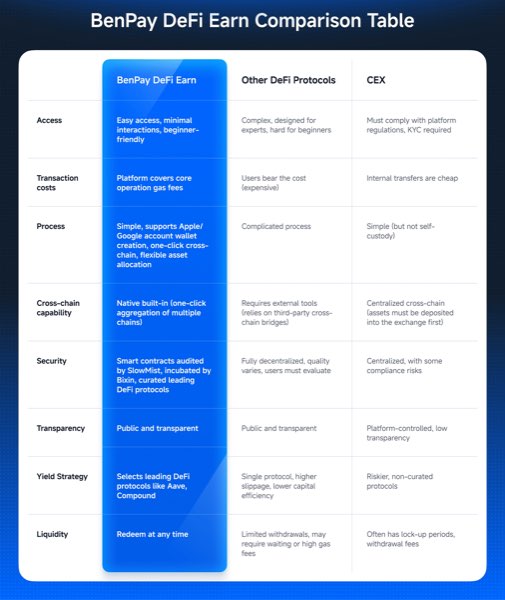 We evaluated cards based on Max Balance, Daily Spend Limit, and Capital Efficiency (Cost to unlock limits).
1. BenPay Alpha Card (The Liquid High-Roller)
Best for: Paying rent, taxes, and luxury goods without locking capital.
-
Max Balance: $200,000.
-
Daily Spend: High (Dynamic based on Tier).
-
Cost to Unlock: $9.90 (Opening Fee) + KYC. No staking required.
-
Funding: USDT/USDC.
-
Why it wins: It offers “Black Card” level utility without the “Black Card” annual fee or the $400k staking requirement. It is purely transactional.
2. Crypto.com Obsidian (The Status Symbol)
Best for: Users who already hold massive amounts of CRO.
-
Max Balance: Very High (Unlimited top-up for some regions).
-
Daily Spend: $25,000+.
-
Cost to Unlock: $400,000 staked in CRO.
-
Pros: 5% cashback, private jet partnership perks.
-
Cons: Extreme Capital Inefficiency. Locking $400k in a volatile altcoin is a massive opportunity cost. If CRO drops 10%, you lose $40,000—far more than any cashback value.
3. Coinbase Card (The Retail Standard)
Best for: Moderate spenders in the US.
-
Daily Spend: ~$2,500 (can request increase).
-
Cost to Unlock: $0.
-
Cons: Limits are often opaque and algorithmically determined based on your trading history. It is hard to predict if a $10,000 purchase will go through.
4. Deep Dive: High-Limit Use Cases
Why do you actually need a $20,000 limit? Here are the three most common scenarios we see.
Scenario A: The “Rent & Tax” Payer
-
The Bill: $4,500 Rent + $12,000 Quarterly Tax Payment.
-
The Challenge: A $2,500 limit card is useless here. Splitting payments often triggers fraud alerts.
-
The Solution: A card with a $200,000 balance cap allows you to execute these large, single transactions smoothly.
Scenario B: The Business Expense
-
The Bill: $15,000 for Server Costs (AWS) or Ad Spend (Google).
-
The Challenge: Business cards require consistency. One decline shuts down your ads.
-
The Solution: Pre-loading a “Business Buffer” of $50,000 onto a high-limit crypto card ensures operations never stop due to crypto volatility or low limits.
Scenario C: The Luxury Purchase
-
The Bill: $8,000 Family Vacation or Watch.
-
The Challenge: Travel agencies often require full payment upfront.
-
The Solution: Instant top-up from a self-custodial wallet allows you to move $8,000 from cold storage to the merchant terminal in minutes.
5. Step-by-Step Guide: How to Safely Spend Large Amounts
Spending $10,000 is different from spending $10. It requires a “Warm-Up” strategy to avoid freezing your account.
Phase 1: Verification (The Paperwork)
-
Complete KYC: Ensure your ID and Selfie are approved.
-
Prepare SOF: For very high limits (Tier 3), be prepared to show Source of Funds (e.g., a screenshot of your wallet history or a pay stub). This is standard AML procedure for any financial institution handling large sums.
Phase 2: The “Warm-Up” (Building Trust)
-
Day 1: Load $200. Buy groceries.
-
Day 3: Load $1,000. Pay a utility bill.
-
Day 7: Load $5,000.
-
Why? If you open a new account and immediately drop $50,000, AI fraud systems will flag it. Gradual scaling builds a “Trusted Device” profile.
Phase 3: The Execution
-
Fund Wallet: Ensure you have USDT (Stablecoin). Do not use BTC for large purchases to avoid slippage during the transaction setup.
-
Top Up Card: Move the specific amount (e.g., $15,000) to the BenPay Alpha Card.
-
Fee Check: Verify 0% Top-Up Fee. (Crucial for large amounts. 1% of $15k is $150).
-
-
Notify (Optional): For transactions >$10,000, it is sometimes wise to contact support to “whitelist” the transaction, just like you would call a bank before a foreign trip.
6. Financial Analysis: The Cost of High Spending
Let’s compare the cost of spending $50,000 per year through different card programs.
The Verdict: For high-volume spenders, BenPay is the most mathematically efficient.
-
Coinbase kills you with the 2.49% fee ($1,245 loss).
-
Crypto.com kills you with Opportunity Cost (Your $40k could have earned $2,000 in DeFi).
-
BenPay costs you $9.90.
7. Risk Disclosure: The Reality of “Big Money”
Handling large sums on a prepaid instrument carries specific risks.
1. Account Freezes (Source of Funds)
-
The Risk: Sending $50,000 to a card triggers Anti-Money Laundering (AML) algorithms.
-
The Reality: Your account might be temporarily paused for a “Manual Review.”
-
Mitigation: Have your blockchain transaction history ready. Transparency unlocks accounts quickly.
2. Merchant Holds
-
The Risk: Paying a $500 deposit at a hotel reduces your $20,000 limit to $19,500.
-
Advice: Always use a credit card for deposits and the crypto card for the final bill.
3. Lack of Consumer Protection
-
The Issue: Unlike a Credit Card, a Crypto Debit Card generally does not offer “Purchase Protection” or “Chargeback” rights for dissatisfaction. If you buy a $10,000 car and it breaks, you cannot just “charge back” the crypto.
-
Advice: Only use high-limit crypto cards with reputable merchants.
8. FAQ
Q: Can I withdraw $10,000 cash from an ATM? A: No. While the card balance can hold $200,000, ATM networks have physical limits (usually $1,000 – $2,000 daily). High limits apply to POS (Point of Sale) swipes, not cash withdrawals.
Q: Is the BenPay Alpha Card metal? A: It is primarily Virtual for instant high-limit access via Apple Pay. This avoids the shipping delays associated with physical high-tier cards.
Q: Does spending $100,000 affect my credit score? A: No. This is a debit instrument. It does not report to credit bureaus, which can be a benefit (keeps utilization low) or a drawback (doesn’t build history), depending on your goals.
9. Conclusion
High spending limits in crypto are no longer reserved for early Bitcoin adopters who can stake $400,000. In 2025, utility is democratized.
The BenPay Alpha Card breaks the “Pay-to-Play” model. By offering a $200,000 limit with 0% fees and no staking, it respects the liquidity needs of modern high-net-worth individuals. It transforms crypto from a “holding asset” into a “living asset.”
Unlock your purchasing power. Download BenPay, verify your identity to unlock Tier 2/3 limits, and make your first major purchase today.
Disclaimer: Limits are subject to individual KYC/AML verification. High-value transactions may require additional documentation. Cryptocurrency investments involve risk.