
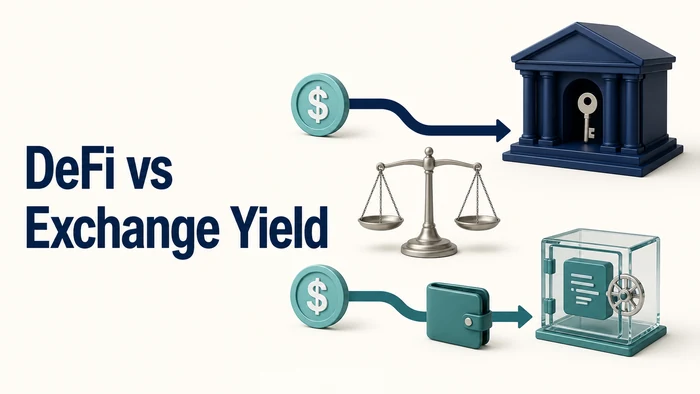
Someone sees a stablecoin yield product advertised on a crypto exchange, then finds a DeFi protocol advertising a noticeably higher APY on what looks like the same stablecoin. The natural assumption is that the higher number is simply the better deal. That assumption skips a question that matters more than the rate: who actually holds the funds while they earn, and what happens if something goes wrong. Custody and risk type differ sharply between DeFi yield and exchange yield products, even when the advertised APY looks similar. This comparison walks through what custody means in each case, how the risks differ, and what actually determines which option fits a given situation.
What “Better” Actually Means Here
“Better” can mean a higher rate, easier access, fewer steps to set up, or stronger guarantees about where the funds actually are. These do not always point the same direction. A product that is simple to use may also mean handing control of the funds to someone else. A product that keeps control with the holder may also require more steps to set up and monitor. Before comparing rates, it helps to separate four questions: who holds the funds, where the yield comes from, what withdrawal actually looks like, and how much of this can be checked independently. Each is covered below.
Who Holds the Funds
Exchange yield products: custodial by default
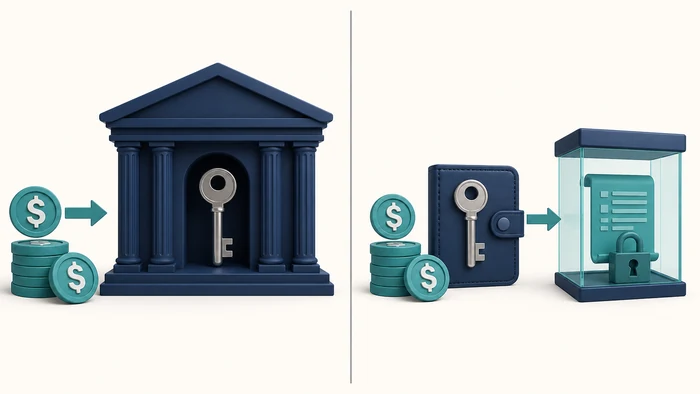
On a crypto exchange, depositing funds into a yield or earn product means the exchange acts as a custodian, holding the private keys and administering the position. The holder has a claim on the exchange, not direct control of the assets on-chain. This arrangement is generally easier to set up: no wallet management, no separate transaction signing. The condition attached to that ease is trust — the holder is relying on the exchange’s solvency, security practices, and willingness to process withdrawals as promised.
DeFi yield: non-custodial by design
DeFi yield products, part of the broader decentralized finance category, work differently. Funds stay in a wallet the holder controls and interact directly with a protocol’s smart contracts. No intermediary is holding the assets on the holder’s behalf. This removes the exchange-solvency question, but it introduces a different one: the protocol’s code, not a company’s policies, decides what happens to the funds. A bug or exploit in that code is a real possibility, and there is no customer service line to call if the contract behaves unexpectedly.
Where the Yield Actually Comes From
What funds exchange yield
Exchange yield is typically funded by the exchange’s own lending or staking operations, sometimes with a commission taken from the underlying reward before it reaches the depositor. Some exchange products are also run at promotional or subsidized rates for a limited time, which is one reason a rate seen today may not hold next quarter. The published rate does not always disclose which of these is happening.
What funds DeFi yield
DeFi yield can come from several distinct sources: interest paid by borrowers in a lending pool, a share of trading fees generated by a decentralized exchange, or staking rewards tied to network security. Separately, some protocols pay part of their advertised yield in the protocol’s own token as an incentive, on top of these organic sources. A rate built mostly on lending interest or trading fees behaves differently over time than one leaning heavily on token incentives, since incentive programs can be reduced or ended.
What Happens at Withdrawal
Exchange lock-ups and processing time
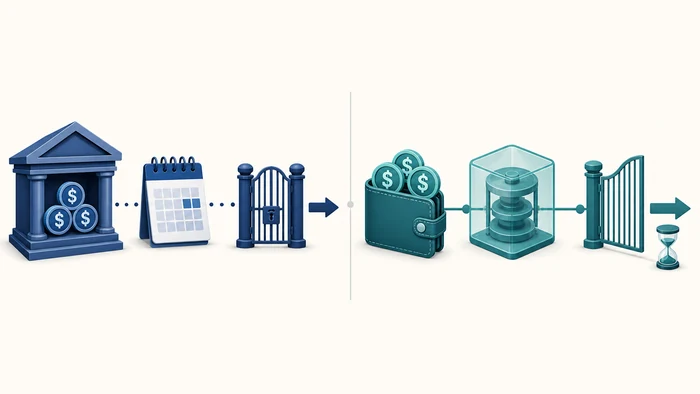
Exchange earn products range from flexible balances that can be withdrawn on short notice to fixed-term tiers that lock funds for a set period in exchange for a higher advertised rate. Flexible tiers are easier to exit but often pay less than locked ones. Fixed terms mean the funds are genuinely unavailable until the term ends, regardless of what the holder needs in the meantime.
DeFi redemption terms
DeFi protocols vary as well. Some support redemption at any time, limited mainly by network conditions. Others impose a waiting or unbonding period built into the contract itself, during which the funds cannot be moved even if the holder wants them elsewhere. Reading the specific protocol’s redemption terms before depositing matters more than the headline rate.
How Much of This Can Actually Be Checked
Exchange disclosures
An exchange’s yield operations may not be independently visible to the depositor. A depositor sees the advertised rate and the balance in the account, but not the underlying lending book or how conservatively it is managed. Independent confirmation depends on the exchange’s own audits, reserve attestations, or regulatory disclosures, where they exist.
DeFi on-chain verifiability
A DeFi protocol’s smart contract code and the current state of every deposit are typically public on the blockchain, so anyone can, in principle, verify what a contract is doing. In practice, reading raw contract code requires technical skill most depositors do not have, so this verifiability is real but not always usable without help. A published third-party audit narrows that gap somewhat, though an audit reduces risk without eliminating it.
Choosing Between the Two
No single answer fits every situation, since the two options score differently on each of the four questions above. The table below lines them up at the category level.
| Factor | Exchange yield products | DeFi yield |
|---|---|---|
| Custody | Held by the exchange; holder has a claim, not direct control | Held in the holder’s own wallet throughout |
| Yield source | Exchange lending/staking operations, sometimes commission-adjusted or promotional | Lending interest, trading fees, or staking rewards; sometimes supplemented by token incentives |
| Withdrawal terms | Ranges from flexible to fixed-term lock-ups set by the exchange | May be immediate when liquidity and protocol terms allow, up to a protocol-defined waiting period |
| Verifiability | Limited to the exchange’s own disclosures and any external audits | Contract and balances are publicly visible on-chain, though reading them requires technical skill |
| Main risk | Counterparty risk — depends on the exchange remaining solvent and cooperative | Smart contract and protocol risk — depends on the code and market conditions behaving as expected |
What the table actually says: Exchange yield trades direct control for convenience and depends on one institution behaving well over the whole holding period. DeFi yield trades that convenience for direct control, but shifts the main risk onto the protocol’s code and the holder’s own ability to use a wallet correctly. Neither row is a strictly safer bet than the other — a poorly managed DeFi protocol can fail as badly as a poorly managed exchange, and a well-run exchange can be more dependable in practice than an obscure, unaudited protocol. The deciding factor is which specific risk a given holder is better positioned to evaluate: an institution’s disclosures, or a protocol’s contract and audit history.
A practical way to narrow the choice: someone who wants minimal setup and is comfortable relying on an exchange’s track record leans toward exchange yield. Someone who wants to keep direct control of assets, and is willing to check a protocol’s audit and redemption terms before depositing, leans toward DeFi yield. Someone unsure which they are should start with a small amount in whichever option they choose, since either category can be tested at low stakes before committing more.
A Self-Custodial Route for DeFi Yield: BenPay DeFi Earn
For holders who prefer key control but do not want to open separate positions across multiple DeFi interfaces, BenPay DeFi Earn brings selected multi-chain strategies into the BenPay wallet. Assets remain controlled by the holder’s private key, and BenPay covers the BenFen gas cost for depositing and redeeming. This makes the practical difference clear: exchange yield puts an institution between the holder and the position, while DeFi Earn keeps the authorization in the wallet and reduces the manual setup needed to reach a selected strategy.
The selected strategy still sets the yield and redemption terms. Its underlying smart contracts remain part of the decision, so the route is for holders who value self-custody and a simpler DeFi entry, not a substitute for understanding the strategy being authorized.
Frequently Asked Questions
Is exchange yield ever non-custodial?
Not in the traditional sense. Depositing into an exchange’s yield or earn product means the exchange holds the assets and administers the position on the holder’s behalf. Any product that keeps assets in a personal wallet, even if accessed through an exchange’s interface, works differently and should be checked individually.
Does a higher advertised rate mean higher risk?
Not automatically, but it is worth checking why the rate is higher. A rate funded mainly by lending interest or trading fees behaves differently than one propped up by temporary token incentives or a promotional period, even when the two numbers look similar today.
Can DeFi yield be withdrawn instantly?
It depends on the specific protocol. Some support redemption at any time with minimal delay. Others include a waiting period built into the contract, so the redemption terms should be checked before depositing rather than assumed.
Does a smart contract audit mean the funds are safe?
An audit lowers the chance of certain coding errors being exploited, but it does not remove market risk or guarantee against every possible failure. Audited protocols have still experienced losses under specific conditions, so an audit is one data point, not a guarantee.