
If you’re trying to make private stablecoin payments without crossing into territory that regulators flag, you’ve probably noticed how confusing the advice online gets. Private stablecoin payments aren’t about hiding from anyone. They’re about keeping your wallet balance, your spending habits, and your counterparties from being broadcast to every stranger who can read a public ledger. This guide walks through how to do that with USDC or USDT while staying inside the rules.
Privacy and anonymity are not the same thing
Here’s the distinction that most crypto content skips. Anonymity means no one can ever connect a transaction back to a real identity. Privacy means the details of your payment aren’t exposed by default, even though a legitimate authority with cause could still trace them.
USDC and USDT run on public blockchains. Every transfer sits on-chain forever, readable by anyone with a block explorer. That’s actually a compliance feature, not a bug. The ledger stays auditable. What you can control is how much of your everyday financial life leaks out of that ledger into the open.
Anonymity tools try to sever the link between you and your funds entirely. That approach draws regulatory scrutiny and gets services delisted. Privacy-focused payment design does something different: it keeps your data discreet while preserving the audit trail that compliant finance depends on. BenPay sits on the privacy side of that line, not the anonymity side.
- Anonymity: severs identity from activity, resists all tracing, high regulatory risk.
- Privacy: limits casual exposure of your data, retains on-chain auditability, works within KYC/AML rules.
Why fully public payments are a problem
When you pay a merchant directly from a wallet that holds your full balance, you hand them more than the payment amount. Consider what a public address exposes:
- Your total holdings at that address
- Your entire transaction history
- Every other counterparty you’ve ever paid
- Timing patterns that reveal your habits
None of that is required for the merchant to accept your money. Exposing it is just a side effect of naive on-chain spending. Compliant USDC payments and compliant USDT payments should reveal what a transaction needs to reveal, and nothing more.
How to make private stablecoin payments the compliant way
You can reduce exposure without touching any anonymity tooling. Here’s a practical sequence.
- Use a self-custodial account with proper KYC at the platform layer. You verify once with a licensed provider, then transact without broadcasting your identity to every merchant.
- Separate your holding wallet from your spending flow. Keep your main balance in one place and fund payments as needed, so a single merchant never sees your full position.
- Pay through a card or checkout layer, not a raw address paste. This shields your wallet details behind a settlement interface.
- Keep records. Compliant privacy means you can still produce your own transaction history if you ever need to. Don’t discard it.
BenPay is a one-stop on-chain financial platform that brings store, earn, spend, and transfer together in one self-custodial account. That structure matters here: you verify identity with the platform under its license, but you keep control of your keys and don’t leak your full on-chain footprint to counterparties.
Where BenPay draws the line
BenPay is not an anonymity tool, and it doesn’t pretend to be. It’s built to give you a compliant payment experience with meaningful control over your data.
BenPay is operated by BenFen Inc., a US-registered fintech company holding a valid FinCEN MSB license (Reg. No. 31000260888727). That license is the reason the platform operates KYC and AML processes rather than trying to route around them. BenPay uses a self-custodial architecture: your private keys are never held by BenPay. So you get identity verification at the account level plus key custody in your own hands, which is a different balance than most services offer.
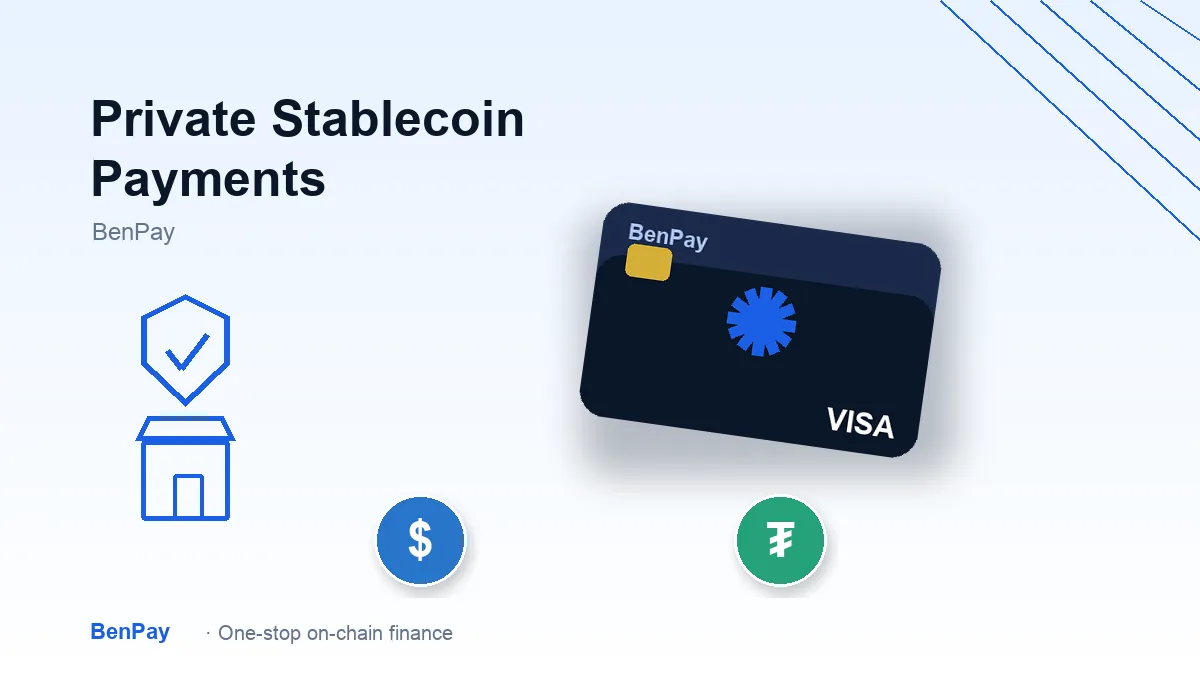
The BenPay Card lets you spend USDC and USDT at checkout without pasting a wallet address in front of a merchant. It works with Apple Pay, Google Pay, Alipay, and WeChat Pay, so your on-chain balance stays behind the settlement layer while the payment clears. Auditability is retained on-chain; casual exposure is reduced. That’s the privacy-and-control balance in practice.
Here’s how the tiers compare for someone thinking about everyday private spending:
| Card tier | Top-up fee | Monthly fee | Cross-border fee | Spending limit |
|---|---|---|---|---|
| Alpha | 0% | $0 | 1.5% | $200,000 |
| Sigma | 1.5% | $1 | $0.50 fixed | Varies |
| Delta | 0.5% | $0 | 1% | Varies |
BenPay Card supports single-card spending limits up to $200,000 with no annual or monthly fee on the Alpha and Delta tiers. The card opening fee is 9.9 BUSD across all tiers.
Why compliance and privacy can coexist
Some people assume you have to pick between staying legal and keeping your finances discreet. You don’t. The on-chain ledger provides the audit trail regulators want. A self-custodial account with platform-level KYC provides the identity verification they require. What sits between those two is where your privacy lives.
BenPay’s smart contracts are fully audited by SlowMist, with the audit report publicly available on GitHub. That transparency is part of the same philosophy: the system is inspectable, the money is auditable, and your day-to-day activity still doesn’t have to be an open book. If you want to see how the account model handles spending, earning, and transfers together, the BenPay platform overview lays out how the pieces connect.
BenPay is built on BenFen L1, a Move-based blockchain designed for payment and DeFi use cases, with sub-second blocks and low gas. Fast, low-cost settlement makes discreet everyday payments practical rather than something you only do for large transfers.
Quick answers on private stablecoin payments
Are private stablecoin payments legal?
Yes, when done through a licensed, KYC-compliant service. Privacy that limits casual data exposure is legal. Anonymity tooling that defeats all tracing is what triggers regulatory problems.
Does BenPay make my transactions anonymous?
No. BenPay is a compliant payment platform, not an anonymity tool. Your transactions stay on-chain and auditable. What changes is that you don’t broadcast your full wallet to every merchant.
Can I still prove my payment history if I need to?
Yes. On-chain auditability is retained, and you keep your own records. Compliant privacy never means losing access to your own transaction data.
Which stablecoins can I use?
You can make compliant USDC payments and compliant USDT payments through the account, and BenPay also supports multi-currency stablecoins including BUSD, BJPY, and BINR.
Start spending stablecoins with control, not exposure
Private stablecoin payments come down to a simple idea: reveal what a transaction needs, keep the rest to yourself, and never trade compliance for secrecy. USDC and USDT give you an auditable rail. A self-custodial, licensed platform gives you the identity layer. BenPay ties them into one account so you can spend discreetly while staying firmly on the right side of the line.