
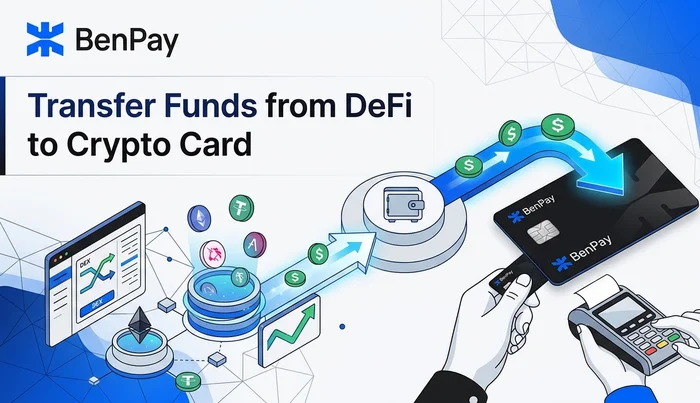
If you earn on DeFi protocols, you likely hold your profits in tokens or LP positions that sit in your wallet. But what if you want to spend that DeFi yield in everyday life—restaurants, online shopping, travel—like regular money?
You can move DeFi funds into a crypto card that turns those assets into real-world spending power. This article walks you through exactly how to move DeFi funds to a crypto card for spending, including common pitfalls and how platforms like BenFen / BenPay help DeFi-savvy users bridge earning and spending in one integrated ecosystem.
Why Move DeFi Funds to a Crypto Card?
Moving DeFi funds to a crypto card makes it easier to use your yield where it matters most: everyday purchases.
- Turn DeFi rewards into spending power Instead of keeping your LP tokens or staking rewards locked in protocols, you can move them into a card-ready balance and spend them like cash.
- Avoid extra CEX steps Many crypto cards let you top-up directly from your wallet or a DeFi-friendly platform, so you don’t have to route everything through a centralized exchange.
- Keep DeFi‑linked rewards active while you spend Some platforms, such as BenFen, let you earn on DeFi-linked balances while still preparing them for card-based spending, so you don’t fully exit the DeFi ecosystem.
What You Need Before Moving DeFi Funds
Before you start moving DeFi funds to a card, you’ll need a few basics in place. This helps you avoid gas-waste, failed transfers, or security issues.
- A self-custody wallet (like MetaMask, Rabby, or similar) connected to DeFi protocols where you earn.
- A DeFi-friendly crypto card provider; some platforms are built for CEX users, while others—like BenFen—are designed to work smoothly with DeFi-style earning and wallet flows.
- Your KYC done and card account set up (app or web account, card activation, PIN setup).
- A basic understanding of gas fees, network costs, and why stablecoins (USDT, USDC, DAI) are usually better for spending than high-volatility tokens.
Once you have these ready, you can move on to the actual steps.
Step-By-Step: Move DeFi Funds to a Crypto Card
This section walks you through how to move DeFi funds to a crypto card step-by-step, from protocol to card-linked balance.
Step 1 – Prepare Your DeFi Assets for Spending
Most crypto cards work best when you feed them stablecoins or widely accepted tokens, not raw LP positions or niche altcoins.
- If you’re in a liquidity pool, withdraw your LP tokens and redeem them into stablecoins (USDT, USDC, DAI).
- If you’re in a staking pool, withdraw your rewards and, if possible, convert volatile tokens into stablecoins.
- Platforms like BenFen’s DeFiearn layer let you optimize your yield and convert it into more spend-ready balances before you even leave the DeFi ecosystem.
Before you move anything, check:
- Estimated gas fees on the current network.
- Any protocol withdrawal or early-unlock penalties.
This helps you avoid wasting DeFi-earned value on fees or penalties.
Step 2 – Move Assets from Your Wallet to the Card Platform
Once your assets are in a wallet-ready form, you can send them to the card’s funding layer. The exact flow depends on the provider, but the general idea is the same.
- Connect your wallet to the card provider’s platform (web app or integrated dApp).
- Approve the token transfer or allowance on the network you’re using.
- Send the desired amount to the provider’s deposit or card-top-up address.
On platforms like BenFen / BenPay, this flow is designed to feel natural for DeFi users:
- You can move earned assets into your BenPay account, where they can be used to top-up your card directly.
- Your balance can sit as a crypto-native balance that’s still backed by DeFi-style earning, yet ready for card‑based spending.
Make sure to:
- Confirm the correct network (e.g., Ethereum, BSC, Arbitrum).
- Send a small test amount first if you’re trying a new provider.
Step 3 – Rebalance or Convert on the Card Platform
Once your funds arrive, most card platforms let you manage or convert them before they hit your card.
- Some providers automatically convert crypto to local fiat at the point of sale.
- Others let you pre-convert your balance into a stable or fiat‑pegged currency inside the app.
- This is especially useful if you want to lock in a stable value before spending.
On systems like BenFen, the platform can handle much of this conversion behind the scenes, so you don’t have to manually swap tokens each time you want to spend. Instead, you:
- Earn on DeFi-linked balances.
- Move them into a card-ready balance.
- Let the platform convert at the right moment, often with transparent FX spreads.
Step 4 – Activate or Top-Up the Card and Start Spending
After your funds are ready, the final step is to activate or top-up the card and start using it.
- If you’re using a virtual card, you can usually activate it instantly in the app and add it to Apple Pay or Google Pay.
- If you’re using a physical card, you may need to wait for shipping and then activate it in the app.
- You can then top-up the card balance manually or set it up for auto-top-up when your balance gets low.
With a card‑focused platform like BenFen, you can:
- Spend your DeFi-earned yield directly.
- Take advantage of any rewards, cashback, or perks the card offers for eligible purchases.
- Keep most of your capital still earning in DeFi-linked products until you actually spend it.
How BenFen Makes Moving DeFi Funds to a Card Easier
Getting DeFi funds into a crypto card isn’t always simple, especially if you’re juggling wallets, CEX transfers, and multiple apps. Platforms like BenFen are built to make this flow smoother for DeFi-focused users.
DeFi-Earn Integration Before Spending
BenFen lets you earn on DeFi protocols through its DeFi-earn layer, which sits between your wallet and your card-linked balance.
- Instead of bouncing your funds through a CEX, you can:
- o Earn on DeFi-linked positions.
- o Withdraw or convert those earnings into a card-ready balance.
- This keeps your funds in crypto-native rails while still preparing them for everyday spending.
Single Platform for Earn and Spend
One of the biggest UX wins is having one dashboard where you can manage both earning and spending.
- You can see your DeFi-earn balances, card balances, and recent transactions in one place.
- This reduces the need to constantly switch between wallets, CEXs, and card apps.
- For users who move DeFi funds to a crypto card often, this single-platform approach can save time and reduce errors.
Security, Limits, and Support
When moving DeFi funds into any card‑linked balance, security and compliance matter.
- BenFen enforces KYC, 2FA, and transaction limits to reduce fraud and unauthorized spending.
- The platform also provides clear information about funding limits, FX spreads, and card‑usage rules.
Common Pitfalls When Moving DeFi Funds to a Crypto Card
Even if you follow the steps, it’s easy to make mistakes that eat into your DeFi yield or block your ability to spend.
- Sending volatile tokens instead of stablecoins Some cards prefer stablecoins for top-ups. If you send a highly volatile token, you may face higher fees or rejection.
- Ignoring gas fees and timing Sending large amounts during peak network congestion can mean high gas costs that cut into your profits.
- Not checking card reload limits or FX fees Many crypto cards have daily or monthly reload limits and foreign-exchange spreads; failing to check them can slow down or block your spending.
- Using the wrong network or address Sending assets to the wrong chain or address can lead to lost or frozen funds until you contact support.
Platforms like BenFen help reduce these risks by:
- Showing clear network and address info in the interface.
- Highlighting estimated fees and balances before you confirm any transfer.
FAQ About Moving DeFi Funds to a Crypto Card
Here are some common questions users have when they want to move DeFi funds to a card.
Can I spend DeFi LP tokens directly on a card?
Most crypto cards cannot spend raw LP tokens directly. You typically need to:
- Redeem your LP tokens into stablecoins or supported tokens.
- Then move those into your card-linked balance.
Some platforms, including BenFen, make it easier to convert DeFi-linked positions into spend‑ready balances without leaving the app.
What’s the cheapest way to move DeFi funds to a card?
The cheapest way usually involves:
- Using low-fee networks (e.g., Arbitrum, Polygon, or similar) when possible.
- Avoiding unnecessary CEX swaps and routing funds directly from your wallet or DeFi-earn layer.
- Sending funds during low-gas periods if you’re on Ethereum mainnet.
Platforms that integrate DeFi-earn and card‑funding—like BenFen—can help you cut out costly hops.
Is it safe to move DeFi funds to a card-linked account?
Moving DeFi funds to a card–linked account can be safe if you:
- Use a reputable provider with KYC, 2FA, and clear security policies.
- Double-check addresses, networks, and amounts.
- Start with a small test transfer.
Systems like BenFen are designed to keep your funds secure while still giving you easy access via a card.
How fast does the card get funded after I move funds from DeFi?
Funding speed depends on:
- Network confirmation time (usually minutes to a few hours).
- The provider’s internal processing time (often instant or near-instant for deposits).
Once the deposit is confirmed, most platforms let you top‑up your card balance immediately or within a short window.