
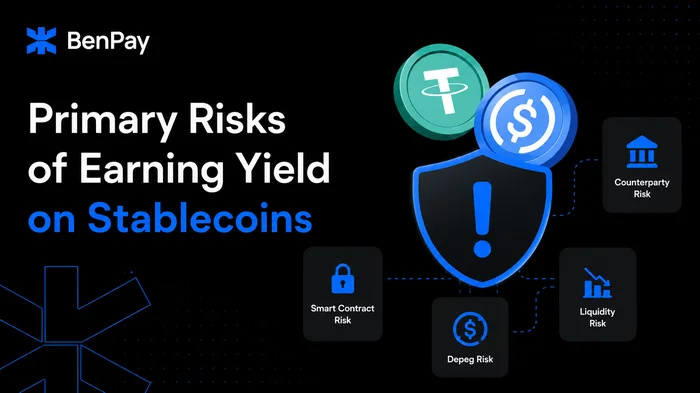
If you’re earning yield on USDT or USDC, you’re betting on more than just “stable” returns. You’re navigating a web of depeg risk, counterparty exposure, protocol bugs, and regulatory uncertainty all wrapped in a simple APY number.
In this guide, you’ll see exactly what can go wrong when you earn yield on USDT or USDC, how to assess your own risk tolerance, and where a product like BenPay DeFi Earn fits into a safer, more structured yield strategy.
Why People Chase Yield on USDT and USDC
Many crypto users treat USDT and USDC as “safe” digital dollars—pegged to the U.S. dollar, built on major blockchains, and accepted almost everywhere. Because of that, they’re popular for earning yield:
- Lending on platforms that pay 5–10%+ APY in some cases.
- Participating in DeFi protocols like Aave and Compound, where liquidity providers earn interest from borrowers.
For many users, the idea is simple:
“Keep my money in USDT or USDC. Get some extra yield. Don’t swing with the price of Bitcoin or Ethereum.”
But that assumption hides six big risk buckets—and if you don’t understand them, yield can turn into loss.
Risk 1: Stablecoin‑Specific Risks (Depeg and Issuer Risk)
Even “stable” coins aren’t risk‑free. The first thing you need to question is: how stable is that peg really?
USDT: Reserve and Issuer Risk
- USDT is issued by Tether, and its reserves are a mix of cash, cash-equivalents, and other assets.
- Any regulatory crackdown, liquidity stress, or loss of trust in Tether can trigger a temporary depeg, even if the peg is restored later.
If you’re earning yield on USDT and a depeg happens, you need to ask:
- Are you locked up right now?
- Is the cited APY still accurate when the peg is 95% instead of 100%?
USDC: Regulatory and Banking-Partner Risk
- USDC is issued by Circle and is often seen as more transparent than USDT, backed by cash and short-term Treasuries.
- But it’s still exposed to banking-partner shocks—like the 2023 SVB episode—and to regulatory changes.
If you’re a user earning yield on USDC, you’re not just exposed to the protocol risk, you’re also exposed to issuer risk. A depeg event can slice through your yield or even wipe out a portion of your balance if you exit at the wrong time.
Risk 2: Counterparty and Custodial Risk
Where you keep your USDT or USDC matters a lot.
Centralized yield platforms
Many CeFi platforms let you “earn yield” on USDT or USDC simply by depositing into their app. Behind the scenes, your funds sit on their balance sheet, not in your own wallet. That introduces counterparty risk:
- Insolvency, leverage mismatches, or frozen withdrawals.
- “Redemption gates” or withdrawal limits in stressed markets.
You, as a user, are effectively lending to the platform, not to a transparent DeFi protocol. That’s why the phrase “not FDIC-insured” matters even for stablecoins.
DeFi vs hybrid models
True DeFi lending (like Aave, Compound) usually keeps your USDC or USDT in a non‑custodial smart contract, so you’re not dependent on the platform’s balance sheet.
Hybrid models (like some “DeFi Earn”-style products) try to give you the best of both worlds:
- Direct exposure to DeFi protocols,
- But with a simplified user experience wrapped into one app.
For example, BenPay DeFi Earn routes user deposits to audited lending protocols (such as Aave and Compound) on its own BenFen blockchain, letting you earn yield without managing dozens of wallets and chains yourself.
Risk 3: Smart Contracts and DeFi Vulnerabilities
Just because yield is “on-chain” doesn’t mean it’s safe. DeFi has its own attack surface.
What can go wrong?
- Un-audited or buggy smart contracts can be exploited in re-entrancy bugs, flash-loan attacks, or oracle manipulations.
- Governance bugs or rushed upgrades can lead to funds being drained or misallocated.
Even popular protocols have been hacked or exploited in the past, which is why many users treat “APY” as a headline, not a guarantee.
How to protect yourself as a user
- Prefer protocols that have been audited by reputable firms and have a long, transparent track record.
- Avoid protocols that promise “too-good-to-be-true” yields backed by opaque or unevaluated mechanisms.
Hybrid products like BenPay DeFi Earn emphasize using audited protocols and routing contracts that are themselves audited by firms such as SlowMist, which helps reduce the layer of smart-contract risk for the user.
Risk 4: Liquidity, Lockups, and Redemption
Yield sounds attractive until you can’t get your money out.
Illiquid or gated withdrawals
Some platforms promise high APY but guard that yield with strict withdrawal rules:
- T+7, T+10, or even longer redemption windows.
- Caps or “gates” that slow or block withdrawals during market stress.
If you’re earning yield on USDT or USDC and you need cash quickly, you might realize your liquidity risk > your APY benefit.
Redemption design matters
Better-designed products let you choose between:
- Instant or very short redemption for lower APY,
- Or longer lock-in for higher APY.
As a user, you should match your time horizon and liquidity needs to the product’s redemption terms. BenPay DeFi Earn, for example, offers different redemption options (including Instant and T+10) so you can decide whether you want flexibility or extra yield.
Risk 5: Regulatory and Compliance Uncertainty
Crypto yield is still in a gray area in many jurisdictions.
What users face
- Governments may change rules around stablecoins, lending, or cross‑border transfers overnight.
- Some platforms or card-linked products may be restricted or shut down in certain countries.
KYC and card-linked products
If you’re using a crypto card that spends USDC or USDT, you can expect KYC/AML checks. That adds friction but also aligns the product with regulatory expectations.
For example, BenPay Card requires KYC to activate higher-tier features and to spend USDC or USDT directly, which helps keep the product compliant while still giving you DeFi-style yield on the underlying assets.
Risk 6: Tax, Fees, and Composability
High APY is rarely the net APY you actually keep.
What eats into your yield
- Protocol and platform fees: Many DeFi-style products take a cut of your yield (for example, 15% of profit).
- Gas and transaction fees across chains.
- Tax treatment: Depending on your country, yield may be treated as interest, income, or even capital gains, which can significantly reduce your real-world return.
You, as a user, should always ask:
- “What is the net APY after fees?”
- “How much extra complexity or tax liability am I taking on?”
How to Evaluate Risk vs Yield on USDT and USDC
So how do you decide whether a yield opportunity on USDT or USDC is “safe enough” for your appetite? Here’s a practical checklist you can use:
1. Check the stablecoin itself
- USDC vs USDT vs other stablecoins.
- Transparency of reserves and issuer reputation.
2. Check the venue
- Pure CeFi custodial platform?
- True DeFi protocol?
- Hybrid “DeFi Earn”‑style product that routes to audited protocols?
3. Ask about audits and history
- Has the protocol been audited?
- Has it had major incidents or hacks in the past?
4. Read the redemption terms
- Instant vs T+10.
- Are there caps or gates during stress?
5. Look at fees and net APY
- Is the headline APY consistent with the net APY after fees?
6. Consider regulatory alignment
- Does the product require KYC?
- Does it operate in your jurisdiction?
If you’re a user who wants to simplify this risk-evaluation, one strategy is to route your USDT and USDC yield through a single, audited hub rather than scattering funds across ten different platforms. That’s one of the reasons products like BenPay DeFi Earn appeal to yield-focused users: they consolidate exposure to multiple protocols into one dashboard while keeping assets on a self-custody-friendly chain.
How BenPay DeFi Earn Helps Manage These Risks
BenPay DeFi Earn is designed for users who want DeFi-style yield without DeFi-level complexity. Here’s how it aligns with the risk-reduction themes above:
One-click access to multiple protocols
You can earn yield on USDC and USDT by routing to Aave, Compound, Unitas, and other audited lending protocols, all from a single interface.
Multi-chain bridge + on-chain redemptions
Your strategy gains can be redeemed on-chain or spent via card, reducing the need to constantly bridge and off‑ramp.
Self-custody-style architecture on BenFen
Your assets are held on BenFen, not on a traditional centralized balance sheet, which reduces pure counterparty risk.
Audited contracts and risk-disclosure
The platform highlights risk factors and links to disclosures in the Help Center, which helps you, as a user, stay informed before committing funds.
If you’re already earning yield on USDT or USDC across multiple platforms, you can think of BenPay DeFi Earn as a risk-consolidation layer: a single point of entry to several DeFi-grade protocols, with clearer terms and fewer places where something can go wrong.
Practical Tips for Safer Yield on USDT and USDC
Here’s a quick action list you can follow as a user:
Diversify stablecoins and venues
Don’t put all your yield capital into a single stablecoin or single platform.
Limit per-platform exposure
If you’re using multiple CeFi or DeFi-style products, cap how much you allocate to each.
Prioritize audited, transparent protocols
Choose protocols and products that publish audit reports and clear risk‑disclosure documents.
Match redemption terms to your needs
If you might need cash soon, pick instant or short-term redemption options, even if the APY is a bit lower.
Use a yield-hub model
Consider routing a portion of your USDT and USDC through a single, audited hub like BenPay DeFi Earn, so you can track your yield, fees, and risk in one place.
FAQ: Risks of Earning Yield on USDT and USDC
1. Are USDC and USDT safe for earning yield?
They’re safer than most volatile assets, but they’re not risk-free. You still face peg risk, issuer risk, counterparty risk, and protocol risk—so treating them as “guaranteed” is a mistake.
2. What is the safest way to earn yield on USDC?
Prefer audited DeFi protocols (Aave, Compound, etc.) or hybrid DeFi-Earn products that clearly show where your funds go.
Avoid platforms with opaque structures or unverified yield-generation mechanisms.
3. Can you lose money earning yield on USDT?
Yes. If USDT depegs, if the platform freezes withdrawals, or if the protocol is hacked, you can lose principal or be stuck in a loss-making position.
4. How does BenPay DeFi Earn reduce risks when earning yield on USDT or USDC?
It routes your USDT and USDC to multiple audited lending protocols on BenFen, while keeping your assets in a self-custody-friendly environment and showing net APY and redemption options clearly.
5. Is USDC yield better than USDT yield?
Not inherently. One coin may have different regulatory or bank‑partner risk, while the other may have different liquidity and redemption terms. Always compare risk vs net APY, not just the token.
Final Thoughts
Earning yield on USDT or USDC can be a smart move—but only if you understand the risks behind the APY. Depeg events, counterparty exposure, smart-contract bugs, liquidity gates, regulatory unknowns, and hidden fees can all turn “safe yield” into a loss.
As a user, you stand in the middle of this trade-off: you can chase the highest headline APY, or you can earn slightly less but with clearer risk controls and simpler management. Products like BenPay DeFi Earn are built to sit in that safer middle ground—giving you access to DeFi-grade yields across USDC and USDT, while keeping your funds on an audited, self-custody-style chain and your redemption terms transparent.