
“Backed by real gold” is one of the most common claims in the tokenized asset space — and one of the least consistently proven. Some gold-backed tokens hold audited physical reserves in professional vaults. Others track the gold price through derivatives or synthetic mechanisms without a single bar in custody. In practice, backing claims are proven in different ways — and the quality of public evidence varies widely from project to project.
For anyone considering tokenized gold as a store of value or a DeFi asset, the first question should not be “which token has the best price” but rather: which ones can actually prove that real gold sits in a verified vault, matched 1:1 to the tokens in circulation? And equally important — how can you verify that yourself?
This guide explains what “1:1 gold backing” means in practice, how verification mechanisms work, and which tokens currently offer the strongest evidence of real physical reserves. We give a detailed look at how BenPay’s BGOLD approaches this problem, and cover other established products for comparison.
What Does “1:1 Backed by Real Gold” Actually Mean?
The phrase gets used loosely, so it helps to define it precisely. A genuinely 1:1 gold-backed token meets three conditions simultaneously:
Physical gold exists. For every token in circulation, a corresponding amount of investment-grade gold is stored in a professional vault. Not paper gold, not futures contracts, not a price-tracking algorithm — actual metal.
Supply is matched. The total number of tokens outstanding never exceeds the assessed value of gold in custody. If 10,000 tokens exist, there must be at least 10,000 units worth of gold (grams or ounces, depending on the token’s denomination) verifiably in storage.
Evidence is available. The issuer provides documentation that users can check: third-party audit reports, proof-of-existence records, proof-of-value assessments, or on-chain attestations. Without evidence, “backed by gold” is just a marketing claim.
The distinction matters because some tokens in the market are technically “gold-linked” — they track the gold spot price — but do not hold physical reserves. These are index products, and they carry a fundamentally different risk profile. If the issuer defaults or the smart contract fails, there is no physical gold to fall back on.
How Verification Works: The Mechanisms That Matter
Different platforms use different approaches to prove their gold reserves. Here are the most common mechanisms, from weakest to strongest:
Issuer self-attestation (weakest). The project simply states that gold exists. No independent verification, no public documentation. This alone should not be considered sufficient evidence.
Periodic third-party audits. An independent accounting or audit firm reviews the gold holdings and publishes an attestation report — typically monthly or quarterly. This is the standard used by the largest tokenized gold products. The strength depends on the auditor’s reputation, the frequency of reports, and whether the reports are publicly accessible.
On-chain proof records. Some platforms go further by recording audit report hashes, proof-of-existence (PoE) documentation, and proof-of-value (PoV) assessments directly on-chain. This creates a tamper-resistant record that any user can verify independently, without relying solely on the issuer’s website.
Mandatory pre-issuance compliance (strongest when combined with the above). In this model, no tokens can be minted until the corresponding gold has been deposited, audited, and documented. The compliance step is a prerequisite for token creation, not an afterthought. When paired with on-chain proof records and third-party audits, this creates a layered verification system.
No single mechanism eliminates all risk. But the more layers a platform uses — and the more accessible the evidence is to ordinary users — the stronger the backing claim becomes.
Gold-Backed Tokens with Verifiable 1:1 Reserves
Not every gold token on the market meets the standard described above. The following products currently provide meaningful evidence of 1:1 physical gold backing, each through a different verification approach. This is not an exhaustive list, and it excludes projects that have been discontinued or whose backing status has changed.
PAXG (Paxos Gold)
Each PAXG represents one fine troy ounce of London Good Delivery gold, held in professional vaults in London. Paxos Trust Company, a regulated U.S. trust company and custodian, issues the token and publishes monthly attestation reports by an independent auditor. The reports confirm that the gold held in custody matches or exceeds the total PAXG supply. Physical redemption into a London Good Delivery bar generally requires a minimum of approximately 430 PAXG plus applicable fees. As an ERC-20 token on Ethereum, PAXG has broad integration across DeFi protocols.
Verification approach: Monthly third-party attestation + regulated issuer status.
XAUT (Tether Gold)
Each XAUT represents one troy ounce of gold on a London Good Delivery bar. The token is issued by TG Commodities, S.A. de C.V., part of the Tether group. Tether Gold publishes quarterly reserves reports independently reviewed by BDO Italia. According to the issuer’s current documentation, each XAUT corresponds to one fine troy ounce of physical gold, and tokens are created only after corresponding gold has been received by the custodian. Available on Ethereum and Tron.
Verification approach: Quarterly third-party reviewed reserves reports + custodian-verified issuance process.
BGOLD (BenPay / BenFen Chain) — Detailed Breakdown
BGOLD is a gold RWA token issued on the BenFen blockchain and available through BenPay, a one-stop on-chain financial platform that also includes a self-custodial payment card, multi-chain wallet, DeFi Earn, and cross-chain bridge.
BGOLD’s approach to 1:1 backing is built around a principle the project calls “physical gold first, token second” — meaning no BGOLD can be minted until the corresponding gold has been deposited, verified, and documented. Here is how the verification layers work:
Mandatory pre-issuance audit. Before any BGOLD token is created, the issuer must submit a set of compliance documents including proof-of-existence (PoE), proof-of-value (PoV), and related audit materials. This is not optional — it is a prerequisite enforced by the issuance standard.
On-chain hash records. The hashes of submitted audit reports are recorded on the BenFen blockchain. Any user can verify that the documentation exists and has not been altered. This creates a transparent, tamper-resistant audit trail that does not depend solely on the issuer’s word.
Supply cap enforcement. The total BGOLD in circulation can never exceed the assessed value of gold in custody. The system is designed so that the token supply is always bounded by verified physical reserves.
Professional vault custody. The physical gold meets LBMA (London Bullion Market Association) standards and is stored at internationally recognized facilities, including Le Freeport and Malca-Amit vaults, with insurance coverage.
Denomination: 1 BGOLD = 1 gram. Unlike troy-ounce tokens, BGOLD uses a gram-based unit, which lowers the entry threshold and makes small allocations practical.
Additional features beyond backing:
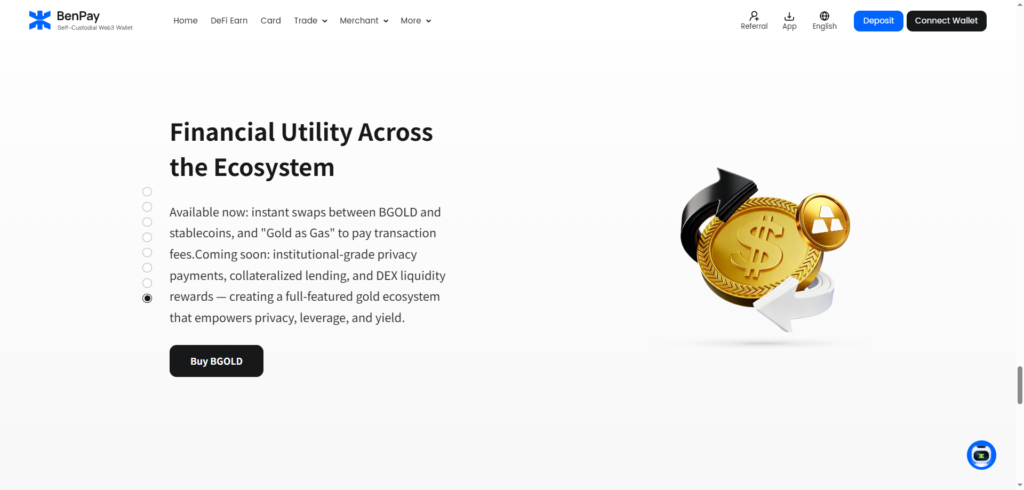
BGOLD is not just a passive store of value within the BenPay ecosystem. Currently live features include instant swap between BGOLD and stablecoins (BUSD/USDT) and the ability to use BGOLD directly as gas payment on BenFen. Planned additions — with no confirmed timeline announced — include collateral for lending protocols, DEX liquidity provision, and privacy payment. Check the BenPay RWA help center for the latest feature availability.
The platform also offers physical redemption through a “request on-chain, collect offline” model: token holders burn their BGOLD, complete KYC, and collect gold at designated partner locations through an offline network including Haobao (a Singapore-licensed precious metals service provider). Specific redemption thresholds may apply — check the BenPay RWA help center for current requirements.
Security note: Built on a Move-based chain designed to reduce certain common smart-contract risks through its architectural properties. Separately, relevant BenPay/BenFen smart contracts have undergone third-party audit by SlowMist.
Verification approach: Mandatory pre-issuance compliance + on-chain audit hash records + professional vault custody + supply cap enforcement.
KAU (Kinesis Gold)
Each KAU represents 1 gram of allocated physical gold. Kinesis uses its own blockchain (based on Stellar) and positions KAU as a monetary asset that can be held, traded, sent, spent, and yield-earning. Physical redemption is available through a global vault network. Kinesis publishes regular independent audits and provides information about its allocated gold holdings to support the 1:1 backing claim.
Verification approach: Regular independent audits + allocated gold records + physical redemption capability.
VRO (VeraOne)
A European tokenized-gold product where each VRO represents 1 gram of LBMA-certified gold, stored in Geneva Free Ports vaults. VRO is 100% redeemable for physical gold through the platform (verified account required). VeraOne provides independent audits and a proof-of-reserves page. Available as an ERC-20 token on Ethereum.
Verification approach: LBMA-certified gold in Geneva Free Ports + independent audits + physical redemption.
What “Backed by Gold” Does Not Guarantee
Even with 1:1 physical reserves and strong verification, gold-backed tokens still carry risks that pure gold ownership does not:
Custody risk. You are trusting a custodian and an issuer. If the custodial entity faces legal, financial, or operational problems, the redemption process could be disrupted — even if the gold technically exists.
Smart contract risk. The token layer introduces code-level risk. A vulnerability in the smart contract could affect your ability to transfer, swap, or redeem tokens, regardless of the physical gold backing.
Audit lag. Even monthly attestations are snapshots. Between audit dates, you are relying on the system’s design and the issuer’s integrity. On-chain proof records improve this, but no verification system operates in true real time.
Redemption friction. Physical redemption — where available — involves KYC, logistics, minimum thresholds, and wait times. It anchors value, but it is not the same as walking into a vault and picking up your gold.
The 1:1 backing claim is a critical foundation, but it does not make gold-backed tokens risk-free. Treating them as a convenient DeFi-native way to hold gold exposure — rather than as a perfect substitute for physical ownership — is the more realistic framing.
Frequently Asked Questions
1. How can I personally verify that a gold token is really backed?
For tokens with on-chain audit records (like BGOLD), you can check the blockchain for stored documentation hashes. For tokens with third-party attestations (like PAXG), look for the auditor’s published reports on the issuer’s website. If neither is available, the backing claim is harder to independently verify.
2. Is price-tracking the same as gold backing?
No. A token can track the gold spot price through derivatives or algorithms without holding any physical gold. In that case, your exposure is to the issuer’s solvency and the contract mechanism — not to actual metal.
3. Does 1:1 backing mean I can always redeem for physical gold?
Not necessarily. Some 1:1 backed tokens only allow secondary market trading. Physical redemption is a separate feature — check whether the specific token supports it, and what the minimum and process look like. For BGOLD redemption details, see the BenPay RWA help center.
4. Which gold token denomination is better — grams or troy ounces?
Neither is inherently better. Gram-based tokens (BGOLD, KAU, VRO) offer lower per-unit cost and easier small allocations. Troy-ounce tokens (PAXG, XAUT) align with traditional gold market conventions. Both can typically be bought fractionally.