
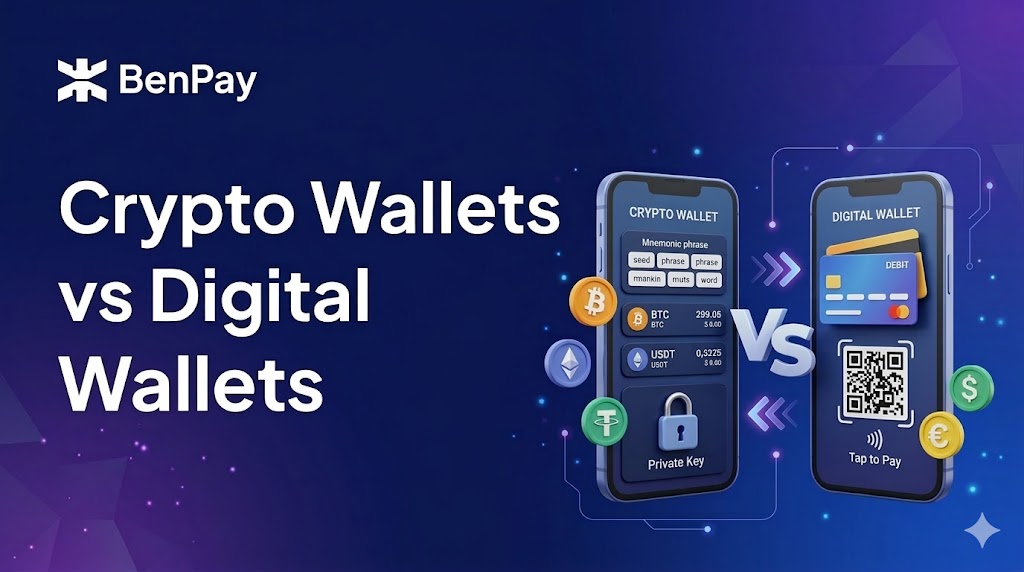
“Crypto wallet” and “digital wallet” are often used interchangeably, but they are not the same thing: a digital wallet manages fiat payment credentials (like bank cards), while a crypto wallet manages blockchain private keys and crypto assets. The two used to operate in entirely separate worlds, but that line is blurring: a growing number of products now bridge both sides, connecting crypto wallets to Apple Pay, Google Pay, or Alipay so users can spend stablecoins at everyday merchants. BenPay is one example of this “both-in-one” approach. This guide breaks down how each wallet type works, where they differ, and where they’re starting to converge.
What Is a Digital Wallet?
A digital wallet is a software application that stores your fiat payment information — debit cards, credit cards, bank accounts, loyalty programs, boarding passes, transit cards — and lets you make payments through your phone or wearable device.
Common examples: Apple Wallet, Google Pay, Samsung Pay, PayPal, Alipay, WeChat Pay.
How it works: You link a bank card or bank account to the app. When you pay at a store, the wallet transmits your payment credentials via NFC (tap-to-pay) or QR code. The actual money still moves through traditional payment rails — Visa, Mastercard, UnionPay, or local banking networks. The wallet is essentially a convenient container for your existing financial instruments. If a transaction goes wrong, you can dispute it through your bank or card issuer — the same consumer protections you’d have with a physical card still apply.
Key characteristic: Traditional digital wallets are primarily designed around fiat payment rails — they don’t involve private keys or blockchain in their core function. Your funds remain in a bank account or payment platform, and the wallet is the interface you use to access them. That said, the boundary is shifting: platforms like PayPal, Revolut, and Cash App now offer limited crypto buying and holding within their apps, though these are typically custodial (the platform holds the keys, not you) and are better understood as fiat payment apps with crypto add-ons rather than full crypto wallets. This also means your access depends on the bank or platform: if they freeze your account, the digital wallet becomes unusable.
In short, a digital wallet is the mobile payment layer on top of traditional finance.
What Is a Crypto Wallet?
A crypto wallet is a tool for managing your private keys — the cryptographic credentials that prove you own assets on a blockchain and authorize transactions.
Common examples: MetaMask, Trust Wallet, Ledger (hardware), BenPay Wallet, and exchange-built wallets inside platforms like Binance or Coinbase.
How it works: When you create a crypto wallet, it generates a key pair — a public address (which others use to send you crypto) and a private key (which you use to sign and authorize transactions). In self-custodial wallets, this private key is derived from a seed phrase (12 or 24 words) that only you control. In custodial wallets (like exchange accounts), the platform manages the keys for you.
Key characteristic: A crypto wallet operates on blockchain infrastructure, not banking networks. It deals with assets like BTC, ETH, USDT, and USDC — not bank card numbers. In the self-custodial model, it is generally much harder for any third party to freeze your funds or reverse your transactions compared to traditional banking — though not impossible. Centralized stablecoins like USDT and USDC can be blacklisted at the smart contract level by their issuers, and law enforcement has tools to trace and, in some cases, seize on-chain assets. The flip side: if you lose your seed phrase or send crypto to a wrong address, there is no bank to call and no chargeback to file. Ownership comes with full responsibility.
In short, a crypto wallet is the ownership and control layer for blockchain-based assets.
Crypto Wallet vs Digital Wallet — Key Differences
Here’s a side-by-side comparison of the core distinctions:
| Dimension | Digital Wallet | Crypto Wallet |
| What it manages | Fiat payment credentials (bank/credit cards) | Blockchain private keys and crypto assets |
| Underlying infrastructure | Banking and payment networks (Visa, Mastercard) | Blockchain networks (Ethereum, BTC, BenFen, etc.) |
| Who controls the funds | Bank or payment platform | Depends: platform (custodial) or the user (self-custodial) |
| KYC required to create | Usually yes | Self-custodial: no; certain features may require it |
| Can you spend at stores directly | Yes (NFC / QR code) | Not directly — unless integrated with a payment card |
| Recovery if lost | Contact bank or platform support | Self-custodial: seed phrase only — no support team can help |
| Typical users | Anyone who pays with their phone | Crypto holders, traders, DeFi users, cross-border payers |
The takeaway: these are not competing products — they address different layers of the financial stack. One connects you to banks, the other connects you to blockchains. Asking “which is better” is like asking whether a passport is better than a house key — they open different doors.
Where Crypto Wallets and Digital Wallets Overlap
Most articles stop at the differences. But the more interesting development is where the two are starting to merge.
Stablecoin Payments via Traditional Payment Networks
A growing number of products now allow users to spend stablecoins (like USDT or USDC) through Visa or Mastercard networks. The flow typically looks like this:
- User holds stablecoins in a crypto wallet.
- Stablecoins are loaded onto a payment card linked to that wallet.
- The card is bound to Apple Pay, Google Pay, or another digital wallet.
- At the point of sale, the digital wallet handles the tap-to-pay; behind the scenes, stablecoins are converted to local currency.
The result: the user’s money originates from a crypto wallet but is spent through a digital wallet’s payment experience. From the merchant’s perspective, it looks like any normal card transaction — they receive fiat currency and don’t need to know or care that the buyer started with USDT on a blockchain.
This convergence is still early. Fee structures and regional availability vary significantly across providers. But the direction is clear: the wall between “crypto money” and “spendable money” is getting thinner.
The Emerging “Both-in-One” Model
Some newer products are designed to function as both a crypto wallet and a digital-wallet-compatible spending tool within the same app. Instead of managing your blockchain assets in one app and your payment methods in another, everything lives in a single interface:
- Self-custodial key management (crypto wallet function)
- Multi-chain asset support across BTC, ETH, stablecoins, and more
- Direct connection to a payment card that works with Apple Pay, Google Pay, Alipay, or WeChat Pay (digital wallet function)
- Optional DeFi yield and cross-chain bridge capabilities
This model doesn’t replace either type of wallet — it combines their core capabilities so the user doesn’t have to context-switch between “managing crypto” and “spending money.” The trade-off is that these products are typically tied to a specific ecosystem, which may limit flexibility compared to using separate tools for each function.
Can You Use Crypto with Apple Pay or Google Pay?
This is one of the most frequently asked questions in the space, so it’s worth addressing directly.
Short answer: Yes, but not natively. Apple Pay and Google Pay do not support cryptocurrency directly — you cannot load BTC or USDT into Apple Wallet the way you add a bank card. However, you can use crypto with Apple Pay or Google Pay through an intermediary: a crypto-linked payment card.
How it works in practice:
- You hold stablecoins (USDT, USDC, etc.) in a self-custodial crypto wallet.
- You top up a payment card issued by the wallet provider.
- You add that card to Apple Pay or Google Pay.
- You tap to pay at any merchant that accepts contactless payments.
BenPay Card, for example, connects a self-custodial wallet to a Mastercard-compatible card that supports Apple Pay, Google Pay, Alipay, and WeChat Pay — allowing users to spend USDT or USDC at millions of merchants globally. The wallet remains self-custodial (you keep your private keys), while the card handles the fiat conversion at the point of sale.
Important caveats: Not every crypto wallet offers this path. Card availability, supported currencies, and fee structures vary by product and region. Always review the provider’s fee schedule and geographic coverage before relying on this as a primary payment method.
How to Decide Which One You Need — Or Whether You Need Both
Rather than asking “which is better,” it’s more useful to match the wallet type to your actual situation:
You only use fiat for everyday payments → A digital wallet (Apple Pay, Google Pay, Alipay) covers your needs. No crypto wallet necessary.
You hold crypto and want to manage it yourself → You need a self-custodial crypto wallet. For guidance on choosing one, see our guide on how to choose a crypto wallet. If you’ve never set one up before, our step-by-step setup guide walks through the full process.
You hold crypto and want to spend it in daily life → You likely need both capabilities — a crypto wallet for asset management and a digital-wallet-compatible payment card for spending. Products that integrate both (like BenPay) reduce the friction of switching between apps, letting you go from holding USDT on-chain to tapping Apple Pay at a coffee shop within the same ecosystem. That said, no single product covers every blockchain, every country, and every payment network. Evaluate based on which chains you use, which payment methods matter to you, and which regions the card supports.
FAQ
Q1: Is a crypto wallet the same as a digital wallet?
No. A digital wallet stores fiat payment credentials (bank cards, credit cards) and works through traditional payment networks like Visa or Mastercard. A crypto wallet stores blockchain private keys and manages crypto assets like BTC, ETH, and stablecoins. They operate on different infrastructure entirely. However, some newer products — such as BenPay — combine both functions in a single app, connecting self-custodial crypto management with Apple Pay / Google Pay spending.
Q2: Can I store Bitcoin in Apple Wallet?
Apple Wallet does not support storing or managing cryptocurrency directly. However, you can add a crypto-linked payment card to Apple Pay — which allows you to spend BTC or stablecoins at merchants that accept contactless payments. The crypto-to-fiat conversion happens in the background through the card issuer. For an example of how this works, see BenPay Card.
Q3: Do I need both a crypto wallet and a digital wallet?
It depends on your usage. If you only deal with fiat currency, a digital wallet is sufficient. If you hold crypto but never spend it in physical stores, a crypto wallet alone works. If you want to do both — manage crypto assets and spend them at everyday merchants — you’ll benefit from having both capabilities, either through separate apps or through an integrated product that handles both. For more on how these tools fit together, visit the BenPay blog.