

If you freelance and get paid in USDT or USDC, a crypto debit card lets you spend those stablecoins at any merchant that accepts Visa or Mastercard without first selling on an exchange and withdrawing to a bank account. You load stablecoins onto the card, and it handles the conversion to local fiat at the point of sale. Cards like theBenPay Card take this a step further by keeping your funds in a self-custodial wallet, supporting Apple Pay, Google Pay, Alipay, and WeChat Pay, and connecting to aDeFi yield product so your unspent earnings can generate returns while they sit between paychecks.
The Freelancer Payment Problem
Freelancers who work with international clients or Web3 companies increasingly receive payment in stablecoins. There are good reasons for this: USDT and USDC transfers settle in minutes regardless of which country the sender and receiver are in, fees are a fraction of international wire transfers, and there is no intermediary bank holding funds for days during “processing.”
But receiving stablecoins is only half the problem. The other half is spending them. Your landlord, grocery store, and electric company do not accept USDT. Turning stablecoin income into everyday spending money has traditionally meant:
- Receive USDT/USDC to your wallet or exchange account.
- Sell the stablecoins for fiat on an exchange (trading fee: 0.1-0.5%).
- Withdraw fiat to your bank account (withdrawal fee: $1-25 depending on method and country; processing time: 1-5 business days).
- Spend from your bank account using a regular debit card.
This four-step process adds fees at every stage, introduces multi-day delays, and creates friction that defeats much of the speed advantage of getting paid in crypto in the first place. For freelancers in countries with limited banking infrastructure, unreliable local exchanges, or capital controls, the off-ramp to fiat can be even more painful.
A crypto debit card collapses steps 2 through 4 into a single action: load stablecoins, spend with the card. The stablecoins go in, fiat-denominated purchasing power comes out at the merchant terminal.
How the Freelancer-to-Card Workflow Actually Looks
Here is the practical flow using a self-custodial card setup:
Your client pays you. They send 2,000 USDT to your wallet address. If they send on Ethereum, Arbitrum, BNB Chain, or another supported network, the transfer settles in seconds to minutes. Cost to the sender is typically a few dollars in gas.
You receive the USDT in your self-custodial wallet. WithBenPay Wallet, you can receive on multiple chains from a single wallet interface. If the USDT arrives on a chain other than BenFen, you use theBenPay Bridge to move it to BenFen, where card top-ups and DeFi deposits happen.
You decide how to allocate. This is where the freelancer workflow diverges from a simple “spend everything” approach. Most freelancers do not spend their entire paycheck immediately. A practical split might look like:
- 40% ($800) tops up theBenPay Card for this month’s living expenses.
- 50% ($1,000) goes intoDeFi Earn to generate yield until next month.
- 10% ($200) stays liquid in the wallet as a buffer.
You spend from the card. Tap Apple Pay at the coffee shop, pay rent to a landlord who accepts card payments, subscribe to software tools, book flights. The card converts stablecoins to local fiat at the point of sale. From the merchant’s side, it looks like any normal card payment.
Next month, you redeem from DeFi Earn and repeat. The $1,000 that was earning yield getsredeemed back to your wallet (plus accrued interest), and you allocate again based on that month’s needs.
The entire cycle stays on-chain until the moment of purchase. No exchange accounts, no bank withdrawal queues, no multi-day holds.
Comparing Card Options for Freelancers Paid in Stablecoins
Not every crypto card is equally suited for the freelancer use case. The key factors are: how easily you can load stablecoins, what the ongoing costs look like for regular spending, and whether the platform lets you do more with your idle funds.
Coinbase Card
Loading stablecoins: You deposit USDC to your Coinbase account and select it as your spending asset. USDT is also supported but with higher fees.
Per-transaction cost: 0% for USDC spending. 2.49% for BTC, ETH, and most other assets.
Freelancer fit: Good if you are paid in USDC specifically and are comfortable with Coinbase custody. The 0% USDC fee is the lowest raw transaction cost available. However, converting USDT to USDC on Coinbase incurs a trading fee, so freelancers paid in USDT face an extra step.
Limitations for freelancers: Custodial. Funds sit in Coinbase. No built-in yield product connected to the card. No Alipay or WeChat Pay support, which limits usefulness for freelancers based in or traveling through Asia.
Bybit Card
Loading stablecoins: Fund from your Bybit account balance. USDT and USDC supported.
Per-transaction cost: Varies. No annual fee. Check current fee schedule.
Freelancer fit: Reasonable for freelancers already using Bybit as their primary exchange. Real-time conversion from USDT at point of sale.
Limitations for freelancers: Custodial. Tied to Bybit’s platform and regulatory status. No DeFi yield integration. Limited mobile wallet support compared to BenPay.
RedotPay
Loading stablecoins: USDT on multiple chains. Deposit to the RedotPay platform.
Per-transaction cost: Card issuance fee plus transaction and top-up fees. Rates vary.
Freelancer fit: Popular in Asia-Pacific markets. Accepts USDT directly.
Limitations for freelancers: Semi-custodial. No integrated DeFi yield. Fee structure can be complex to calculate for regular spending.
BenPay Card
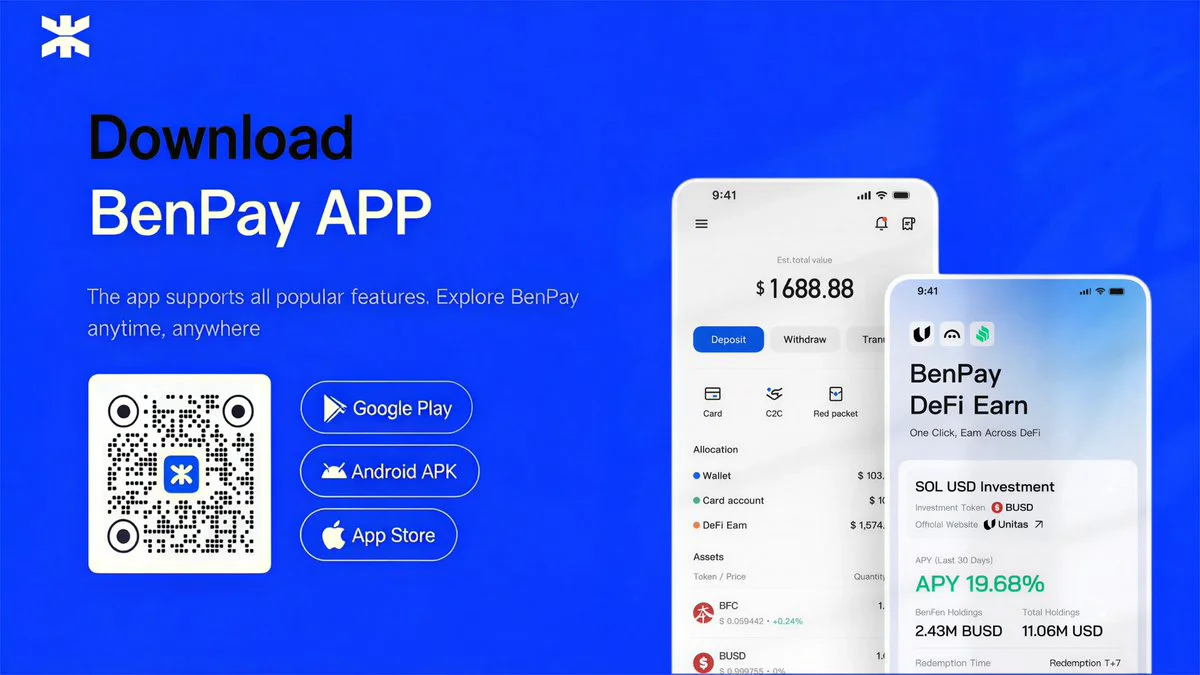
Loading stablecoins: USDT, USDC, BUSD from yourself-custodial wallet. Multi-chain support via theBenPay Bridge.
Per-transaction cost by card type:
|
Alpha |
Sigma |
Delta | |
|
Top-up fee |
0% |
1.5% |
0.5% |
|
Transaction fee |
1% |
0.5% (min $0.50) |
$0.35 + 1% |
|
Cross-border fee |
1.5% (non-USD) |
$0.50 fixed |
1% (non-USD) |
|
Monthly fee |
$0 |
$1 |
$0 |
|
Opening fee |
9.9 BUSD |
9.9 BUSD |
9.9 BUSD |
Freelancer fit: Designed for exactly this use case. Self-custodial, so your paycheck stays in your wallet until you choose to spend it. Idle funds can earn yield throughDeFi Earn (Aave, Compound, Unitas integration, 15% yield fee, no principal fee). Four mobile wallets supported (Apple Pay, Google Pay, Alipay, WeChat Pay), which covers freelancers in the US, Europe, and Asia.
Which BenPay card type for which freelancer?
- Alpha fits US-based or globally mobile freelancers who make large monthly top-ups. Zero top-up fee means loading $2,000-3,000 per month costs nothing at the loading stage.
- Sigma fits freelancers based in or frequently spending in mainland China and broader Asia. The fixed $0.50 cross-border fee per transaction saves significantly on high-value purchases compared to percentage-based models.
- Delta fits freelancers who want the simplest ongoing cost with zero monthly fee and moderate rates across the board.
The Math: Crypto Card vs. Exchange-to-Bank for a Freelancer Earning $4,000/Month
Let us compare the total monthly cost of two approaches for a freelancer receiving $4,000 in USDT and spending it on everyday expenses.
Path A: Traditional off-ramp (Exchange → Bank → Spend)
|
Step |
Cost |
|
Deposit USDT to exchange |
~$0 (network gas only) |
|
Sell USDT for USD on exchange |
0.1-0.5% = $4-20 |
|
Withdraw USD to bank account |
$5-25 (wire or ACH) |
|
Bank debit card FX fee (if spending abroad) |
1-3% on international purchases |
|
Monthly total (domestic spending) |
~$9-45 |
|
Monthly total (international spending, 50% abroad) |
~$29-105 |
|
Time to access funds |
1-5 business days |
Path B: BenPay Alpha Card (Direct stablecoin spend)
|
Step |
Cost |
|
Receive USDT in BenPay Wallet |
~$0 (on BenFen) or small bridge fee |
|
Top up BenPay Alpha Card with $2,500 |
0% top-up fee = $0 |
|
Deposit $1,500 into DeFi Earn |
Minimal gas on BenFen |
|
Spending $2,500 (Alpha: 1% per txn) |
~$25 |
|
Cross-border fee (1.5% on ~$1,250 non-USD) |
~$18.75 |
|
Monthly total |
~$43.75 |
|
Time to access funds |
Minutes |
|
Yield earned on $1,500 idle (5% APY, net of 15% fee) |
+$5.31 |
|
Effective monthly cost |
~$38.44 |
For a freelancer spending primarily in USD (domestic US), Path B is slightly more expensive on raw fees than Path A with a cheap exchange. But Path B eliminates the 1-5 business day withdrawal delay, avoids the exchange custody risk, and adds yield on idle funds.
For a freelancer spending internationally (digital nomads, travelers, Asia-based), Path B often comes out cheaper because the traditional bank card’s 1-3% FX fee on every foreign purchase adds up fast, while the crypto card’s cross-border structure is more predictable. And the Sigma Card’s flat $0.50 cross-border fee makes Path B significantly cheaper for international freelancers making larger purchases.
Making Your Stablecoin Income Work Harder Between Paychecks
The dead time between receiving payment and spending it is an overlooked cost for freelancers. If you receive $4,000 on the 1st of the month and spend it gradually over 30 days, on average roughly half your balance ($2,000) is sitting idle at any given point. Over a year, that is $2,000 in average idle capital producing zero return.
BenPay DeFi Earn changes this calculation. By depositing the non-immediate portion of each paycheck into DeFi Earn (which routes to Aave, Compound, and Unitas), you earn yield on money that would otherwise sit dormant. The redemption has no lockup period, so you canpull funds back to your wallet and top up your card whenever you need more spending money.
At 5% APY on an average $2,000 idle balance, net of BenPay’s 15% yield fee, that is roughly $85 per year. Not a fortune, but it is money earned on capital that was previously doing nothing. For freelancers with higher incomes or those who maintain larger stablecoin reserves, the numbers scale accordingly.
The key consideration: your funds in DeFi Earn carry smart contract risk. BenPay’s contracts are audited by SlowMist, and the underlying protocols (Aave, Compound) have extensive audit histories, but no DeFi product is risk-free. Only deposit amounts you can afford to have temporarily at risk, and keep your immediate spending needs funded on the card or in your liquid wallet balance.
Setting Up the Full Freelancer Payment Stack on BenPay
- Create aBenPay Wallet. Back up your seed phrase securely and offline. This wallet receives your client payments and manages all your BenPay interactions.
- Share your wallet address with clients. You can receive USDT or USDC on BenFen directly, or on Ethereum, Arbitrum, BNB Chain, and other supported networks. If clients send on another chain, use theBenPay Bridge to bring assets to BenFen.
- Open aBenPay Card. Choose Alpha (best for zero top-up fee, high-limit, US/international use), Sigma (best for Asia-based spending with fixed cross-border fee), or Delta (best for zero monthly fee, balanced global use). Opening fee is 9.9 BUSD.
- On payday, allocate your earnings. Top up the card with your estimated spending for the coming weeks. Deposit the rest intoDeFi Earn. Keep a small buffer liquid in your wallet.
- Spend normally. Use the card through Apple Pay, Google Pay, Alipay, or WeChat Pay at any merchant worldwide. Pay for subscriptions, groceries, travel, software, coworking spaces, whatever your life requires.
- Replenish monthly.Redeem from DeFi Earn as needed, top up the card, repeat.
FAQ
1.Can my clients pay me directly to a crypto card?
Not directly to the card itself. Clients send USDT or USDC to your wallet address, and you thentop up the card from your wallet. With BenPay, both the wallet and the card are managed within the same app, so the extra step takes minutes. Think of the wallet as your “receiving account” and the card as your “spending account,” similar to how you might receive a bank wire into savings and transfer to checking when you need to spend.
2.Is getting paid in USDT/USDC legal for freelancers?
Receiving payment in stablecoins is legal in most jurisdictions, but tax treatment varies. In the US, stablecoin income is treated as ordinary income valued at the fair market price when received (which for USDT/USDC is approximately $1 per token). You are responsible for reporting this income to your tax authority. Consult a tax professional familiar with crypto in your country, especially regarding record-keeping requirements for stablecoin transactions.
3.What if I need to convert stablecoins to local fiat in my bank account instead of using a card?
A crypto card does not replace the need for a bank account entirely. For expenses that require a bank transfer (rent paid via direct debit, loan payments, certain government fees), you will still need an off-ramp to fiat. A crypto card handles the day-to-day spending portion of your finances. Many freelancers use a hybrid approach: card for daily spending, periodic exchange-to-bank withdrawals for fixed obligations that require bank transfers.