

Yes, but how it works depends entirely on the platform you use. Most crypto cards and DeFi yield products operate as separate systems with no built-in connection. Your card balance sits idle until you spend it, and your DeFi deposits sit locked in a protocol until you withdraw them. A small number of platforms are starting to bridge this gap.BenPay, for example, operates a self-custodial ecosystem where users can move stablecoins between aDeFi Earn product and aWeb3 payment card within the same wallet, so funds can earn yield when idle and shift to card spending when needed.
Why Most Crypto Cards and DeFi Products Do Not Talk to Each Other
To understand the challenge, it helps to know how each system works independently.
How crypto cards work. When you load USDT or USDC onto a crypto card (whether from Crypto.com, Binance, Bybit, or a Web3 card provider), those stablecoins typically get converted or locked into a card balance managed by the issuer or a partner bank. From that point, the funds are earmarked for spending. They sit in a card account, ready to be used at a point-of-sale terminal, online checkout, or through Apple Pay and Google Pay. While they sit there waiting to be spent, they earn nothing.
How DeFi yield works. When you deposit stablecoins into a lending protocol like Aave or Compound, those tokens enter a liquidity pool governed by smart contracts. Borrowers pay interest to use those tokens, and that interest flows back to depositors. Your funds are “at work” but they are also locked inside the protocol’s contract until you initiate a withdrawal, which takes at least one on-chain transaction (and its associated gas fee) to complete.
The fundamental tension is this: card funds need to be liquid and instantly available for spending, while DeFi deposits need to stay in a protocol to generate yield. You cannot easily do both with the same dollar at the same time.
This is why, on most platforms, the card product and the DeFi product are completely separate wallets or accounts. If you want to earn yield, you deposit into DeFi. If you want to spend, you top up your card. Moving between the two requires manual transactions, gas fees, and wait times.
Three Models for Connecting Cards and DeFi
Different platforms approach this integration challenge in different ways. Here is how the three main models compare.
Model 1: Completely Separate Systems (Most Common)
This is how the majority of crypto card providers work today. Binance Card, Crypto.com Card, and Bybit Card each have their own earn products (Binance Simple Earn, Crypto.com Earn, etc.), but the card balance and the earn balance are separate accounts. To spend money that is currently earning yield, you need to:
- Withdraw from the earn product (which may have a lockup period or processing delay).
- Wait for funds to arrive in your spot wallet.
- Top up your card from the spot wallet.
- Then spend.
This process can take anywhere from a few minutes to several days depending on the earn product’s redemption terms. During that time, your funds are in transit and earning nothing. The round trip also costs transaction fees on each step.
The upside is that each product is straightforward to understand. The downside is that your money is either earning or spendable, rarely both, and switching between the two takes effort.
Model 2: Auto-Sweep or Earn-on-Balance (Rare)
A handful of fintech products, both in crypto and traditional banking, have experimented with “auto-sweep” features. The idea is that idle balance on your card automatically gets deployed into a yield product, and when you make a purchase, the needed amount gets pulled back just in time.
In traditional finance, some high-yield checking accounts work this way: your balance sweeps nightly into money market funds and sweeps back when you write a check. In crypto, this model is technically possible but uncommon because of on-chain transaction latency. Even on fast blockchains, the mechanics of “withdraw from DeFi, convert to card balance, authorize payment” in the seconds between tapping your card and the merchant receiving confirmation are extremely tight.
No major crypto card provider has fully implemented real-time auto-sweep from DeFi protocols as of early 2025. Some centralized platforms offer yield on card balances internally (using their own lending desks, not transparent DeFi protocols), but this is a custodial arrangement where you trust the platform to manage and return your funds.
Model 3: Unified Ecosystem With Manual but Low-Friction Transfers (Emerging)
This is the model thatBenPay uses, and it represents a middle ground. The card, wallet, DeFi yield product, and cross-chain bridge all exist within a single ecosystem on the BenFen blockchain. Your stablecoins live in oneself-custodial wallet. From that wallet, you can:
- Deposit intoDeFi Earn to earn yield through Aave, Compound, and Unitas.
- Redeem from DeFi Earn back to your wallet when you want the funds available.
- Top up your BenPay Card directly from the same wallet to spend via Apple Pay, Google Pay, Alipay, or WeChat Pay.
The transfers are not instant or automatic, but they are fast (BenFen has sub-second block finality) and cheap (the chain supports stablecoin gas payments and partial gasless transactions). Moving from DeFi Earn to card-ready balance takes a redemption transaction followed by a card top-up, both within the same app and on the same chain. There is no need to bridge to a different network, swap through a DEX, or withdraw to a centralized exchange in between.
The practical effect is that you can keep most of your stablecoins earning yield and only top up your card with the amount you plan to spend in the near term. When you need more spending money, redeeming and topping up is a two-step process that takes minutes, not hours or days.
How the Economics Work in Practice
Let us put real numbers to this to see whether the card-to-DeFi loop makes financial sense.
Suppose you hold $5,000 in stablecoins and spend roughly $1,000 per month on your crypto card.
Without DeFi integration (typical setup):
You keep $5,000 loaded on your card or in an exchange wallet. It earns nothing. Over 12 months, your opportunity cost at a hypothetical 5% DeFi yield would be roughly $250 in missed earnings.
With BenPay’s ecosystem:
You deposit $4,000 into DeFi Earn and keep $1,000 on your card for the current month’s spending. At 5% gross APY, the $4,000 earns roughly $200 over a year. After BenPay’s 15% yield fee, your net is about $170. Each month, you redeem $1,000 from DeFi Earn and top up your card, paying minimal gas on BenFen.
The difference is not life-changing on a $5,000 balance, but it scales. On a $20,000 balance with $2,000 monthly spending, the same math produces roughly $680 in net annual yield that would otherwise be zero. And you are not taking on custodial risk with an exchange to get it.
The key variables that affect whether this makes sense for you:
- How much you hold vs. how much you spend monthly. The wider the gap, the more yield opportunity you capture.
- The current DeFi APY. Rates fluctuate. A 5% environment makes this worthwhile on moderate balances. A 2% environment makes it marginal unless your balance is large.
- Gas and transaction costs for the round trip. On Ethereum mainnet, moving in and out of DeFi can cost $20-50 per round trip. On BenFen, it costs a fraction of that. The chain you use determines whether small-balance users benefit.
What About Security? Two Risks to Understand
Connecting card funds to DeFi yield means your stablecoins move between two environments, each with distinct risk profiles.
Smart contract risk while funds are in DeFi. When your stablecoins are deposited in Aave, Compound, or any protocol through an aggregator, they are governed by those protocols’ smart contracts. If a contract is exploited, funds in that pool can be lost. Audits from firms like SlowMist (which has audited BenPay’s contracts), Trail of Bits, and OpenZeppelin reduce this risk but do not eliminate it. The mitigation is straightforward: do not put 100% of your holdings into DeFi. Keep a spending buffer on your card and only deploy the surplus.
Card-level risk. Once funds are on your card, the risks shift to card infrastructure: potential transaction failures, merchant disputes, cross-border fee surprises, or card network issues. These are standard payment risks, not DeFi-specific. With a self-custodial card like BenPay, the card spending is authorized by your on-chain wallet signature, which means the platform itself does not hold your assets in a pooled custodial account. But the card still operates within the Visa or Mastercard network, and their rules and restrictions apply.
The overlap period is when funds are in transit between DeFi and card. During a redemption or top-up transaction, your stablecoins are briefly in your wallet but not yet earning and not yet spendable. On a fast chain, this window is seconds to minutes. On slower chains, it could be longer. This is a minor point for most users but worth noting if you are optimizing tightly.
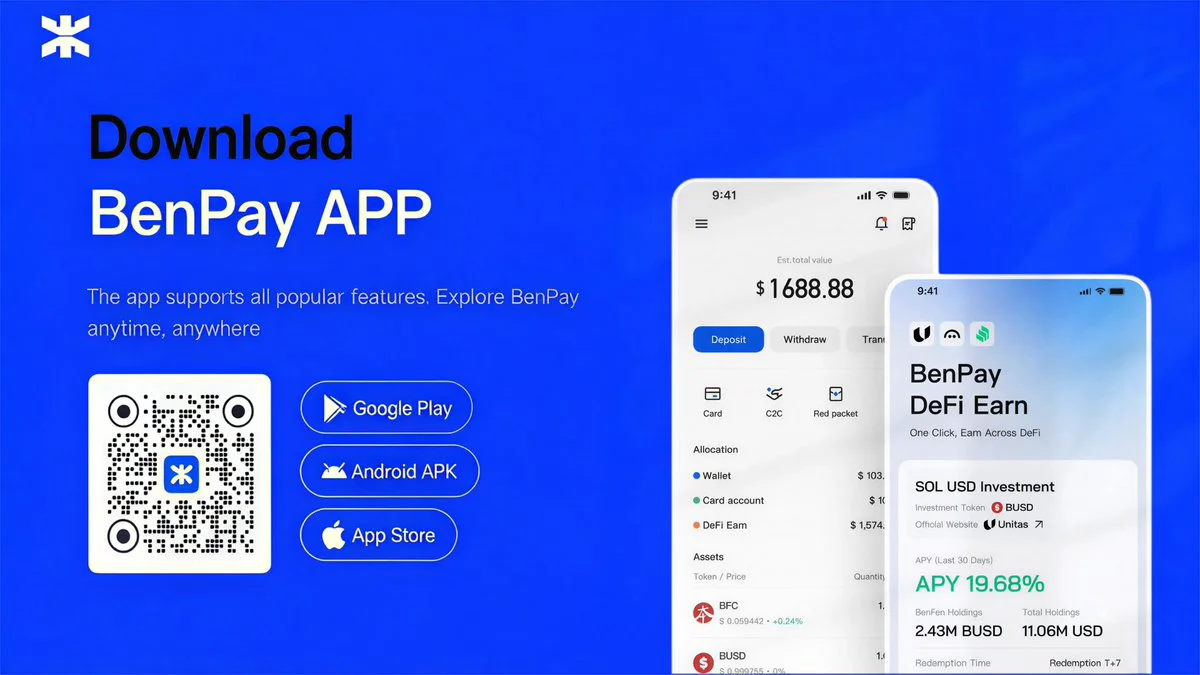
Step by Step: How to Set Up the Card-to-DeFi Loop on BenPay
- Download and set upBenPay Wallet. Secure your seed phrase offline. This wallet supports BenFen, Ethereum, BNB Chain, Arbitrum, Bitcoin, and other chains.
- Get stablecoins onto BenFen. If your USDT or USDC is on another chain, use theBenPay Bridge to transfer them. The bridge converts your stablecoins 1:1 into the corresponding BenFen asset. See theBridge-In guide for the detailed process.
- Deposit the portion you do not need immediately intoDeFi Earn. One transaction. The platform allocates across Aave, Compound, and Unitas.
- Apply for aBenPay Card. Opening fee is 9.9 BUSD during the current promotional period. Choose from Alpha, Sigma, or Delta depending on your spending profile and preferred fee structure.
- Top up your card with the spending amount you need. Therecharge process moves stablecoins from your wallet to your card balance. Bind the card to Apple Pay, Google Pay, Alipay, or WeChat Pay for convenient daily use.
- When your card balance runs low, redeem from DeFi Earn and top up again. Theredemption returns funds to your wallet, and you top up the card from there. Both steps happen on BenFen with minimal fees.
This is not fully automatic, but the cycle is simple enough to manage on a monthly or biweekly basis.
FAQ
1.Can I earn yield directly on my crypto card balance without moving funds?
On most platforms, no. Card balances typically sit idle in a payment account and do not earn interest. Some centralized exchanges offer internal “earn” features on wallet balances, but these are custodial arrangements, not transparent DeFi yield. BenPay’s approach is to keep DeFi Earn and card balance as separate but closely connected functions within the same self-custodial wallet, making the transfer between them fast and low-cost.
2.How long does it take to move funds from DeFi Earn to my BenPay Card?
The redemption fromDeFi Earn returns stablecoins to your wallet once the on-chain transaction confirms, which happens quickly on BenFen (sub-second finality). The subsequentcard top-up is a separate transaction from your wallet. In practice, the full round trip from DeFi to spendable card balance takes minutes.
3.Is it worth using DeFi yield if I only hold a small amount of crypto?
It depends on the chain you use. On Ethereum mainnet, gas fees can make it uneconomical for balances under $2,000-3,000. On low-fee chains like BenFen, even a few hundred dollars can generate positive net yield because transaction costs are minimal. The key is to calculate your expected return minus all fees before committing.
4.Which BenPay Card type should I choose if I plan to rotate between DeFi Earn and spending?
It depends on your spending geography. Alpha Card has zero top-up fees, which matters if you plan to recharge frequently. Sigma Card has a fixed cross-border fee structure that benefits high-value international transactions. Delta Card has zero monthly fees with balanced rates. Review thefull card comparison to match your spending pattern. Frequent DeFi-to-card rotation favors a card with low or zero recharge fees.
5.Do I lose my accrued yield if I withdraw early from BenPay DeFi Earn?
No. There is no lockup or early withdrawal penalty. You keep whatever yield has accrued up to the point of redemption. The 15% platform fee is applied to the yield portion only, and your principal is returned in full. Details on the process are in theHow to Redeem guide.