
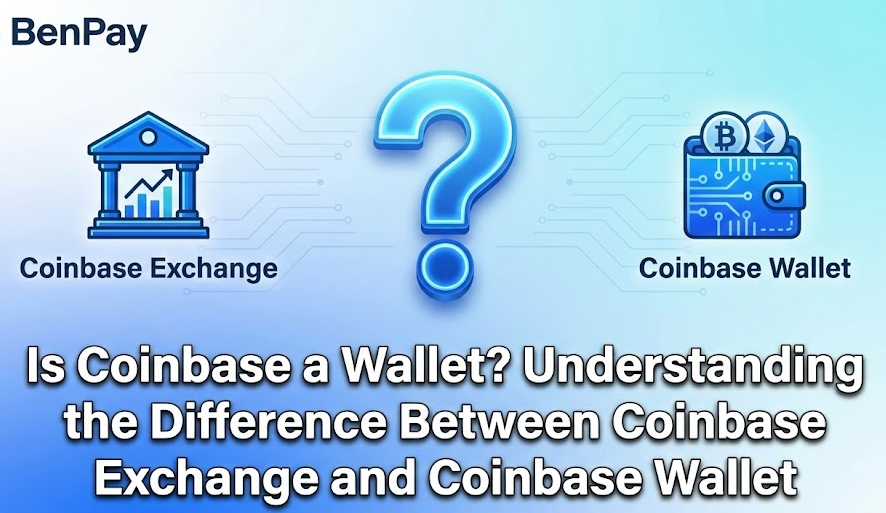
Is Coinbase a wallet? This question confuses many crypto newcomers, and for good reason—Coinbase actually offers two distinct products with very different security models. The Coinbase exchange (coinbase.com) is a custodial platform where Coinbase holds your private keys, while Coinbase Wallet is a separate self-custodial app where you control your own keys.
Understanding this distinction is critical for your crypto security. In this guide, we explain how each Coinbase product works, compare their security trade-offs, and help you decide which option—or alternative—fits your needs.
Coinbase Exchange vs Coinbase Wallet: Key Differences
When people ask “is Coinbase a wallet,” they usually mean the main Coinbase platform where they buy and sell crypto. Let us clarify what each product actually is.
Coinbase Exchange (Custodial)
The Coinbase exchange at coinbase.com is primarily a trading platform, not a true wallet. Key characteristics:
- Custodial model: Coinbase holds your private keys on your behalf
- Account-based access: You log in with email and password, similar to a bank
- Regulated entity: Coinbase is a publicly traded company (NASDAQ: COIN) subject to US regulations
- Insurance coverage: Crypto held on the platform has some insurance protection against platform breaches
- Trading features: Buy, sell, and trade hundreds of cryptocurrencies
When you “store” crypto on Coinbase exchange, you are trusting Coinbase to secure and manage your assets. You do not have direct access to private keys or seed phrases.
Coinbase Wallet (Self-Custodial)
Coinbase Wallet is a completely separate mobile app with a fundamentally different security model:
- Self-custodial: You control your private keys via a 12-word recovery phrase
- No Coinbase account required: The wallet operates independently from the exchange
- DeFi access: Connect to decentralized applications, NFT marketplaces, and DeFi protocols
- Multi-chain support: Ethereum, Polygon, Solana, and other networks
- Full responsibility: If you lose your recovery phrase, Coinbase cannot help recover funds
The two products share a brand name but operate on opposite security philosophies.
Is Coinbase a Wallet You Can Trust?
Now that we have clarified “is Coinbase a wallet,” let us examine whether each option deserves your trust.
Coinbase Exchange: Pros and Cons
Advantages:
- Beginner-friendly interface with easy fiat on-ramps
- Regulated and publicly audited as a listed company
- Insurance on custodial holdings against platform breaches
- Customer support available for account issues
- No risk of losing access due to forgotten seed phrases
Disadvantages:
- You do not control your keys (“not your keys, not your coins”)
- Platform can freeze your account or restrict withdrawals
- Past incidents of account lockouts reported by users
- Limited DeFi and Web3 functionality
- Withdrawal fees can be high
Risk example: When Coinbase faced financial difficulties in 2022, users were reminded that in bankruptcy, their crypto could be treated as company assets—not protected customer funds.
Coinbase Wallet: Pros and Cons
Advantages:
- True self-custody with full key control
- Access to DeFi protocols and dApps
- No account freezes possible—you control access
- Works independently from Coinbase exchange status
- Open-source and auditable
Disadvantages:
- Full responsibility for seed phrase security
- No recovery option if seed phrase is lost
- Less intuitive for beginners
- No integrated fiat on-ramp
- Limited customer support for wallet issues
Is Coinbase a Wallet Alternative Worth Considering?
For users evaluating whether Coinbase products meet their needs, comparing alternatives helps clarify the decision.
| Feature | Coinbase Exchange | Coinbase Wallet | BenPay Wallet | Hardware Wallets |
|---|---|---|---|---|
| Custody type | Custodial | Self-custodial | Self-custodial | Self-custodial |
| Key control | Coinbase holds keys | You hold keys | You hold keys | You hold keys |
| Account freeze risk | Yes | No | No | No |
| DeFi access | Limited | Yes | Yes | Limited |
| Payment card integration | Coinbase Card (custodial) | No | Yes (self-custodial) | No |
| Multi-chain support | Yes | Yes | Yes | Varies |
| Security audits | Company audits | Open-source | Third-party audited | Varies |
| Best for | Trading, beginners | DeFi users | Spending + security | Long-term storage |
For users who want self-custody combined with the ability to spend crypto directly via Apple Pay or Google Pay, BenPay Wallet offers an interesting middle ground. It maintains self-custodial architecture while integrating Web3 payment cards—something neither Coinbase product provides in a fully self-custodial manner.
Security Considerations: What You Need to Know
If Using Coinbase Exchange
- Enable all available security features: 2FA (preferably authenticator app, not SMS), withdrawal address whitelisting, and vault time-locks for large holdings
- Do not store more than you can afford to lose on any exchange
- Understand that account access depends on Coinbase’s continued operation and policies
- Keep records of your holdings independent of the platform
If Using Coinbase Wallet
- Back up your 12-word recovery phrase on paper or metal, stored in multiple secure locations
- Never share your recovery phrase with anyone—Coinbase support will never ask for it
- Verify app downloads come from official sources only
- Review token approvals regularly when using DeFi applications
- Consider pairing with hardware wallet for large holdings
General Best Practices
Regardless of which option you choose, diversification reduces risk. Many experienced users maintain:
- Exchange account for active trading and fiat conversion
- Self-custodial hot wallet for regular transactions and DeFi
- Hardware wallet or cold storage for long-term holdings
Who Should Use Which Option?
Coinbase Exchange suits you if:
- You are new to crypto and prioritize simplicity
- You actively trade and need fiat on/off ramps
- You prefer customer support availability over full control
- You hold moderate amounts for short-term trading
Coinbase Wallet suits you if:
- You want true ownership of your crypto assets
- You use DeFi protocols, NFTs, or dApps
- You understand seed phrase security responsibilities
- You distrust centralized custody after exchange failures
Consider BenPay Wallet if:
- You want self-custody with integrated spending capability
- You need multi-chain support with payment card access
- You prefer third-party audited security over closed-source solutions
- You want to spend crypto via Apple Pay or Google Pay without giving up key control
Verdict: Is Coinbase a Wallet?
So, is Coinbase a wallet? The answer is nuanced. The Coinbase exchange functions more like a bank account than a true wallet—convenient but custodial. Coinbase Wallet, the separate app, is a legitimate self-custodial wallet where you control your keys.
For most users, the right choice depends on priorities:
- Convenience and support: Coinbase exchange
- Control and DeFi access: Coinbase Wallet
- Self-custody plus spending: Alternatives like BenPay
The crypto security principle “not your keys, not your coins” exists for good reason. Exchange failures, account freezes, and regulatory actions have cost users billions. While Coinbase is among the more reputable exchanges, understanding the distinction between custodial and self-custodial options empowers you to make informed decisions about where your assets truly belong.
Frequently Asked Questions
Is Coinbase a wallet or an exchange?
Coinbase operates both. The main Coinbase platform (coinbase.com) is a custodial exchange where Coinbase holds your keys. Coinbase Wallet is a separate self-custodial app where you control your own private keys. They serve different purposes with different security models.
Is Coinbase a wallet that is safe?
Coinbase exchange has strong security measures and insurance for custodial holdings, but you are trusting a third party. Coinbase Wallet is as safe as your seed phrase protection—you have full control but full responsibility. Neither is inherently “safer”; they have different risk profiles.
Can I transfer from Coinbase to Coinbase Wallet?
Yes. You can withdraw crypto from your Coinbase exchange account to your Coinbase Wallet address. This moves assets from custodial to self-custodial storage. You will pay network fees for the transfer.
Does Coinbase Wallet require a Coinbase account?
No. Coinbase Wallet operates independently and does not require a Coinbase exchange account. You can use it as a standalone self-custodial wallet for any supported blockchain.
What happens to my crypto if Coinbase goes bankrupt?
For assets on Coinbase exchange, users could be treated as unsecured creditors in bankruptcy—meaning potential loss. For Coinbase Wallet, bankruptcy would not affect your funds since you hold the keys independently. This is a key reason many users prefer self-custody.