
Suppose someone holds USDC and wants to earn a return without converting it into another asset. The obvious question is: what is the best DeFi platform to earn passive income on stablecoins? Search results show different annual percentage yields, fees, and withdrawal terms. The highest advertised rate may not produce the highest return after costs. This article explains five factors that matter when comparing direct DeFi deposits with platforms that route funds into DeFi protocols.
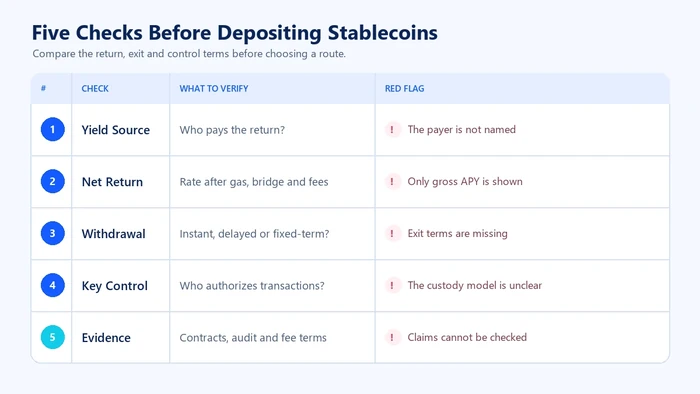
Check One: Where the Yield Actually Comes From
A stablecoin does not produce a return by itself. The return has to come from an identifiable activity or subsidy, and those fall into four groups.
The four common sources of a stablecoin rate
- Borrowers paying interest. Lending markets such as Aave and Compound match deposits with borrowers who post collateral. On both, the supply rate is a function of how much of the pool is currently borrowed.
- Traders paying swap fees. Stablecoin pools on exchanges such as Curve charge a fee on each swap and pass a share to the depositors who supplied the pool. Income tracks trading volume, so quiet weeks pay less.
- A protocol paying token incentives. Some rates are topped up with a protocol’s own token to attract deposits. Those programs can be reduced or ended under their own rules or a governance process.
- A strategy or reserve paying through a token. Yield-bearing stablecoins and asset-backed products such as Ethena, Sky, and Ondo pass on the return of their own strategy or reserve assets. The issuer sets the terms and can change them.
Why the source decides whether a rate can last
A rate lasts as long as its payer keeps paying. Borrowing demand and trading volume rise and fall with market activity, so rates from those two sources move continuously. A token subsidy behaves differently: it can hold a rate above what borrowers are paying until the program is changed or ends.
Check Two: What Is Left After Costs
The advertised rate is a gross figure. Several costs sit between it and the balance a year later.
Where the number shrinks
- Network gas. Every on-chain action costs a fee in the chain’s own gas token, including the deposit and the withdrawal.
- Getting funds to the right chain. A bridge or a swap is needed when the stablecoin sits on a different network from the protocol.
- Protocol-level fees. Some lending protocols keep part of the interest spread, and the supplier rate on display already reflects that protocol’s rate model.
- A platform’s own fee. Any service that deposits on someone’s behalf charges for it, either as a share of profit or as a charge against the balance.
APY, APR, and reading the number correctly
APR is the simple annual rate. APY includes an assumed compounding schedule, so it is the larger figure for the same underlying return. Comparing one option’s APY with another’s APR is not like-for-like, and the two may also use different fee conventions.
A spot rate is what the market pays at this moment. A trailing 30-day figure annualizes what was observed over the preceding period, so it looks backward and does not promise the next one. Rates driven by borrowing demand can swing far enough that the two figures tell different stories.
The same deposit, two cost structures
| Cost item | Depositing directly into a protocol | Depositing through a routing platform |
|---|---|---|
| Network gas | Paid per transaction by the depositor, on every deposit and withdrawal | May be bundled or absorbed, depending on the platform’s stated terms |
| Moving funds to the right chain | A bridge or swap fee, paid each time funds move | Usually handled at deposit, on terms the platform sets |
| Protocol economics | Set by the protocol and already inside the displayed rate | Exposure to the same protocol returns, adjusted by any wrapper or share class the platform uses |
| Service fee | None | A published share of profit, or a charge against the balance |
| Where the terms are published | Protocol documentation and on-chain contracts | The platform’s fee schedule |
What the table actually says. The two structures fail in opposite situations. One-time costs, meaning gas and bridging, hurt small deposits and short holding periods most, while a recurring percentage hurts large deposits held for years.
The basis of the fee matters as much as its size. A fee charged on profit collects nothing in a flat year, while a fee charged against the balance is collected whether the strategy earns anything or not.
Check Three: How Fast the Money Can Come Back
Withdrawal terms come in three forms: available immediately, delayed by a fixed period, or locked until a date. This is written in the terms of the specific strategy, not in the rate.
Instant withdrawal, and the conditions that suspend it
Protocol withdrawals are often available on demand, because deposits sit in a pool that borrowers draw from. They still depend on how much liquidity is currently free, on protocol controls, and on whether the deposit is pledged against a borrow position, as reflected in Aave’s withdrawal documentation.
When almost everything in the pool has been borrowed, withdrawals wait until borrowers repay or new deposits arrive. That tends to bite during the volatile periods when the money is most needed.
Cooldowns, settlement windows, and locked positions
Staked products often require a cooldown, meaning a fixed waiting period between requesting an exit and receiving funds. Platforms that manage deposits may settle redemptions on a schedule, such as a set number of days after the request. Fixed-term positions follow product-specific early-exit rules, which may mean a penalty, a secondary-market sale, or no early exit at all.
Matching withdrawal terms to what the money is for
Money with a known spending date belongs in a strategy whose exit is shorter than that date. The mistake is discovering the term after the deposit.
Check Four: Who Controls the Private Keys
There are two custody models. The difference decides who is able to delay or block a withdrawal.
Self-custody and custodial accounts
- Self-custodial. Private keys stay with the holder, who authorizes wallet transactions. Deposited funds may still be governed by smart contract permissions, and recovery depends on the wallet’s documented method.
- Custodial. The operator holds the keys, and the balance is an entry in an account. Access can be paused, limited, or delayed by the operator, and the holder is an unsecured claimant if the operator fails.
Neither model removes risk; it moves risk between the holder and an operator.
Smart contract risk, depeg risk, and bridge risk
Smart contract risk is the possibility that the code holding the deposit contains a flaw that can be exploited. Depeg risk is the possibility that the stablecoin itself stops trading at its reference value, which reduces the principal regardless of how well the strategy performed. Bridge risk depends on how a bridge locks, mints, releases, or validates assets, and a failure in those contracts or validators can interrupt or reduce recovery.
What an audit covers, and what it does not
An audit is a review of specific code at a specific date by a named firm. It does not cover code deployed afterwards, decisions taken by governance, the behaviour of the operator, or market conditions. An audit is evidence that a review happened, not a statement that the deposit cannot be lost.
Check Five: What Can Be Verified Before Depositing
Some claims can be confirmed independently; others can only be believed. Sorting a platform’s statements into those two piles is the last step before depositing.
Evidence that can be checked
- On-chain. Contract addresses, the size of a pool, the share of it currently borrowed, and the rate history over previous weeks.
- Named audits. A report from a named firm, with a stated scope and date, published in full rather than referenced as a logo.
- Registrations. A registration number that can be looked up in the issuing authority’s public register. An entry confirms the registration itself, not product safety or a licence in every jurisdiction.
- Written fee terms. A fee schedule that states the percentage, what it is charged on, and when it is collected.
Claims that cannot be checked, and how to treat them
Forward-looking rate promises cannot be verified, because the payer has not paid yet. Neither can “audited” without a firm name and report, or “partnered with” without a named counterparty. These stay in the marketing column until something checkable replaces them.
Two Routes to the Same Yield: Direct Protocol Deposits vs Platforms That Route Funds
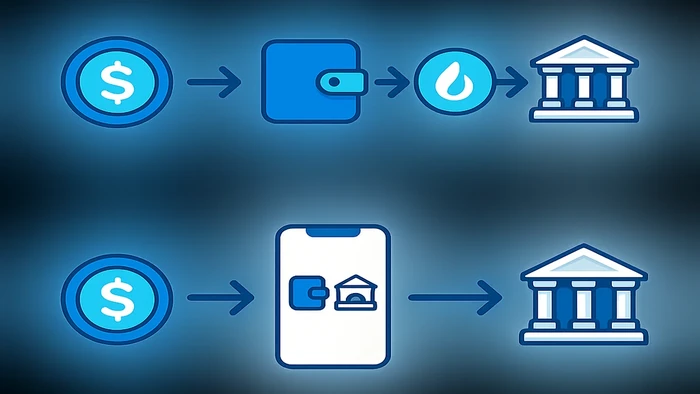
Both routes can place funds into the same underlying DeFi strategies. The difference is who performs the steps in between.
What the direct route requires
- A self-custodial wallet, and the recovery phrase stored safely.
- The stablecoin sitting on the same chain as the chosen market, which often means bridging USDT or USDC across chains first.
- The chain’s gas token, held separately, for every transaction.
- A choice of market, then ongoing attention to the rate and the utilization of that pool.
- A second signed transaction to withdraw.
What the routed route changes, and what it charges for
A routing platform may combine some of those steps in one interface, which is what multi-chain DeFi yield aggregators are built to do. Chain selection, gas handling, and protocol selection can happen at deposit.
Its fee, custody model, settlement terms, and protocol selection have to be checked separately, because they differ from one platform to the next.
The five checks applied to both routes
| Check | Direct protocol deposit | Routing platform |
|---|---|---|
| 1. Yield source | Readable on the protocol’s own market page | Known only if the platform names the protocols it deposits into |
| 2. Costs | Gas on every transaction, plus bridging or swap costs | Exposure to the same protocol returns, plus any routing-layer fee, wrapper, or settlement terms |
| 3. Withdrawal speed | The protocol’s own terms apply | The protocol’s terms plus the platform’s settlement schedule |
| 4. Key control | The depositor or an approved wallet authority authorizes protocol transactions | Depends entirely on the platform’s custody model |
| 5. Verifiable evidence | Contracts, pool size, and rate history are public | Depends on what the platform publishes about protocols, fees, and audits |
What the table actually says. On checks one, two, and five, the direct route can be easier to verify when the protocol publishes its contracts and market data. A routing platform can match that only when it publishes its protocols, its fees, and its settlement terms.
The practical split comes down to deposit size and habits: a large deposit held for years gives up the most to a recurring fee, while smaller, more frequent deposits across chains lose more to one-time costs.
Where BenPay DeFi Earn Sits on the Five Checks
BenPay is a one-stop on-chain financial platform: store, earn, spend, and transfer. Stablecoins can be bridged in from supported networks, one deposit puts them into a DeFi strategy, and the same account can top up a Visa card to spend what the deposit earns. Details are in the complete guide to BenPay DeFi Earn.
BUSD, USDT, and USDC can all be used in DeFi Earn. Bridged USDT or USDC may be converted into BUSD, which is BenFen’s native stablecoin minted 1:1 with USDT or USDC according to the BenFen Bridge documentation, while individual strategies list which assets they accept. Yield is settled daily and compounds automatically, and redemption returns the balance to the BenPay wallet.
Running the five checks on one routed platform
| Check | What applies to BenPay DeFi Earn |
|---|---|
| 1. Yield source | Strategies deposit into protocols including Aave, Compound, Morpho, Sky, and Ethena, alongside a SOL-USD strategy. Availability changes, so the live strategy list is the reference. |
| 2. Costs | 15% of profit, 0% on principal, as published in BenPay’s investment documentation. BenPay materials cite a gross APY range of 3%–8%, variable, and a live rate can sit outside a promotional range. A 6% gross strategy nets roughly 5% after the platform’s share. |
| 3. Withdrawal speed | Two modes: instant redemption, and redemption after a fixed number of days. Current listings include instant, about 30 minutes for some V2 strategies, and 10 days after the request for others; the redemption documentation controls. |
| 4. Key control | Self-custodial, so private keys stay with the holder. BenFen materials list a US FinCEN MSB registration number, 31000260888727. |
| 5. Verifiable evidence | BenFen states that its core smart contracts underwent a SlowMist audit and links the report from its support site, while each underlying protocol runs its own security reviews. Gas for deposits and redemptions on the BenFen chain is covered by the platform, and bridging or source-chain costs are separate. |
What the table actually says. The fee basis is the line that changes the arithmetic. Because 15% is charged on profit and nothing on principal, a flat year costs nothing, while in an earning year roughly one dollar in seven of the income goes to the platform.
On a 6% gross strategy that is the difference between 6% and about 5%. A $2,000 deposit at 5% net produces around $100 over a year.
Row three is the row to read before depositing, not after. Money with a spending date belongs in an instant strategy, because a fixed-period strategy returns funds only after the stated wait. On row four, private keys stay with the holder, while smart contract permissions and smart contract risk still apply, as with any self-custodial multi-chain wallet.
Who this route fits, and who is better off going direct
- Fits the routed option: deposits arriving from several chains, and balances that are topped up and spent regularly.
- Better off going direct: a single large deposit held for years by someone already holding gas tokens, since the share of profit grows with the balance.
Note: APY is variable and not guaranteed, strategy availability and redemption terms change, and smart contract risk applies to every strategy. Past performance does not indicate future returns.
Running the Five Checks Before Depositing Stablecoins
Answering the five checks in order produces a comparison that survives a rate change.
A five-line worksheet
- Name the payer. Write down who funds the rate: borrowers, traders, a token budget, or a reserve strategy.
- Subtract the costs. List gas, bridging or swap costs, and any share of profit, then recalculate the return on the actual deposit amount.
- Read the exit terms. Record whether redemption is instant, on a settlement schedule, or locked to a date.
- Identify the key holder. Confirm whether private keys stay with the holder or with an operator.
- Check what is published. Look for named protocols, a named auditor with a dated report, and a written fee schedule.
Two decision paths by scenario
For a deposit that will sit untouched for years, the fee basis and the yield source matter most, and depositing directly keeps the chain of parties short. For a balance that moves between chains, earns, and gets spent, repeating those steps by hand is the larger cost, and a routing platform such as BenPay DeFi Earn is one option worth running the same five checks against.
Either way, the comparison should start with a small amount. A first deposit tests the withdrawal path as much as the rate, though it does not prove future liquidity, contract security, or a platform’s ability to pay.
Frequently Asked Questions
What is the safest way to earn passive income on stablecoins?
There is no option without risk, so the real question is which risks can be examined. Established lending markets that publish contract addresses, audits, and withdrawal terms may be easier to evaluate than a platform that publishes none of them. Smart contract risk, depeg risk, and liquidity risk still apply to them.
Is a high advertised stablecoin APY sustainable, or does it depend on incentives?
It depends on who is paying. Rates funded by borrowing demand or trading fees move with market activity and are linked to ongoing protocol activity. Rates topped up with a protocol’s own token last as long as that program does, which is why the source matters more than the number.
What is the difference between APY and APR on a stablecoin deposit?
APR is the simple annual rate, while APY includes an assumed compounding schedule, so APY is the larger figure for the same underlying return. Comparing one platform’s APY against another’s APR is not like-for-like. It is also worth checking whether a figure is current or trailing, since BenPay materials describe a 30-day rolling APY per strategy, which looks backward rather than forward.
How much does a stablecoin deposit earn in a year after fees?
Gross rate minus costs, calculated on the actual amount. On BenPay DeFi Earn the fee is 15% of profit and 0% on principal, so a 6% gross strategy nets roughly 5%, and $2,000 at 5% net produces about $100 over a year. APY is variable and not guaranteed, so a figure of this kind is an illustration rather than a projection.
Are stablecoin yields better than a bank savings account?
They are different categories of risk rather than better or worse versions of the same product. Bank deposit terms and DeFi rates are set through different legal and technical systems, and both change over time. Deposit insurance covers bank deposits in many jurisdictions and does not cover crypto assets, so this comparison holds only at a specific moment in a specific country.
Is stablecoin yield taxable?
Tax treatment of stablecoin income varies by jurisdiction and changes as rules are updated, so no general answer applies. The IRS digital-asset guidance illustrates why records of deposits, redemptions, and settled yield are worth keeping. A local tax professional is the correct source for a specific situation.